Editorial independence: our scores and rankings are produced using the fixed criteria above and are not influenced by advertisers. This is an independent ranking site and is not operated by, or affiliated with, any provider we list.
Affiliate disclosure: some links on this page may earn us a commission at no extra cost to you. This does not affect our rankings.
Live market data via CoinGecko, for informational purposes only. Not financial advice.
| Best for | Not for |
|---|---|
| May offer a simple swap-oriented interface | Limited independently verifiable operating record |
Criteria Breakdown
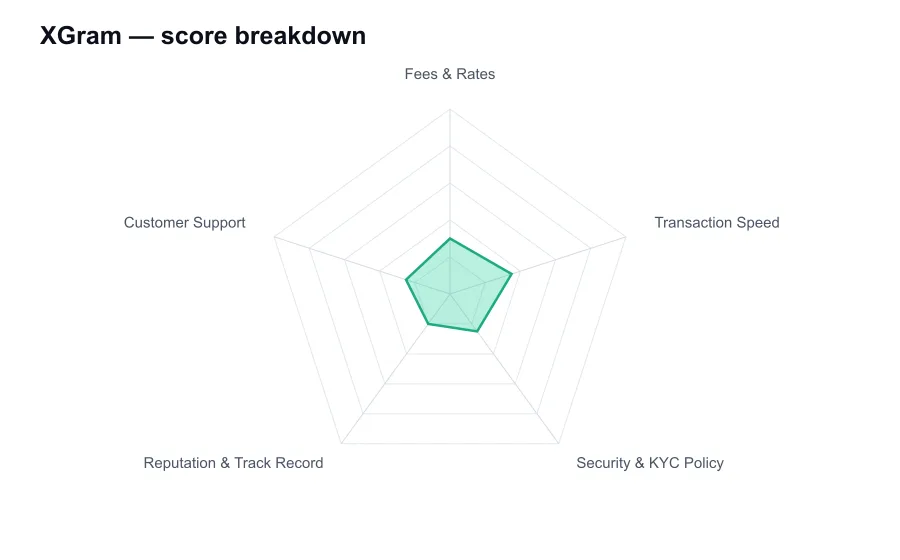
| Criterion | Score | Notes |
|---|---|---|
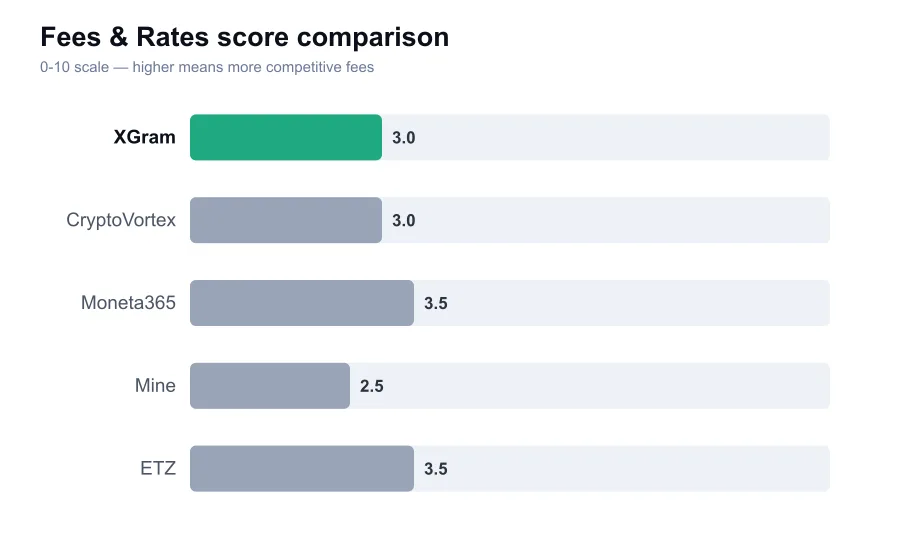
| Fees & Rates | 3.0 | Insufficient verifiable pricing history to assess value |
| Transaction Speed | 3.5 | No strong independent evidence of reliable settlement |
| Security & KYC Policy | 2.5 | Limited verifiable operator and policy transparency |
| Reputation & Track Record | 2.0 | Too little established public track record |
| Customer Support | 2.5 | Support performance is not independently well documented |
In-Depth Review
XGram is not a name with the public footprint of Changelly, Coinbase, Kraken, or even the more niche instant-swap brands. That matters from the first click. In crypto, a small provider can be competent, but obscurity raises the burden of proof. A polished landing page, a list of supported coins, and a promise of rapid exchange are not enough to establish that customers will be treated fairly if something breaks.
The available public record around XGram is too limited for me to describe it as an established exchange provider with confidence. I have not found the depth of independently verifiable operating history, corporate transparency, regulatory disclosure, major integrations, or sustained reputable coverage that I would expect before recommending a service for meaningful value. That does not automatically prove misconduct. It does mean a careful reviewer should stop short of giving the platform borrowed credibility.
This distinction is especially important because crypto exchange sites often look similar. They display live price widgets, trust badges, partner logos, transaction counters, and cheerful claims about security. Those are marketing devices until a user can verify who operates the service, where the company is incorporated, how funds are handled, what its compliance process is, and whether its claims survive independent examination. XGram does not provide enough widely corroborated information for me to answer those questions comfortably.
I would not rely on any advertised fee figure without testing the final quote against the market. With lesser-known swap services, the headline fee may be zero, low, or not prominently stated, while the actual cost is embedded in the exchange rate. The only number that matters is how much of the destination asset reaches your wallet after all costs. Compare that amount with a liquid exchange and at least one established instant-swap competitor before sending anything.
A low stated service fee should never be confused with a low effective fee. Providers can earn from spread, routing arrangements, withdrawal charges, and unfavorable rate refreshes. This is not unique to XGram, but it is more problematic where a platform has little reputation to protect. The customer has less basis for trusting that the quote is competitive or that an unexpected shortfall will be corrected promptly.
Transaction speed is another category where unsupported promises deserve skepticism. A provider may say exchanges are instant, but crypto settlement depends on deposit confirmations, the asset pair, liquidity availability, source and destination network conditions, and any manual review. An unfamiliar service has an additional uncertainty: users cannot readily assess whether delays are ordinary network friction or internal operational trouble. A status page and an order tracker help, but they do not substitute for a demonstrated track record.
If you decide to test XGram, treat the first transaction as a technical experiment rather than a payment. Use a small amount, choose a mainstream network, verify every address character, and keep screenshots of the quote, order ID, deposit transaction, and stated terms. Do not start with a token bridge, a memo-based asset, a large stablecoin transfer, or a deadline-sensitive payment. Those are precisely the cases where a young or opaque provider can become expensive.
Security is where I am least comfortable assigning XGram much credit. A responsible exchange provider should make its legal operator, policy framework, terms, privacy practices, and support channels easy to verify. It should explain whether it uses transaction monitoring, how it handles suspicious transfers, what can trigger KYC, and what happens to held funds. Where those details are unclear or not independently substantiated, users are being asked to trust more than they should.
No-KYC language, if presented by a small crypto platform, is not a safety feature. It can mean less friction, but it can also mean the user discovers the real compliance rules only after a transfer is pending. Many services reserve the right to request documents once a transaction is scored as risky. That can leave funds in limbo. Before using any exchange that markets privacy or account-free swaps, read the refund and verification clauses rather than relying on the headline.
Reputation is not merely about online star ratings. Reviews can be bought, selectively displayed, or distorted by customers who made address errors. The stronger signals are long-term domain and business history, named operators, credible external reporting, established wallet partnerships, responsive public communication, and evidence of fair dispute handling. XGram has not built enough visible evidence in those areas for me to grant it the benefit of the doubt.
Customer support is similarly hard to score well where there is little robust public evidence of how cases are handled. A contact form or chat bubble proves that a channel exists. It says nothing about response time, competence, refund authority, or whether a customer can reach a real person when a transaction is held. With a major exchange, imperfect support is frustrating. With an opaque provider, weak support can mean there is no meaningful remedy at all.
There is also a practical phishing concern. Lesser-known brand names are easier to imitate, and users may have difficulty distinguishing a legitimate domain, social account, or support representative from a copycat. Never accept help through unsolicited direct messages, never share seed phrases, and never send an additional deposit to "unlock" an earlier transaction. Any provider or alleged support agent asking for that should be treated as a severe danger signal.
XGram might eventually establish a stronger public record. It could publish clearer ownership information, improve policy disclosure, obtain recognizable integrations, and demonstrate years of reliable service. But recommendations should be based on what can be verified now, not on a charitable assumption that these things exist somewhere behind the scenes. A reviewer who fills those gaps with invented specifics is doing readers a disservice.
My recommendation is simple: do not use XGram for a significant exchange until you can independently verify the operator and find credible, current evidence of successful support and settlement. If curiosity gets the better of you, use only a trivial amount that you can lose, then judge the exact rate, completion time, and support quality yourself. For normal users, established venues offer enough alternatives that accepting this level of uncertainty makes little sense. Convenience is not valuable if the provider has not earned trust.
Pros & Cons
| Pros | Cons |
|---|
Is XGram a well-established crypto exchange?
I could not verify the kind of long, independently documented operating history and public transparency that would justify treating it as an established provider.
Should I send a large transaction to XGram?
No. Without stronger verification of its operator, pricing, support, and dispute handling, significant or time-sensitive transfers are not prudent.
How can I test an unfamiliar swap service safely?
Use a trivial amount, a mainstream asset, a personal receiving wallet, and save all order details. Never share a seed phrase or send extra funds to release a swap.