Editorial independence: our scores and rankings are produced using the fixed criteria above and are not influenced by advertisers. This is an independent ranking site and is not operated by, or affiliated with, any provider we list.
Affiliate disclosure: some links on this page may earn us a commission at no extra cost to you. This does not affect our rankings.
Live market data via CoinGecko, for informational purposes only. Not financial advice.
| Best for | Not for |
|---|---|
| May offer simple wallet-to-wallet conversions | Weak independently verifiable reputation |
Criteria Breakdown
| Criterion | Score | Notes |
|---|---|---|
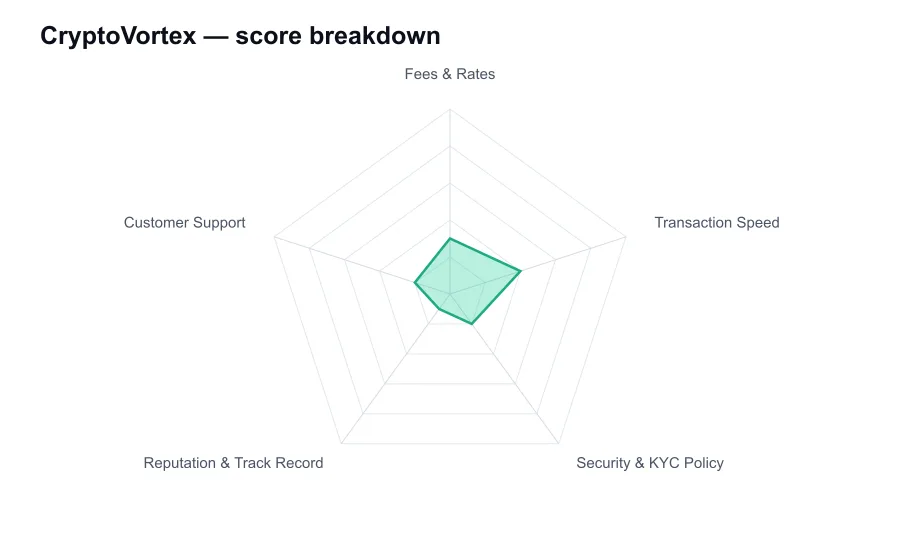
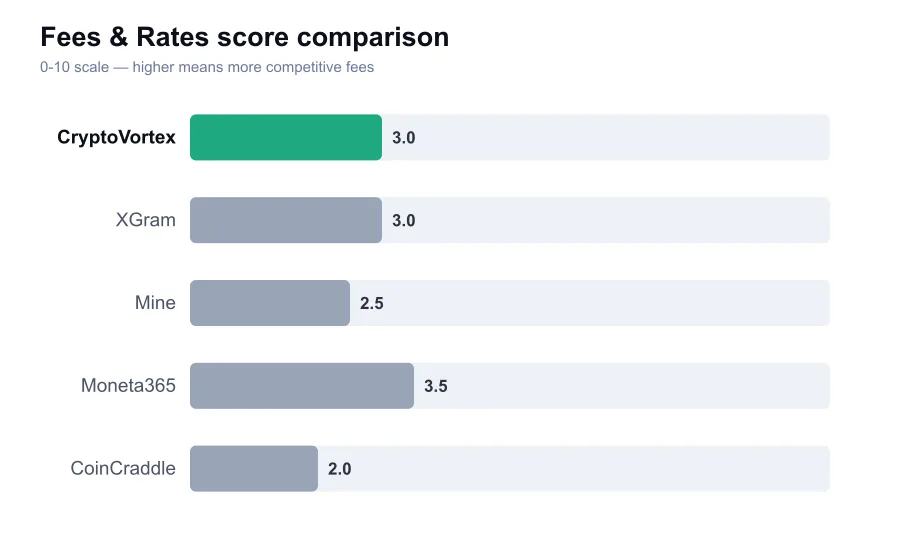
| Fees & Rates | 3.0 | Final-rate transparency is difficult to verify. |
| Transaction Speed | 4.0 | Limited public evidence of reliable completion times. |
| Security & KYC Policy | 2.0 | Sparse security and compliance disclosure. |
| Reputation & Track Record | 1.0 | Very limited independently established track record. |
| Customer Support | 2.0 | Support standards and escalation paths are unclear. |
In-Depth Review
CryptoVortex sits in the least comfortable corner of the crypto exchange market: a relatively obscure brand with limited independently verifiable history, a thin public footprint, and little of the operational transparency people should expect before sending a sizeable transaction. It appears positioned as a quick crypto conversion service rather than a full trading venue, but the basic question is not whether the interface can produce a quote. It is whether a customer can confidently establish who runs it, how it handles funds, and what recourse exists when something goes wrong.
That lack of public depth is the central problem. Small exchange services are not automatically unsafe, and plenty of legitimate operators began with little recognition. Still, a service asking users to transfer irreversible digital assets needs to earn trust through clear company information, visible terms, responsive support, security documentation, and a long record of independently discussed transactions. CryptoVortex does not have the same body of public evidence available for ChangeNOW, EasyBit, or established centralized exchanges.
The pricing picture is similarly hard to assess. A swap service can claim low or zero commission while recovering its margin through the exchange rate, network-fee estimate, or partner liquidity spread. Unless CryptoVortex displays a complete pre-transaction quote, including the exact expected output and all deductions, a headline fee tells a customer very little. With an obscure provider, users should compare the final amount against at least two alternatives before depositing.
That comparison matters most on popular routes such as BTC to USDT, ETH to BTC, or stablecoin swaps. These are liquid pairs, so a materially worse quote is difficult to justify. A small spread can be reasonable compensation for noncustodial convenience and routing, but a large gap from ChangeNOW, EasyBit, or a major exchange's conversion desk is a warning sign. The service should not be trusted simply because its quoted percentage looks attractive.
Speed is another area where marketing can be misleading. A crypto conversion may technically be processed quickly once a deposit confirms, yet Bitcoin deposits can take from minutes to much longer depending on network conditions and the confirmation policy. Ethereum and stablecoin transfers may be faster, but congestion, low gas, or a liquidity-provider review can still delay delivery. CryptoVortex does not have enough transparent, widely documented operating data to support strong claims about consistently fast completion.
For a first test, I would use a small amount and select an asset with a sensible network fee and reasonably quick settlement. Record the quoted output, the deposit address, the transaction ID, and the arrival time. If the service has no visible transaction tracker, no meaningful status updates, or no useful way to contact support during a delay, that is not a minor inconvenience. It is a reason to stop using it.
Security is where the distinction between noncustodial design and trustworthy operation matters. A noncustodial swap service may avoid holding a lasting account balance, which reduces one category of platform risk. It does not remove the risk of sending coins to a poorly documented operator, a compromised website, or a service with unclear compliance procedures. Customers still need confidence that the destination address, quote engine, and support process are legitimate.
CryptoVortex does not appear to provide the kind of detailed security disclosures that would reassure a careful buyer. I would expect clear explanations of wallet handling, infrastructure controls, anti-phishing guidance, privacy practices, terms for failed swaps, and an identifiable legal operator. Vague assurances about encryption or anonymity are not enough. They are common website language, not evidence of mature risk management.
KYC policy is also difficult to evaluate without clear public documentation. Some instant exchangers advertise no registration and then reserve the right to request identity documents when a transaction triggers fraud, sanctions, or source-of-funds controls. That model can be legitimate if plainly explained before payment. It becomes unacceptable if a user discovers it only after funds are held and support provides no time frame or appeal route.
Reputation is CryptoVortex's weakest category by a wide margin. I could not establish a substantial record of credible third-party coverage, sustained community discussion, or a long independently documented service history comparable with better-known competitors. A lack of complaints is not a positive signal when there is also little evidence of real transaction volume. It may simply mean the service is too small or too new to have been properly tested in public.
The support proposition should therefore be judged harshly. On an exchange service, support is not a decorative chat bubble. It is the mechanism that resolves a wrong memo, delayed partner payout, AML review, or failed refund. A provider with limited public accountability needs especially clear support channels, response expectations, and escalation procedures. If CryptoVortex cannot provide those, users are carrying far more risk than the convenience is worth.
I would not use it for a large purchase, a time-sensitive payment, or any transaction where the loss of access to the funds would cause real harm. That is not a claim that every transaction will fail. It is a practical assessment of the information imbalance. There are simply too many established services offering comparable swaps with better documentation, years of public operating history, and more visible customer-service infrastructure.
CryptoVortex might appeal to someone experimenting with a tiny, disposable amount, particularly if a specific route is unusually competitive. Even then, check the domain carefully, avoid links from social media advertisements, and never send more than you can afford to have delayed. A small successful test does not prove that a platform can handle a larger transaction or resolve a difficult case.
My view is blunt: CryptoVortex has not earned a recommendation as a primary exchange provider. Its apparent convenience cannot compensate for the lack of verifiable reputation, transparent operating detail, and demonstrated support standards. Until the company provides much stronger public evidence of ownership, security controls, fees, and a durable customer track record, better-known noncustodial services are the sensible choice.
Pros & Cons
| Pros | Cons |
|---|
Is CryptoVortex safe for large crypto swaps?
I would not use it for a large swap. Publicly verifiable information about its operating history, security practices, and dispute handling is too limited to support that level of trust.
Does CryptoVortex require KYC?
Its policy should be checked directly before sending funds. Any provider can apply risk-based checks, and customers should understand the document-request and refund process in advance.
How can I test CryptoVortex safely?
Use a small amount, save the quoted output and transaction ID, verify the destination address carefully, and compare the delivered amount and timing with established alternatives.