Editorial independence: our scores and rankings are produced using the fixed criteria above and are not influenced by advertisers. This is an independent ranking site and is not operated by, or affiliated with, any provider we list.
Affiliate disclosure: some links on this page may earn us a commission at no extra cost to you. This does not affect our rankings.
Live market data via CoinGecko, for informational purposes only. Not financial advice.
| Best for | Not for |
|---|---|
| Simple exchange-focused positioning | Public fee transparency is limited |
Criteria Breakdown
| Criterion | Score | Notes |
|---|---|---|
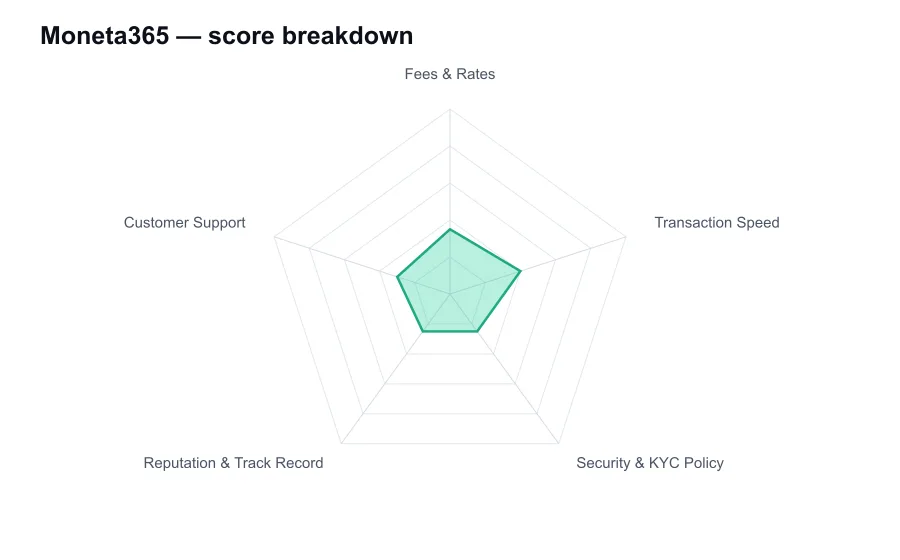
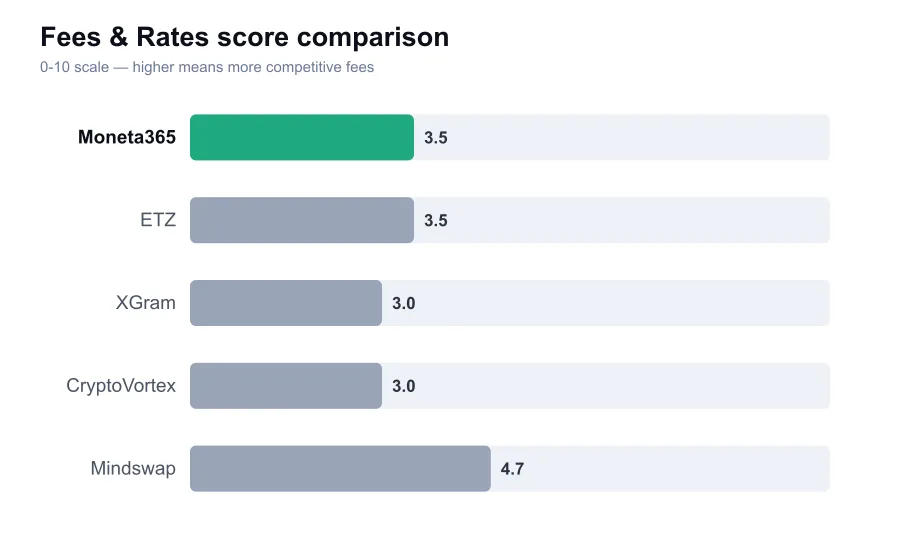
| Fees & Rates | 3.5 | No clearly verifiable public fee and spread schedule |
| Transaction Speed | 4.0 | Processing times are not independently well documented |
| Security & KYC Policy | 2.5 | Limited public evidence of custody and KYC controls |
| Reputation & Track Record | 2.5 | Thin independently verifiable operating track record |
| Customer Support | 3.0 | Support quality is difficult to verify publicly |
In-Depth Review
Moneta365 presents itself as a crypto exchange service aimed at people who want a straightforward route between digital assets and fiat money. It does not sit in the same league as Coinbase, Kraken, Bitstamp, or Binance in terms of recognisable market presence, public reporting, or independently documented operating history. That difference matters. A smaller exchange can still be useful, but users should not mistake a clean website or a broad asset list for the institutional depth that established platforms have earned over years.
The first difficulty with Moneta365 is basic verification. I could not establish a clearly documented corporate profile, a widely cited regulatory registration, independently audited reserves, or a substantial public record of management accountability. Those are not cosmetic details in crypto. They are the things that tell a customer where funds are held, which legal entity is responsible, and what recourse exists if a withdrawal is delayed or an account is frozen.
Fees are also hard to assess with confidence. Major exchanges publish maker and taker schedules, conversion spreads, withdrawal charges, and network-fee policies in one place. Moneta365 does not appear to have a transparent, easily independently verifiable fee schedule with the same level of detail. That leaves users relying on the quote presented at checkout, which is a poor position for anyone moving more than a small test amount.
A quoted exchange rate can hide a great deal. Services that market themselves as simple swaps often do not charge a visible trading commission, yet build their margin into the rate. There is nothing inherently wrong with a spread, provided it is clear. The problem is that a user cannot compare a spread properly without seeing the market reference price, the provider's execution price, every network fee, and the final amount delivered. Moneta365 does not offer the kind of pricing transparency I expect before recommending a service for meaningful volume.
For a small conversion, the practical cost might not feel important. For a four-figure or five-figure transaction, even a 1 percent or 2 percent spread can quickly become more expensive than using a regulated spot exchange and withdrawing the asset yourself. Kraken Pro, for example, discloses trading fees and lets experienced customers see the order book. Moneta365's apparent simplicity may appeal to beginners, but simplicity should not mean users have to guess where their money went.
Transaction speed is another area where marketing language needs to be separated from the mechanics. A crypto transfer cannot be faster than the blockchain confirmation requirements, and a fiat payout can be held up by banking cutoffs, compliance checks, or the receiving institution. Without a detailed service-level commitment and a substantial body of independently reported user experiences, there is no reliable basis for treating fast processing claims as a promise.
A swap that appears instantaneous at the screen can still become a manual review after funds arrive. That is particularly common with services that accept card payments, larger orders, or assets linked to risk-screening tools. Moneta365 does not have enough public operational evidence for me to put it in the same speed category as mature exchanges with status pages, published incident reports, and years of documented withdrawal behaviour. Test the full route with an amount you can afford to have delayed.
Security documentation is the central weakness. I found no strong public basis to confirm cold-storage practices, multi-signature custody arrangements, insurance coverage, penetration-testing disclosures, proof-of-reserves work, or a formal bug-bounty programme. A provider does not need to publish every security control, but it should make clear what protects customer assets and who is accountable. Silence forces the customer to make assumptions, and crypto is an unforgiving place to make them.
KYC policy deserves the same caution. Some smaller exchange services advertise convenience or light onboarding, then request identity documents once a transaction triggers an internal risk rule. That can be legitimate compliance practice, but it becomes frustrating and risky if the policy is vague before the customer sends funds. I could not verify a detailed, stable Moneta365 verification policy covering thresholds, document requirements, review timelines, rejected applications, and the treatment of funds during review.
That uncertainty creates a practical problem. A user could choose Moneta365 for speed or privacy, send crypto, and later find the order paused pending identity checks. The money may not be lost, but access can be delayed while the user supplies documents to a company whose compliance framework is not easy to assess publicly. If KYC predictability matters, a platform that asks for verification before deposits is often the safer, if less convenient, choice.
Reputation is thin rather than clearly disastrous, and that distinction is important. I did not find the sort of sustained, credible track record that would justify a strong trust score, but lack of visible evidence is not proof of fraud. It does mean Moneta365 has not yet cleared the bar required for a confident recommendation. In this sector, reputation is built through time, transparent ownership, responsive handling of public complaints, and a history that can be checked outside the provider's own channels.
Customer support appears difficult to evaluate for the same reason. A support email address or chat widget is not enough. Good support means reachable humans, clear escalation, realistic response times, and a resolution trail visible in public reviews and help documentation. Moneta365 does not offer enough independently verifiable material for me to judge its support operation as dependable during an account lock, a missing deposit, or a disputed rate.
Anyone still considering the service should take a disciplined approach. Verify the legal entity and applicable jurisdiction directly, read every term before payment, capture the displayed quote, and start with a small transaction. Use a wallet you control for the destination, never send an unsupported network or token, and do not send funds based on a social-media message claiming to represent support. If the service asks for documents after receiving money, keep communications in writing.
My view is blunt. Moneta365 may be capable of completing routine small exchanges, but the public information available does not justify treating it as a primary venue or a place to store assets. Its lack of easily verified pricing, security detail, regulation, and long-term reputation outweighs the appeal of a simple interface. Experienced users should use established exchanges for material sums. Newcomers should be even more careful, because they are the least equipped to recognise a bad quote or recover from a compliance dispute.
Pros & Cons
| Pros | Cons |
|---|
Does Moneta365 publish a clear trading fee schedule?
I could not verify a detailed public schedule comparable to major exchanges. Check the live quote, terms, network fee, and final received amount before submitting any order.
Is Moneta365 suitable for storing crypto?
I would not use a lightly documented service as a long-term custody solution. Keep long-term holdings in self-custody or with a well-established, regulated provider.
Can Moneta365 ask for KYC after a transaction starts?
That is possible with many exchange services under risk controls. Read the current verification policy before sending funds and avoid using money you need immediately.