Editorial independence: our scores and rankings are produced using the fixed criteria above and are not influenced by advertisers. This is an independent ranking site and is not operated by, or affiliated with, any provider we list.
Affiliate disclosure: some links on this page may earn us a commission at no extra cost to you. This does not affect our rankings.
Live market data via CoinGecko, for informational purposes only. Not financial advice.
| Best for | Not for |
|---|---|
| May offer a simple conversion route | Ambiguous public identity and limited disclosure |
Criteria Breakdown
| Criterion | Score | Notes |
|---|---|---|
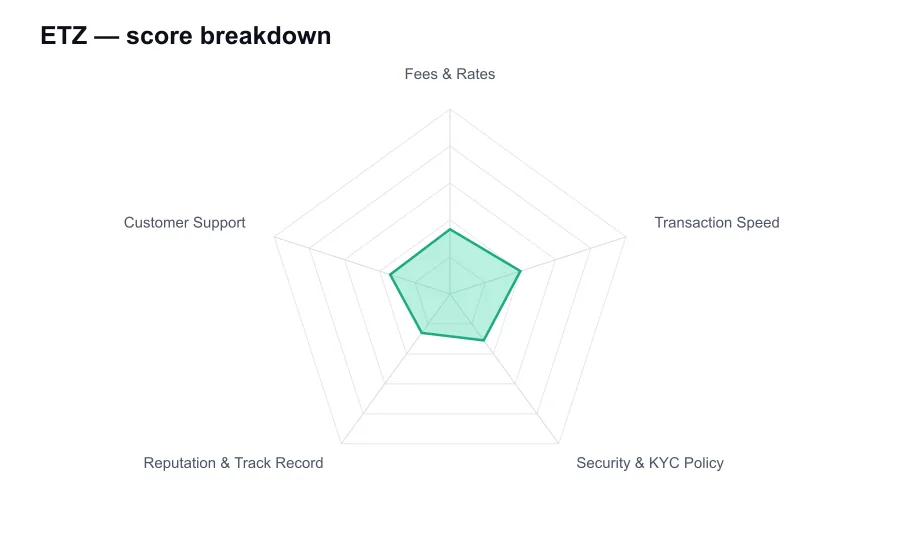
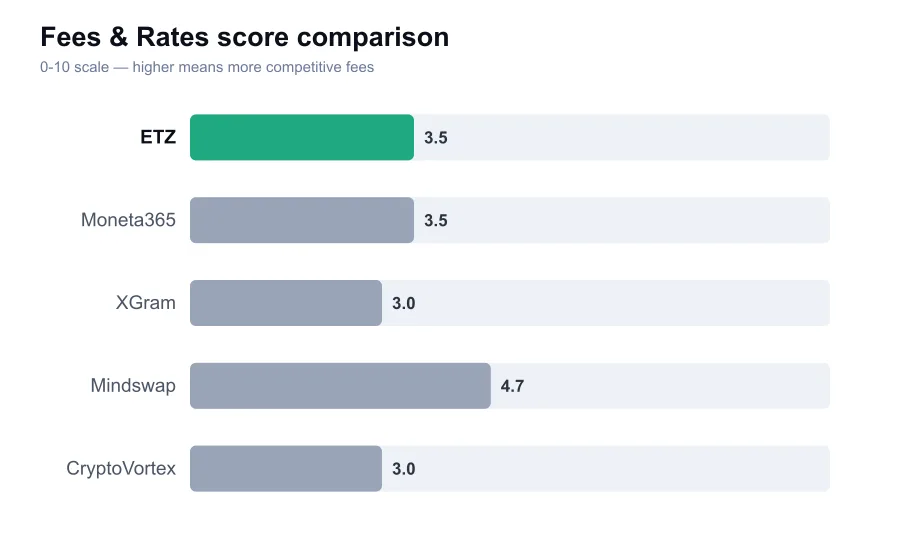
| Fees & Rates | 3.5 | Public pricing transparency is too limited for confidence. |
| Transaction Speed | 4.0 | Insufficient reliable evidence of consistent processing times. |
| Security & KYC Policy | 3.1 | Sparse public security and custody information raises risk. |
| Reputation & Track Record | 2.6 | Very limited independently verifiable operating record. |
| Customer Support | 3.4 | Support quality cannot be confidently assessed from public evidence. |
In-Depth Review
ETZ is difficult to assess with the confidence I would want before recommending a crypto exchange provider. The name has a very limited and ambiguous public footprint compared with recognized exchange brands, and there is not enough reliably attributable information to treat it like a mature, established platform. In crypto, that is not a minor inconvenience. Clear company identity, operating history, support records, and security disclosures are part of the product, not optional extras.
A prospective user should begin by confirming exactly which entity is being called ETZ. Short crypto names are especially prone to confusion with token tickers, wallet products, regional brokers, and unrelated websites. A search result, social account, or app listing can look convincing while pointing to an unaffiliated service. I would not send funds until the official domain, legal entity, terms of service, and support contacts have been independently verified through consistent sources.
The exchange model itself is also not sufficiently documented in public material to make strong claims about how ETZ executes orders. It may present itself as a swap service, broker, exchange, or wallet-connected conversion tool, but those categories carry very different risks. A real exchange should explain whether it holds customer assets, uses third-party liquidity, operates an order book, or simply forwards transactions to another provider. If that answer is unclear, users cannot properly judge the counterparty they are trusting.
Fees are therefore a major concern. A trustworthy provider should tell users whether it charges a trading commission, an embedded spread, a withdrawal fee, a deposit fee, or a network fee, and it should distinguish those charges clearly. If ETZ only shows a final quote without a documented pricing policy, the user needs to treat that quote as the entire fee disclosure. Compare the actual payout against several alternatives, because a hidden spread can be substantially more expensive than a visible trading fee.
Lack of transparency matters more on large orders. A small conversion might only reveal a few dollars of slippage. A larger swap can lose hundreds or thousands if the provider's liquidity is weak or its pricing includes a generous margin. The absence of a public fee schedule does not prove unfair pricing, but it removes an important basis for trust. Serious users should not reward opacity with blind volume.
Speed claims deserve the same skepticism. Any crypto service can advertise rapid swaps, but a transaction only becomes useful after the incoming deposit is detected, required confirmations are reached, an execution route is found, and the outgoing transfer is broadcast. If ETZ cannot provide public, pair-specific guidance on expected confirmation handling and payout times, there is no sensible basis for assuming it will be fast. Claims of instant settlement should be read as marketing until supported by clear operational evidence.
The worst delays tend not to happen on the ordinary path. They happen when a transaction amount differs from the order, a destination tag is missing, a token is sent on the wrong chain, the provider's liquidity partner is unavailable, or an automated compliance system flags an address. Mature providers publish procedures for these situations and have a visible support trail. With ETZ, the lack of widely available evidence makes it hard to know how effectively an exception would be handled.
Security is where a sparse public record becomes most troubling. I want to see clear statements about custody, user account protections, wallet infrastructure, audit practices where applicable, phishing guidance, and incident response. For a noncustodial swap provider, I also want to know how long funds may be held and whether third parties are involved. If ETZ provides little of this information, users should not fill in the blanks with optimism. Crypto history is full of services that looked polished until withdrawals became difficult.
A no-KYC claim, if one is made, should not be treated as a security feature. It can be convenient, but it often obscures the fact that a provider may still freeze or request documents for an order that triggers compliance screening. Any centralized service interacting with blockchain analytics, banking partners, or external liquidity can impose a review. ETZ should state its policy plainly. If it does not, users need to assume verification could arise at the least convenient moment.
The reputation issue is not that ETZ necessarily has a documented history of wrongdoing. The problem is that there is too little independently verifiable history to establish a positive reputation. A dependable provider accumulates years of public feedback, third-party coverage, identifiable leadership or corporate disclosures, and visible responses to complaints. A few testimonials hosted by the provider itself do not meet that standard. Neither do anonymous social-media endorsements, which are easy to manufacture.
This makes due diligence unusually important. Check domain age and consistency, read terms rather than just the homepage, look for a real support address and legal jurisdiction, and inspect whether the platform has documented withdrawal limits or dispute procedures. Search for external complaints, but read them carefully because crypto users often blame a service for their own wrong-network transfer. The goal is not to demand perfection. It is to establish whether there is enough evidence to justify sending irreversible assets.
Customer support should be tested before any meaningful deposit. Ask a precise question about a supported network, minimum amount, or KYC trigger and judge whether the response is specific and coherent. A generic reply is not reassuring. If support cannot explain what happens to a delayed deposit before you send money, it is unlikely to be more helpful after a problem occurs. Avoid relying on a chat bubble alone as proof of a functioning service operation.
I would also avoid uploading identity documents to a poorly documented crypto provider. KYC carries its own privacy and identity-theft consequences, especially if the operator's data security practices are not clear. If ETZ asks for sensitive documents after receiving a deposit, users can end up in an uncomfortable position where both funds and personal information are exposed. That is another reason to choose a provider with a known compliance framework if verification is likely.
ETZ may be capable of processing routine small transactions, but there is insufficient public evidence for me to endorse it beyond a carefully controlled test amount. The potential upside of using an obscure provider is usually a marginally better quote or access to a particular route. That upside is rarely enough to justify uncertain support, unclear security practices, and thin reputation. Established instant exchanges are not risk-free, but they offer more evidence on which to make a decision.
My view is blunt. ETZ belongs in the high-caution category until it provides clearer, independently verifiable information about ownership, security, pricing, execution, and customer redress. Do not use it for savings, urgent payments, or any amount you would struggle to lose or have delayed. If curiosity gets the better of you, use a fresh wallet, make a small test, save every record, and wait for completion before doing anything larger. Most users will be better served by a provider whose identity and track record do not require detective work.
Pros & Cons
| Pros | Cons |
|---|
Is ETZ safe to use?
There is not enough independently verifiable public information to rate ETZ as a high-confidence provider. Do not send significant funds without confirming its identity, policies, and support quality.
Does ETZ require KYC?
Its verification policy is not sufficiently clear from reliable public information. Assume that a centralized provider may request documents if a transaction triggers compliance screening.
Should I test ETZ before a large transaction?
Yes. If you choose to use it at all, make only a small test transfer first, verify the exact network and recipient address, and retain the order and transaction records.