Editorial independence: our scores and rankings are produced using the fixed criteria above and are not influenced by advertisers. This is an independent ranking site and is not operated by, or affiliated with, any provider we list.
Affiliate disclosure: some links on this page may earn us a commission at no extra cost to you. This does not affect our rankings.
Live market data via CoinGecko, for informational purposes only. Not financial advice.
| Best for | Not for |
|---|---|
| Self-custody style of trading | Weakly established public track record |
Criteria Breakdown
| Criterion | Score | Notes |
|---|---|---|
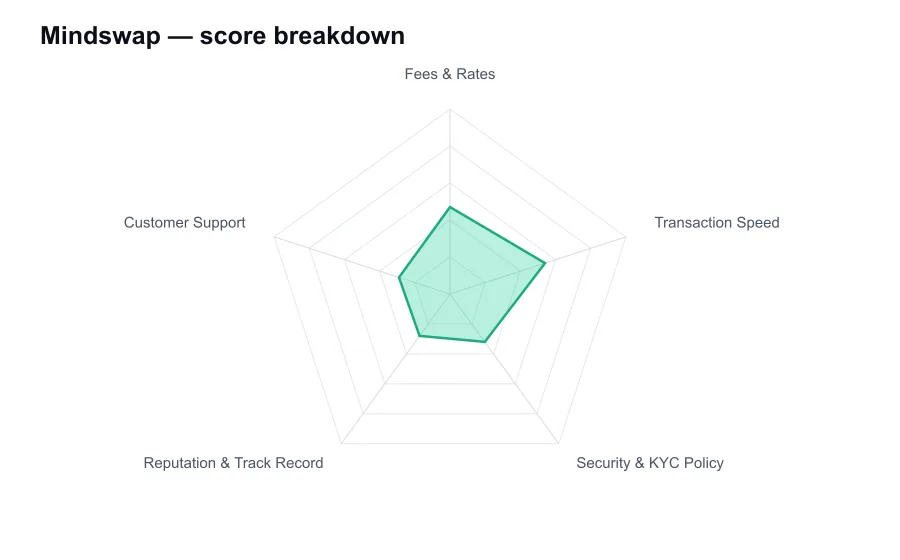
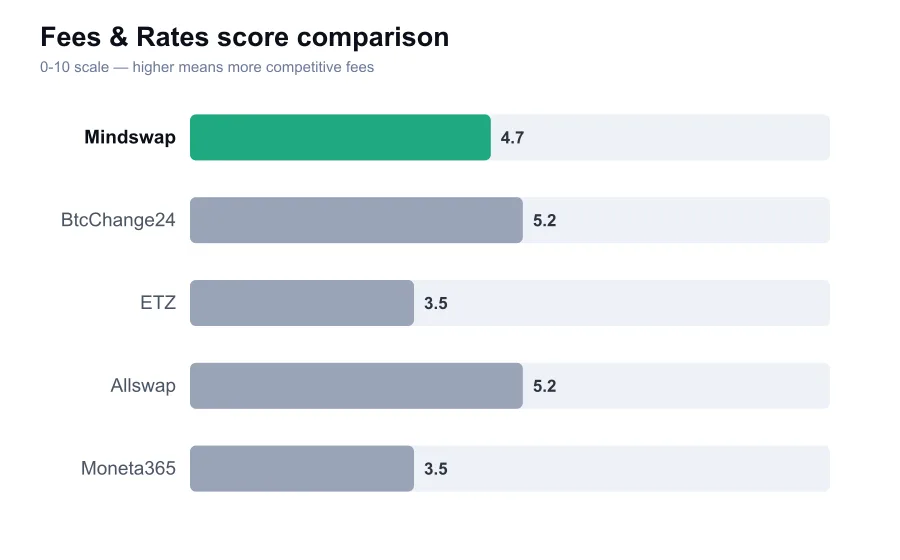
| Fees & Rates | 4.7 | Slippage and liquidity can outweigh stated pool fees |
| Transaction Speed | 5.4 | Execution depends primarily on the host chain |
| Security & KYC Policy | 3.2 | Contract verification and audit evidence are crucial |
| Reputation & Track Record | 2.8 | Limited visible protocol history and public footprint |
| Customer Support | 2.9 | Self-custody transactions have no recovery desk |
In-Depth Review
Mindswap is one of those crypto names that requires more care than a superficial review allows. The branding has been used around decentralized swap and token products, but it does not carry the clear, enduring market identity of Uniswap, PancakeSwap, 1inch, Curve, or Sushi. That ambiguity is a problem before a user even reaches fees or speed. A financial application needs an unmistakable official domain, audited contracts, and a community that can verify what it is using.
The broad idea is familiar. A decentralized swapping product lets users exchange tokens from a self-custody wallet through smart contracts rather than depositing money with a traditional centralized exchange. That model can be powerful. There is no account balance held by a company in the usual sense, and users can interact directly with a supported wallet. It also shifts more responsibility to the user, because a signed transaction cannot normally be reversed.
Mindswap should not be evaluated as if it were a mature blue-chip decentralized exchange simply because it uses the word swap. The public footprint and independently documented protocol history are far thinner than the leaders in this category. I could not establish the same depth of transparent, current governance, audited deployment history, liquidity reporting, or sustained developer activity that makes larger decentralized venues easier to assess.
Fees on decentralized exchanges come from several places. There may be a pool fee paid to liquidity providers, an interface or protocol charge, price impact from shallow liquidity, and the network gas fee. A low-looking pool fee can be irrelevant if a token pair has little liquidity. The trade can move the market against you by far more than the stated fee. That is the central economic risk for little-known decentralized venues.
With Mindswap, users should be particularly skeptical of any claim that a trade is cheap without checking the transaction preview and comparing it to a liquid route on a well-known aggregator. A 0.3 percent pool fee is common in automated market maker design, but it tells only a small part of the story. Price impact, token taxes, and poor routing are where traders get hurt. A token can look tradable and still be effectively difficult to exit.
The best practical comparison is not an advertised rate. Quote the exact same trade on 1inch, Matcha, Uniswap, and the chain's leading native exchange, then examine expected output, estimated gas, and price impact. For a small trade, gas may dominate. For a larger trade, liquidity depth matters far more. If Mindswap cannot beat or closely match those routes, there is little reason to add a lesser-known smart contract to your risk stack.
Speed is mostly a function of the underlying blockchain, not the logo on the swap page. A transaction on a low-cost chain may confirm quickly, while Ethereum can become slower and more expensive in busy periods. Yet confirmation speed is only useful if the contract executes correctly and the liquidity is real. A fast failed transaction still costs gas, and a fast fill with huge slippage is not a good fill.
Security is the decisive weakness. Self-custody reduces the risk of a centralized exchange losing deposited funds, but it introduces contract risk, wallet-approval risk, fake-token risk, and front-end risk. Before interacting with Mindswap, I would want to independently verify the contract address through official channels, inspect whether the implementation is verified on the relevant block explorer, and locate credible third-party audit reports that apply to the exact deployed code.
An audit is not a magic shield, and no audit should be treated as one. Still, an unaudited or poorly documented contract deserves a sharply lower confidence level, especially if it asks for unlimited token approval. Set a specific spending limit whenever your wallet allows it. After a trade, revoke approvals you no longer need. This is good discipline anywhere, but it is essential around obscure decentralized applications.
KYC is usually not built into a standard decentralized wallet interaction. You connect a wallet and sign a transaction. That is different from saying activity is invisible or exempt from compliance concerns. Public-chain transfers are traceable, analytics firms monitor flows, and a wallet may later interact with regulated services that apply screening. Privacy should be judged from the chain and your habits, not from a no-login interface.
Reputation cannot be borrowed from decentralized finance as a whole. Mindswap needs its own record of uptime, handling vulnerabilities, maintaining liquidity, communicating with users, and surviving difficult markets. I do not see enough independent evidence to place it alongside established protocols on that basis. The absence of widely reported failures is not the same as evidence of strong security, especially where usage itself appears limited.
Customer support is structurally limited in many decentralized products. There may be a community channel or social account, but nobody can reverse a transaction you signed or recover assets sent to the wrong address. A responsive community moderator can help locate a transaction, but cannot repair a malicious token approval or a bad trade. Anyone expecting bank-style support should not be trading through an obscure decentralized swap application.
There is a narrow audience for Mindswap. Advanced users who can verify contracts, inspect liquidity, read a block explorer, and accept the possibility of total loss may choose to experiment with a very small amount. That is experimentation, not a recommendation to rely on the protocol. For ordinary swaps, the established decentralized venues offer better liquidity, stronger documentation, more visible security work, and much easier peer review.
My take is harsher than it would be for a transparent newcomer because decentralized products directly touch wallets. Mindswap may have an interesting concept, but concept is cheap in this part of crypto. Until there is a clearly verifiable official deployment, robust audit evidence, sustained liquidity, and a substantial operating record, it belongs in the high-risk experimental category. Most users should simply use a better-known route.
Pros & Cons
| Pros | Cons |
|---|
Does Mindswap require KYC?
A typical decentralized wallet connection does not require a conventional exchange account. That does not make transactions private, because public blockchain activity remains visible and other services may screen wallet activity.
What is the biggest risk of using Mindswap?
The biggest practical risks are interacting with the wrong contract, approving excessive token spending, and trading against shallow liquidity. Verify contract addresses independently and use a small test transaction.
Can Mindswap support reverse a bad swap?
No decentralized application can normally reverse a confirmed blockchain transaction. Support or community moderators may help interpret a transaction, but they cannot retrieve funds from a wrong address or undo a signed trade.