Editorial independence: our scores and rankings are produced using the fixed criteria above and are not influenced by advertisers. This is an independent ranking site and is not operated by, or affiliated with, any provider we list.
Affiliate disclosure: some links on this page may earn us a commission at no extra cost to you. This does not affect our rankings.
Live market data via CoinGecko, for informational purposes only. Not financial advice.
| Best for | Not for |
|---|---|
| Simple conversion-oriented concept | Limited public reputation evidence |
Criteria Breakdown
| Criterion | Score | Notes |
|---|---|---|
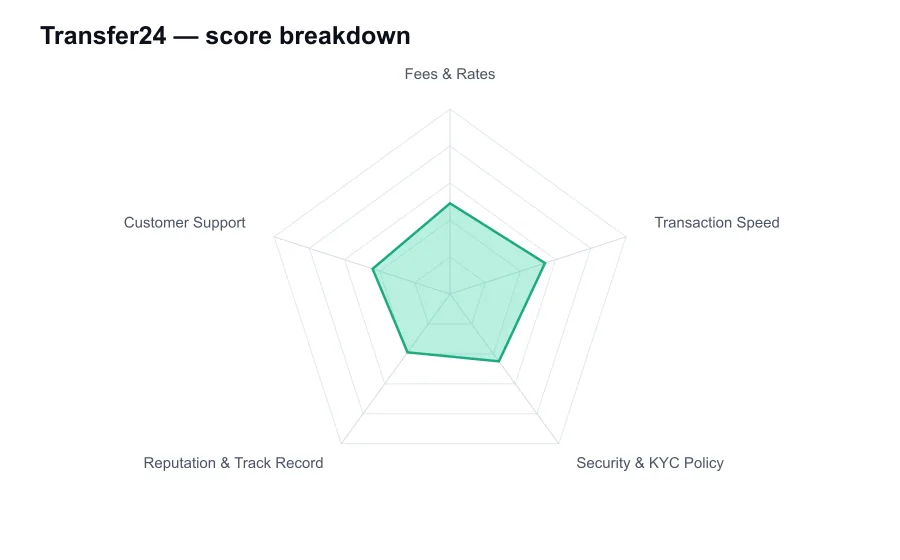
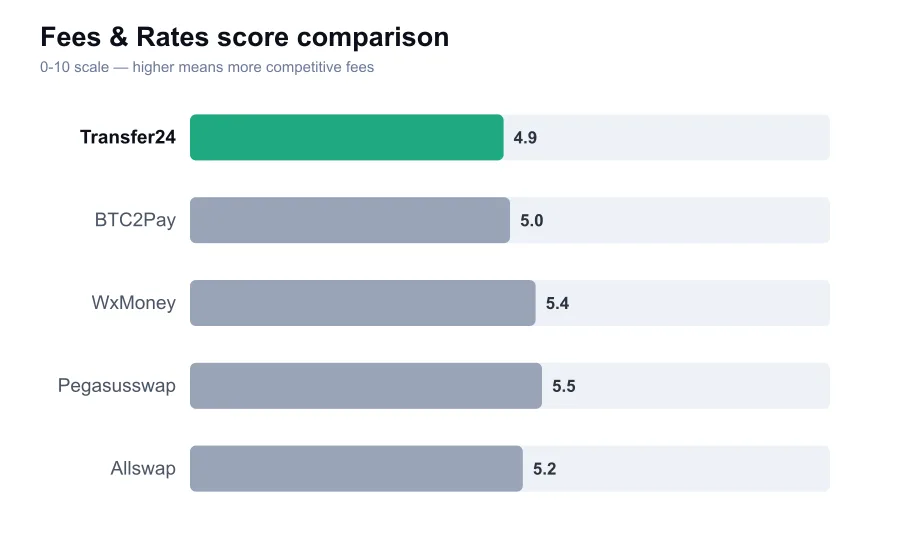
| Fees & Rates | 4.9 | Bundled quote pricing makes final-cost comparison essential. |
| Transaction Speed | 5.4 | Processing speed remains dependent on networks and reviews. |
| Security & KYC Policy | 4.5 | Limited public evidence for a high security rating. |
| Reputation & Track Record | 3.9 | Insufficient widely documented operating track record. |
| Customer Support | 4.4 | Verify response quality before sending any funds. |
In-Depth Review
Transfer24 is a small crypto exchange and transfer-style service operating in a crowded part of the market where names, websites and offers can change quickly. It is not a brand with the same public standing as Coinbase, Kraken, Bitstamp or even some of the better known instant-swap providers. That does not make every transaction suspect, but it means reputation must be treated as a live question rather than an established asset.
The service appears designed around quick conversions and payments rather than advanced spot trading. Users looking for a simple route from one cryptocurrency to another may find that attractive. There is a place for focused exchange tools. Not everyone needs charting software, margin products or a full portfolio account just to convert Bitcoin into USDT or send a different asset to a wallet.
But a streamlined page can hide important details. Before using Transfer24, I would want to see a clear legal operator, current terms of service, an explicit list of supported networks, a privacy policy and a reachable support channel. Those are not bureaucratic niceties. They tell you who is responsible if the transaction is delayed, if a deposit is not recognized or if the service asks for additional verification after receiving funds.
The fee picture is likely based on a quote rather than a public maker and taker schedule. That format is convenient for casual users because the result is shown in one number. It is weak for comparison because the spread, liquidity charge and sometimes part of the network cost can be bundled together. The quoted output may be acceptable, but you need to check it against the actual market price and alternatives at the moment you transact.
Transfer24 is therefore not a venue I would use blindly for size. Small differences in a rate can matter far more than a stated service fee, especially on stablecoin and Bitcoin conversions. Ask what you would receive on a liquid exchange after fees, then compare that with the Transfer24 output after all costs. If the difference is meaningful, convenience is not a compelling reason to pay it.
Speed claims deserve the same scrutiny. A provider can process an order quickly after it sees your deposit, but it cannot bypass blockchain confirmations, wallet maintenance, liquidity issues or a congested destination network. The phrase 24 in a brand name should not be read as a promise that every transaction will settle around the clock without interruption. Crypto services can have manual reviews and maintenance windows even if the website remains online.
For ordinary transfers, the network you choose will have a major effect. Sending a stablecoin on a low-cost fast network may finish far sooner than an Ethereum mainnet transaction during congestion. That is not a unique Transfer24 feature, but the service must make network distinctions unambiguous. If an order page leaves any doubt about whether USDT is ERC-20, TRC-20 or another version, stop and ask support before transferring.
Security is difficult to score highly where public technical disclosures and long-term external scrutiny are limited. A provider can use HTTPS, basic account protections and transaction monitoring, but those are baseline requirements, not proof of exceptional custody controls. The safer interpretation is that Transfer24 may be adequate for a limited exchange flow, while remaining unsuitable as a place to store significant assets or disclose more personal information than is needed.
KYC is especially important to clarify before funding an order. Many services in this part of the market advertise quick access, then retain broad rights to pause a transaction for anti-money-laundering review. That is legally understandable but operationally hazardous for someone who assumes a swap is final the moment funds are sent. Do not confuse a registration-light interface with a guaranteed anonymous service.
A dependable reputation is earned during difficult cases, not during straightforward swaps. Transfer24 does not have the kind of widely documented, multi-cycle record that would let me give it the benefit of the doubt. There is less independent reporting on its governance, customer dispute handling and resilience than there is for established rivals. That gap is not an accusation. It is a real limitation for anyone deciding where to send irreversible crypto.
Support may be the deciding factor if you use it. Check the quality of its help centre and make a simple pre-sale inquiry before sending any funds. A prompt, specific answer about network support or order tracking is a better sign than a generic promise of 24-hour service. If the only contact route is a web form with no clear order escalation path, consider that a material risk rather than a minor inconvenience.
The sensible user profile is narrow. Transfer24 may be considered by a technically competent person who has found a competitive quote for a small, non-urgent conversion and is comfortable testing a service. It is not the venue for a first crypto purchase, business treasury transfer, payroll payment or a large exit from volatile assets. Those activities require a provider with stronger transparency and more dependable recourse.
I would also avoid treating it as a savings account. Complete the conversion, verify receipt in your own wallet and keep custody under your control. The shorter your exposure to a lesser-known intermediary, the better. This is not paranoia. It is one of the few risk controls available to a retail user when the provider does not have a deeply established public reputation.
Transfer24 may be useful in a narrow tactical sense, but it has not earned a broad endorsement. The service needs more transparent fee disclosure, stronger public evidence of security practices and a clearer operating history before it can compete confidently with leading alternatives. If you choose it, test it. If you don't need a particular route it offers, choosing a more established exchange is the better decision.
Pros & Cons
| Pros | Cons |
|---|
Is Transfer24 appropriate for a first crypto purchase?
No. Beginners are better served by an established regulated exchange with clear onboarding, published fees, local payment support and stronger customer-service infrastructure.
Can a Transfer24 transaction be delayed?
Yes. Blockchain confirmations, liquidity, wallet maintenance and possible compliance reviews can delay a conversion. Do not use it for a payment with a hard deadline.
What should I check before using Transfer24?
Confirm the exact blockchain network, minimum amount, destination address, final quoted output, support contact route and current KYC terms. Start with a small test amount.