Editorial independence: our scores and rankings are produced using the fixed criteria above and are not influenced by advertisers. This is an independent ranking site and is not operated by, or affiliated with, any provider we list.
Affiliate disclosure: some links on this page may earn us a commission at no extra cost to you. This does not affect our rankings.
Live market data via CoinGecko, for informational purposes only. Not financial advice.
| Best for | Not for |
|---|---|
| Simple conversion-focused workflow | Limited independently documented track record |
Criteria Breakdown
| Criterion | Score | Notes |
|---|---|---|
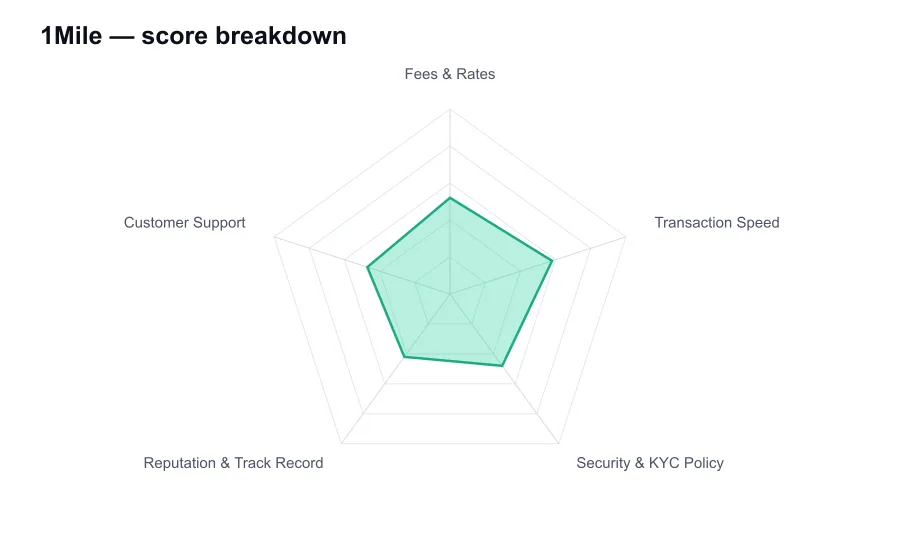
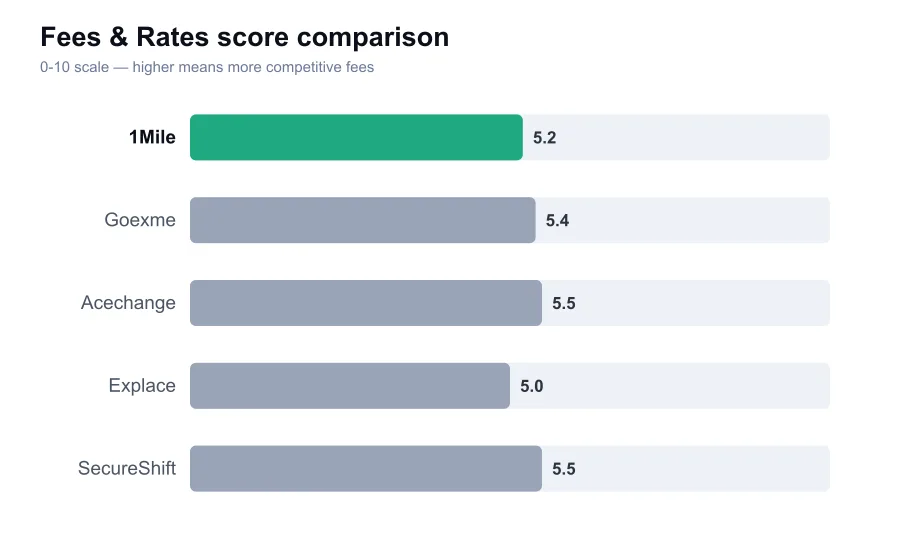
| Fees & Rates | 5.2 | Quote-based pricing needs careful live comparison. |
| Transaction Speed | 5.8 | Dependent on confirmations, liquidity and network choice. |
| Security & KYC Policy | 4.8 | Limited public security evidence supports a cautious approach. |
| Reputation & Track Record | 4.2 | Much less independently documented than established exchanges. |
| Customer Support | 4.7 | Test support responsiveness before relying on it. |
In-Depth Review
1Mile is a lesser-known crypto exchange brand that appears in comparison listings and exchanger directories more often than it appears in mainstream crypto coverage. That immediately shapes the review. It may offer a functional conversion service, but it does not have the public depth, regulatory visibility or independently documented history of a top-tier exchange. Users should approach it as a small provider that must earn trust transaction by transaction.
The service is aimed at simple crypto conversion rather than sophisticated trading. The usual journey is familiar: select what you are sending, choose the asset you want to receive, enter a wallet address and complete the payment. That is a perfectly valid format for someone changing crypto occasionally. It is not a substitute for a transparent, liquid spot market if you trade frequently or need dependable execution at scale.
A sparse public profile does not automatically make a provider unsafe. Plenty of small exchange services operate quietly and handle routine transactions competently. It does, however, mean the burden shifts to the user. You need to inspect the site terms, legal entity information, contact details, supported networks and current independent feedback instead of relying on broad brand recognition. If those basics are hard to find, that is a reason to reduce your transaction size.
Fees are the first place where caution matters. 1Mile's effective charge is likely reflected in the conversion quote, along with blockchain fees and liquidity costs. This model is common, but it can hide a surprisingly large spread on thin pairs. A displayed rate that looks close to market can still produce an uncompetitive result after network costs or quote movement. Calculate the delivered amount, not just the exchange rate shown in large type.
I would not use a little-known instant exchanger for a large swap without obtaining competing live quotes from a major venue and two established swap services. The comparison takes a few minutes and can save a meaningful amount. It also exposes another problem: smaller services may have lower stated minimums or attractive quotes, but their actual liquidity can be less robust when markets move quickly.
Transaction speed should be judged conservatively. The service may process a common asset conversion promptly once a deposit is confirmed, but the total time remains dependent on the incoming chain, liquidity availability and outbound network conditions. A fast interface can create an expectation of immediate settlement that crypto infrastructure cannot always deliver. If you are paying an invoice or moving collateral, use a provider and network you have already tested.
Network selection deserves special attention with a smaller exchanger. Stablecoins now exist on many chains, and a wrong choice between Ethereum, Tron, BNB Smart Chain, Solana or another supported network can be expensive or irreversible. Do not assume a ticker symbol means every version of an asset is accepted. Confirm the exact network on the order screen, then verify the deposit address and destination address character by character before sending.
There is limited public evidence that would justify treating 1Mile as a strong security leader. A no-account or light-registration flow can reduce exposure of personal data, but it does not remove operational risk. During a swap, the user is trusting the provider to credit the deposit, source the output and send it correctly. The lack of a long, highly visible audit trail means this trust should be carefully rationed.
KYC policy is another area where users should read the current terms rather than assuming anonymity. Many instant exchange services advertise easy access yet reserve the right to request documents under anti-money-laundering procedures. That can happen after funds have already been sent. If privacy is central to your decision, conditional KYC is still KYC risk. If compliance certainty is central, a clearly regulated exchange with upfront verification is often the less stressful choice.
Reputation is 1Mile's weakest category. I found less durable, independently verifiable public history around the brand than around established names such as Changelly, ChangeNOW, Kraken or Bitstamp. Directory monitoring and user comments can be useful signals, but neither replaces years of transparent corporate conduct and broadly scrutinized operations. A positive handful of reviews is not enough to establish how a provider behaves during a disputed or delayed transaction.
Support is likely to be acceptable for basic operational questions, but this is exactly where lesser-known exchanges can disappoint. A chat window or email address is not the same as a documented escalation process. Before sending funds, check whether the provider publishes support hours, expected response channels, transaction-tracking instructions and a clear procedure for incorrect deposits. Vague help pages are a bigger concern than a plain-looking website.
There is one sensible way to use 1Mile if you decide to try it: make a very small test conversion of a common, low-fee asset. Save the order reference, record the quoted output and watch the transaction on the relevant block explorer. If that transaction is clean, you have learned something useful. It still doesn't prove that a larger or more unusual swap will receive the same treatment, but it is better evidence than marketing copy.
I would avoid using 1Mile for life savings, large stablecoin conversions, fiat purchases or any payment that needs to arrive at a fixed time. The platform may work perfectly for a small routine exchange, yet its limited public profile leaves too many unanswered questions for a stronger recommendation. Crypto users have plenty of alternatives with clearer fee schedules and more established support records.
My assessment is not that 1Mile should be dismissed automatically. It is that it belongs in the high-caution end of the instant-exchange market. If it offers a uniquely attractive route for a small swap, test it carefully and verify every detail. Otherwise, the modest convenience gain is not enough to outweigh the reputational uncertainty. In crypto, a provider's behavior on the bad day matters more than its quote on the good day.
Pros & Cons
| Pros | Cons |
|---|
Should I use 1Mile for a large crypto swap?
No. Given the limited public track record, use only a small test amount if you choose to try the service. Compare quotes and use a more established exchange for significant value.
Does 1Mile guarantee no KYC?
Do not assume that it does. Instant exchange services can reserve the right to request identification for transactions flagged by compliance or risk controls. Read the current terms before sending funds.
How can I reduce risk on a 1Mile transaction?
Use a small test amount, choose a common asset and network, save the order ID, check addresses carefully and avoid transfers with a strict delivery deadline.