Editorial independence: our scores and rankings are produced using the fixed criteria above and are not influenced by advertisers. This is an independent ranking site and is not operated by, or affiliated with, any provider we list.
Affiliate disclosure: some links on this page may earn us a commission at no extra cost to you. This does not affect our rankings.
Live market data via CoinGecko, for informational purposes only. Not financial advice.
| Best for | Not for |
|---|---|
| Simple conversion-first interface | Opaque effective pricing |
Criteria Breakdown
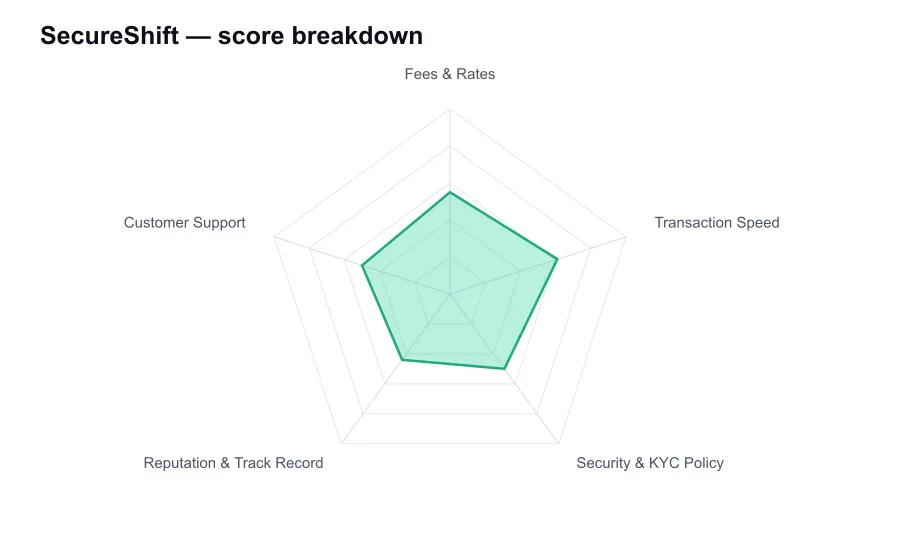
| Criterion | Score | Notes |
|---|---|---|
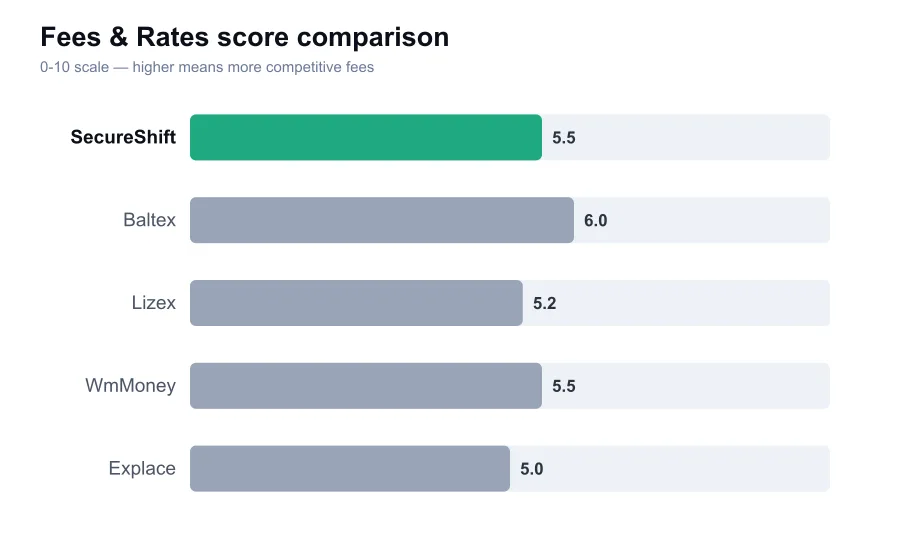
| Fees & Rates | 5.5 | All-in quote needs external comparison |
| Transaction Speed | 6.1 | Network and pair choice drive timing |
| Security & KYC Policy | 5.0 | No deep public security record |
| Reputation & Track Record | 4.4 | Limited long-term market visibility |
| Customer Support | 5.0 | Order-level support is crucial |
In-Depth Review
SecureShift is positioned as a crypto conversion service, not a heavyweight exchange with a public order book, advanced charts, and institutional custody infrastructure. Its appeal is obvious. Pick two assets, enter a receiving address, send the deposit, and let the service handle the route. For users who find centralized exchanges cumbersome, that can feel refreshingly direct. The challenge is that SecureShift operates in a market where a clean interface is easy to build and trust is much harder to establish.
The service should be assessed as an instant exchanger. That means the quoted rate is more important than any headline claim about low fees. SecureShift does not offer the kind of detailed maker and taker pricing that lets traders calculate costs beforehand. The spread, liquidity-provider charge, and blockchain network fee are typically wrapped into the estimate. This can be convenient, but it shifts the burden of comparison to the user. You need to compare what arrives in your wallet, not merely the rate displayed in large type.
On popular pairs, a spread-based swap can be fair enough. A person exchanging a modest amount of USDC for ETH may reasonably pay for convenience and avoid opening a custodial account. SecureShift becomes harder to defend on larger conversions, where even a small pricing difference can cost far more than an exchange withdrawal fee. Kraken Pro, Binance, and Coinbase Advanced can be less convenient, but their trading fees and execution are more visible. SecureShift needs to win on simplicity, not pretend it is always the cheapest route.
The biggest pricing risk is sending funds after a fast market move without understanding whether the quote is floating or fixed. A floating-rate transaction may settle below the amount shown at creation if the market shifts before the deposit is confirmed. That is normal mechanics, not necessarily misconduct, but it can frustrate users who expected a fixed result. If SecureShift presents a fixed-rate option, check the payment deadline, the minimum and maximum allowed deposit, and what happens if the amount sent differs from the order amount.
Speed is usually determined by the least efficient leg of the transaction. A stablecoin swap on a fast network may be completed fairly quickly once the deposit is accepted. A Bitcoin deposit during congestion, or an ERC-20 transaction with a low gas setting, can take much longer. SecureShift cannot remove blockchain confirmation time. What it can control is how quickly it detects the deposit, obtains liquidity, broadcasts the payout, and provides an honest status page. That operational transparency matters more than an ambitious countdown timer.
I would be cautious about assuming every supported pair has equal execution quality. Mainstream assets generally have deeper available liquidity and clearer wallet support. Thinly traded tokens, obscure networks, and newly listed assets are where instant exchange services are more exposed to repricing, manual handling, or cancellation. SecureShift may be useful for a straightforward BTC, ETH, LTC, or stablecoin conversion. It is a weaker choice for a complicated cross-chain move involving an unfamiliar token that would be difficult to recover if anything goes wrong.
Security is where SecureShift's public profile leaves unanswered questions. A non-custodial-style transaction flow reduces exposure compared with parking coins in a web account for months, but it does not eliminate counterparty risk. The service still receives a deposit and must make the correct outgoing payment. Users should verify that the domain is correct, use a hardware wallet where possible, and never trust a deposit address received through a social-media message or search advertisement.
There is a tendency to label every instant exchange as no-KYC. That is sloppy. SecureShift may permit many routine orders without an account or upfront identity document, but compliance screening can still occur. Blockchain analytics flags, sanctions concerns, transaction patterns, or provider rules can lead to a request for information. Anyone for whom uninterrupted access is crucial should choose a service with a policy they have read carefully, rather than relying on an informal claim from a review site.
The platform's reputation is its weakest category. SecureShift does not carry the same weight of long-term public evidence as established services such as ChangeNOW or SideShift. A smaller footprint does not automatically indicate a problem, but it gives prospective customers less material to evaluate. There are fewer years of incident reporting, fewer widely discussed service experiences, and less confidence about how the company handles edge cases. That is precisely why transaction size should remain conservative until a user has tested the service personally.
Customer support can either rescue a small provider's reputation or ruin it. For SecureShift, I would expect users to need clear order tracking, an accessible support channel, and responses that reference the actual transaction hash rather than canned language. A support team does not need to resolve every blockchain delay instantly, because some delays are outside its control. It does need to tell users whether the problem is a missing confirmation, a liquidity issue, an address error, or a compliance hold.
SecureShift is not where I would send a life-changing amount because its operational and corporate visibility is too limited. That is not a dramatic claim, just sensible risk management. The service could execute a small swap perfectly, and many small operators do. But an instant exchanger is only as good as it is on the one transaction that does not complete automatically. Without a substantial public record of handling those moments, caution is more rational than confidence.
The best way to use SecureShift is deliberately. Run a small first order. Save the order page and transaction ID. Verify token contract addresses independently, especially for USDT and USDC across several networks. Do not use a network memo field incorrectly, and do not assume a token ticker alone identifies the correct asset. Those habits sound basic, but most painful swap failures begin with a rushed address or network selection.
For users wanting privacy, SecureShift's model may look preferable to a full custodial exchange. Privacy, however, is not the same as immunity from compliance checks, nor is it a substitute for security. If the service pauses funds, the user may have little leverage beyond its support channel and published terms. A regulated exchange can be more intrusive, but it can also provide clearer legal identity, formal complaint routes, and more robust account controls. Each user has to decide which trade-off they actually value.
My view is that SecureShift is a reasonable option only for relatively small, uncomplicated conversions where convenience matters more than maximum price certainty or corporate transparency. It has the right basic product shape, but it has not demonstrated enough public depth to compete with the strongest names in the category. Check the quote, keep records, and do not treat a smooth first swap as proof that every future one will be equally smooth. It is a tool for careful users, not a platform to trust on autopilot.
Pros & Cons
| Pros | Cons |
|---|
Is SecureShift cheaper than a centralized exchange?
Not necessarily. Its convenience can be valuable, but the cost is built into the quote and may exceed exchange trading fees plus withdrawal fees. Compare the final amount received.
Why can a SecureShift order take longer than expected?
Deposits need blockchain confirmations, and delays can also arise from network congestion, liquidity routing, an incorrect transfer, or a review. Check the transaction hash before contacting support.
Does SecureShift guarantee no KYC?
A no-account flow is not a guarantee against verification. Risk and compliance screening can still trigger an information request on a particular order.