Editorial independence: our scores and rankings are produced using the fixed criteria above and are not influenced by advertisers. This is an independent ranking site and is not operated by, or affiliated with, any provider we list.
Affiliate disclosure: some links on this page may earn us a commission at no extra cost to you. This does not affect our rankings.
Live market data via CoinGecko, for informational purposes only. Not financial advice.
| Best for | Not for |
|---|---|
| Relevant for WebMoney-focused users | Less competitive than major exchanges on liquid crypto pairs |
Criteria Breakdown
| Criterion | Score | Notes |
|---|---|---|
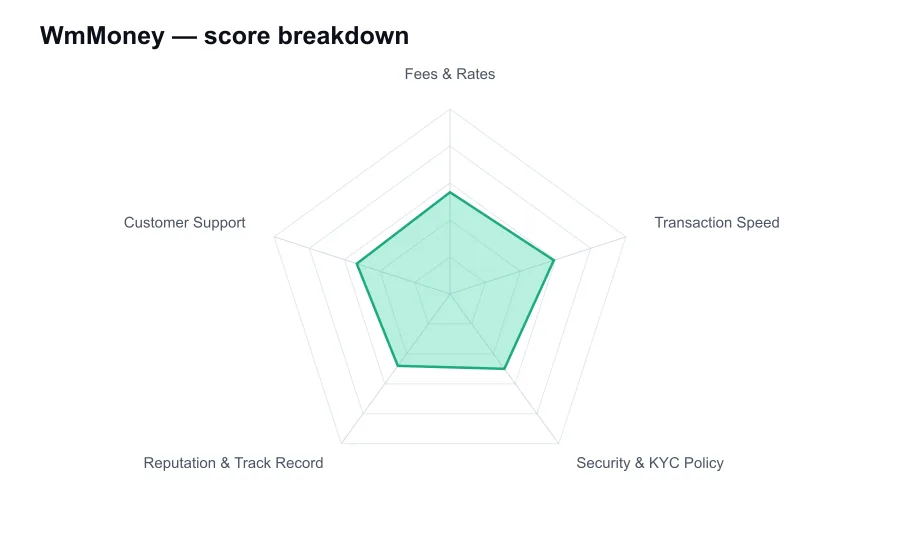
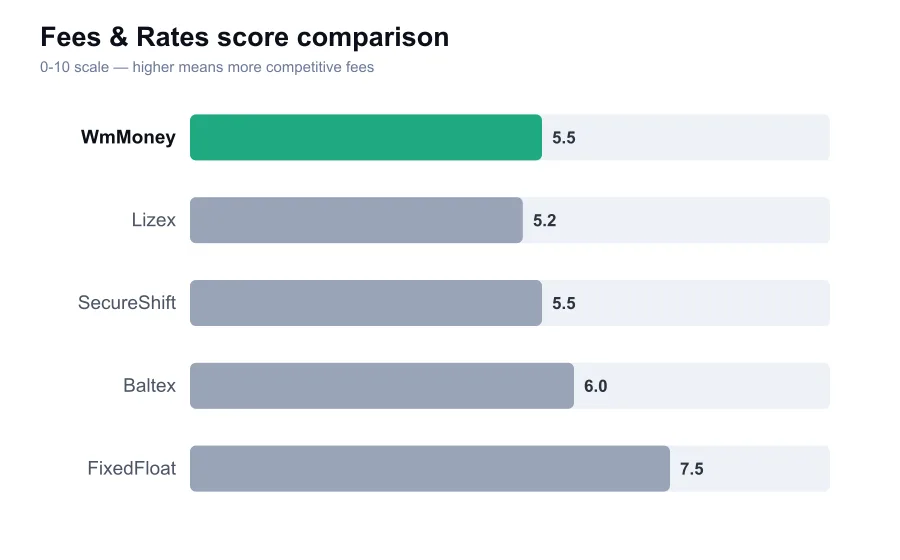
| Fees & Rates | 5.5 | Spreads and payment-system costs need close comparison. |
| Transaction Speed | 5.9 | E-wallet routes can move quickly, other rails vary. |
| Security & KYC Policy | 5.0 | Use transactionally and guard against wallet phishing. |
| Reputation & Track Record | 4.8 | A niche reputation offers limited public assurance. |
| Customer Support | 5.3 | Manual exceptions make clear order support essential. |
In-Depth Review
WmMoney belongs to the older school of online exchangers shaped by WebMoney and electronic-currency users rather than by modern crypto traders. That background matters. The service is likely to make most sense to people who already use WM units, wallets, and regional payment systems, not to someone looking for advanced charting, yield products, or regulated brokerage access. It is a conversion service built for getting money from one rail to another.
For that audience, a specialist can still be useful. WebMoney remains embedded in certain online commercial communities even though its relevance has faded beside cards, stablecoins, and mobile banking. Large exchanges generally do not make WebMoney their priority. WmMoney can fill the gap for users who need to move between a WebMoney balance and another supported payment method without reconstructing their entire financial workflow.
The catch is price transparency. WmMoney's effective fee is commonly the difference between what a customer sends and what the customer receives, rather than a neat commission displayed separately. That spread can be acceptable for an inconvenient payment direction, but it can also conceal a costly deal if the customer does not compare quotes. The only honest comparison is the final output amount after every fee and deduction has been included.
WebMoney itself may have transaction rules and charges that affect the economics, while crypto networks add their own fees and confirmation timing. A user converting a small amount can lose a meaningful percentage before WmMoney's margin is even considered. This is why tiny transactions are useful as a service test but poor as a way to judge value. Test small for reliability, then use a realistic proposed amount to compare the net quote across alternatives.
WmMoney is unlikely to beat a liquid exchange on a mainstream crypto pair. If all you want is BTC, ETH, or USDT against a major stablecoin, use a platform with published trading fees and deep order books. WmMoney earns consideration only when the receiving or sending payment method is difficult to access elsewhere. In that situation, a modest premium can be rational, because convenience has value. It should still be a conscious premium, not an accidental one.
Processing speed depends heavily on the direction. Internal electronic-money transfers can be fast, and an automated exchange may finish soon after payment verification. Crypto deposits must wait for the relevant network confirmation standard, while bank and card payments may take longer due to external processing. The service should not promise a speed it cannot control. Customers should regard estimates as estimates and avoid planning around the fastest possible outcome.
There is a particularly common operational trap with wallet exchanges: payment comments and identifiers. Some systems require an exact note, wallet number, or order reference to match a deposit. Leaving it out, adding extra text, or paying from somebody else's wallet may put the transaction into manual review. Read each instruction before pressing send. It sounds elementary, but most painful exchanger support tickets begin with a small mismatch, not a technical failure.
From a security perspective, WmMoney should be used transactionally, not as a place to keep a balance. Complete the conversion, confirm receipt, and move assets to the account or wallet you actually intend to use. Small exchangers rarely provide the public proof of reserves, insurance disclosures, account controls, or regulatory supervision that make longer-term custody remotely defensible. The fact that an order page functions does not make it a secure deposit institution.
Phishing is a serious concern because WebMoney users are accustomed to wallet credentials and payment confirmations. Never supply recovery codes, private keys, or a WebMoney access credential to someone presenting themselves as support. A legitimate exchanger needs the information required to identify an order, not control over a customer's wallet. Verify the site address through a reliable saved link and be wary of cloned pages that differ by one character.
The no-registration feel some users want should not be confused with guaranteed anonymity. WmMoney, like other operators touching financial networks, can face payment-system restrictions and risk checks. A transaction with inconsistent payer details, an unusual pattern, or a compliance concern may require clarification. If that prospect is unacceptable, the safer choice is to complete verification at a regulated provider before funds need to move, rather than betting on an exchanger's smallest-friction path.
Public reputation is WmMoney's weak point compared with large exchanges. It may have a track record within niche exchanger communities, but it does not offer the breadth of public reporting, corporate disclosure, and independent security evidence expected from a major financial brand. That doesn't mean every order is unsafe. It does mean that a user should not extrapolate from a few smooth transactions into confidence that the service can safely handle life-changing money.
Support quality becomes visible in the edge cases. Can staff explain whether a payment is awaiting confirmation, rejected by a payment system, or simply queued? Do they provide a transaction reference for a completed payout? Are refund terms understandable if an order cannot be completed? These questions are more useful than asking whether support is available 24 hours a day. A human response without a useful answer is not much protection.
I would also be cautious with advertised reserves. An available direction on a monitor or form does not necessarily mean that a large order can be settled immediately at the displayed rate. If you need to exchange a substantial amount, contact the operator first through the official channel and ask whether the reserve is live. Get clarity on rate type, expected settlement time, and documents that may be required. If the answer is evasive, that is the answer.
WmMoney remains a niche utility, and judged as a niche utility it can be serviceable. It offers a route that ordinary crypto platforms may ignore, but it asks users to accept quote-based pricing and a lower level of public assurance. I would use it for a measured, well-documented WebMoney conversion after a test order. I would not use it for custody, for an urgent large payment, or for any transfer whose loss or delay would create serious financial trouble.
Pros & Cons
| Pros | Cons |
|---|
Is WmMoney cheaper than a crypto exchange?
Usually not for standard crypto trading. Its value is access to WebMoney and other niche payment routes, so compare the final received amount rather than a displayed rate.
How can I avoid a delayed WmMoney order?
Send the exact requested amount, use the specified wallet or network, include any required order reference, and avoid payments from a third party.
Is it safe to leave funds at WmMoney?
It is wiser to treat an exchanger as a transaction service, not custody. Confirm the payout and move crypto to a wallet you control or fiat to your own bank account.