Editorial independence: our scores and rankings are produced using the fixed criteria above and are not influenced by advertisers. This is an independent ranking site and is not operated by, or affiliated with, any provider we list.
Affiliate disclosure: some links on this page may earn us a commission at no extra cost to you. This does not affect our rankings.
Live market data via CoinGecko, for informational purposes only. Not financial advice.
| Best for | Not for |
|---|---|
| Simple instant-swap workflow | No transparent trading fee schedule |
Criteria Breakdown
| Criterion | Score | Notes |
|---|---|---|
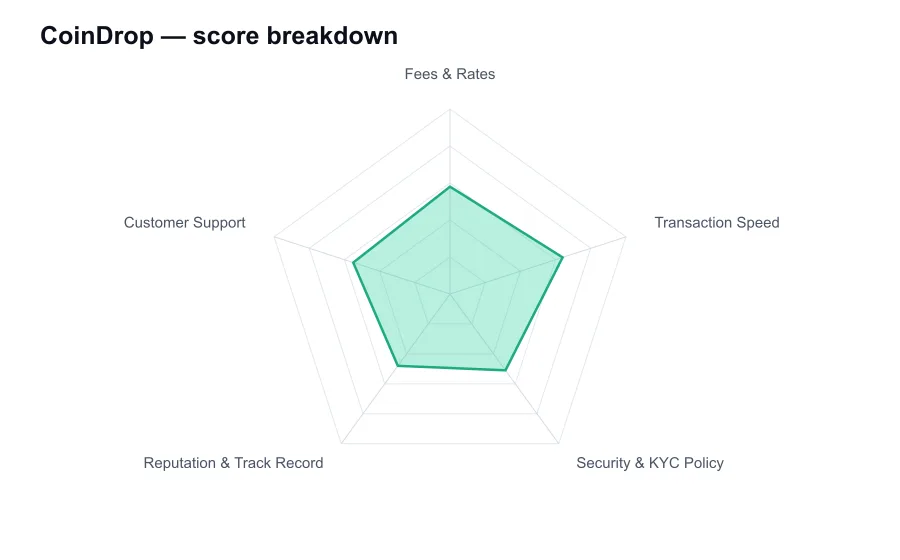
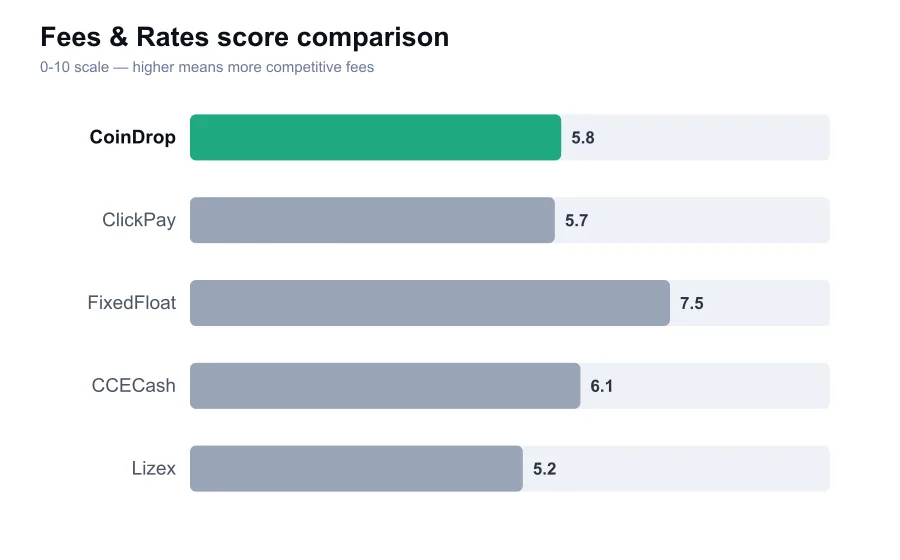
| Fees & Rates | 5.8 | Quote-based pricing requires comparison |
| Transaction Speed | 6.4 | Routine swaps depend on network confirmations |
| Security & KYC Policy | 5.1 | Limited public security transparency |
| Reputation & Track Record | 4.8 | Small public track record |
| Customer Support | 5.5 | Keep order records for escalation |
In-Depth Review
CoinDrop sits in the small, convenience-first end of the crypto exchange market. It presents itself less like a full trading venue and more like a straightforward swap service for people who want to turn one asset into another without learning order books, margin rules, or custody workflows. That simplicity is attractive, particularly to first-time users. It also means CoinDrop needs to earn trust through clear execution and communication, because there is not much institutional history or public transparency to fall back on.
The service appears designed around instant exchanges rather than an account-based brokerage model. A user selects an asset pair, receives a quoted amount and a deposit address, then waits for the outgoing transaction. That is familiar territory for anyone who has used ChangeNOW, SimpleSwap, or StealthEX. CoinDrop's interface is generally easier to grasp than an exchange terminal, but the experience depends heavily on the liquidity partner behind the quote. It is not the same thing as trading directly on a deep centralized exchange.
Pricing is the first area where users should slow down. CoinDrop does not have the kind of clearly published maker and taker schedule that traders can compare across Binance, Kraken, or Coinbase Advanced. Instead, its effective cost is embedded in the quoted exchange rate, with network fees also affecting the final amount. That model is common among instant swap providers, but it makes a quick quote comparison essential. A rate that looks fine on the opening screen can be materially worse than a major exchange after the spread is counted.
For simple, small conversions, the hidden-spread model is not automatically a bad deal. Paying a little more can be reasonable if it saves a user from opening an account, funding it, trading, and withdrawing. The problem is that CoinDrop does not give sophisticated users much evidence that its quotes are consistently competitive. I would not use it for a large Bitcoin to stablecoin conversion without checking at least two alternatives. A few seconds spent comparing final receive amounts can make a surprisingly large difference.
Fixed-rate swaps are the feature I would look for before sending anything during a volatile market. A floating quote may change between deposit confirmation and execution, especially on smaller chains or during a sharp Bitcoin move. If CoinDrop offers a fixed quote on a particular pair, it can be useful, but users should read the terms attached to that quote. Fixed does not always mean unconditional. Deposit limits, timing windows, and blockchain confirmation requirements can still determine whether the original rate survives.
Speed is respectable on uncomplicated orders, although no instant exchange can outrun the underlying networks. A swap involving Litecoin, Tron, or a well-supported stablecoin may complete quickly once the deposit receives confirmation. Bitcoin and Ethereum can take longer, particularly when network fees rise or the service waits for extra confirmations. CoinDrop should be judged on the time from confirmed deposit to payout, not the countdown shown before a transaction is sent. Marketing language around instant swaps tends to be optimistic across this whole segment.
The more important speed question is what happens when a transaction does not fit the happy path. Wrong network selections, delayed deposits, extra compliance checks, and illiquid pairs are where small swap services show their quality. CoinDrop does not have the public operational footprint of the largest non-custodial brands, so there is less independent evidence about how reliably it resolves exceptions. That does not prove poor service. It does mean users should test with a modest amount before trusting it with funds they cannot afford to have delayed.
CoinDrop's security posture is hard to assess with the confidence one could apply to a regulated exchange with audited reserves, named executives, and a long disclosure record. The non-custodial swap model reduces one specific risk because users do not leave a standing balance on the platform. Still, a temporary exchange transaction is not risk-free. Users are trusting CoinDrop's routing, address generation, payout process, and its ability to return funds if a swap cannot be completed.
KYC is another area where the distinction between no-account access and anonymity matters. Services built around instant swaps often allow routine orders without identity verification, but may request information after risk screening or if a transaction is flagged by a compliance provider. Anyone treating CoinDrop as a guaranteed no-KYC option is setting themselves up for disappointment. Read the current terms before depositing and assume that suspicious, high-risk, or unusually large transfers may be paused for review.
I would also be careful with token support. A long list of assets looks impressive, but not every token has the same reliable liquidity or operational support. The safest use case is a mainstream pair such as BTC, ETH, LTC, USDT, or USDC on the exact network shown in the order form. Sending a token on the wrong chain is not a customer support inconvenience. It can become an unrecoverable loss, and a small provider may not have the technical capacity to rescue a complicated deposit.
CoinDrop has a limited public track record compared with established exchange names. That matters more than glossy design. Large exchanges have their own failures and complaints, but years of public reporting create a record that users can examine. CoinDrop has less of that accumulated evidence. It belongs in the category of a service to verify transaction by transaction, not one to trust blindly because its website looks polished or because a comparison page assigns it a high rating.
Support is likely to be adequate for basic order-status questions, but the real test is whether a person can trace an order with a transaction ID and get a useful answer quickly. A generic reply telling a user to wait for confirmations is fine when confirmations are genuinely pending. It is not fine when the deposit has cleared and the payout has stalled. Before using CoinDrop, save the order ID, screenshots of the quoted rate, deposit hash, and receiving address. That record makes a support request much easier to resolve.
There are a few sensible habits that make CoinDrop safer to use. Start with a small test swap, copy addresses rather than typing them, verify the selected network twice, and do not send from an exchange that may use a different memo or tag system. Avoid a large order during extreme price volatility. If the service requests verification after funds are already in transit, stay calm but do not assume immediate access to the funds. Ask support for the exact requirement and retain all transaction records.
CoinDrop can suit someone who values a low-friction one-off conversion more than the best possible price. It is not my first choice for active trading, large treasury conversions, or users who need the protections of a deeply documented company. The platform has the appeal of a simple tool, but it has not built the public reputation needed to justify casual trust with large sums. Use it carefully, compare quotes, and keep each transaction sized to the amount of uncertainty you are willing to accept.
Pros & Cons
| Pros | Cons |
|---|
Does CoinDrop publish a flat exchange fee?
CoinDrop's effective cost is generally reflected in the displayed quote and network conditions rather than a conventional maker and taker schedule. Compare the final receive amount with competing services before depositing.
How long does a CoinDrop swap take?
Timing depends on the deposit chain, confirmation requirements, liquidity, and the payout network. Mainstream assets can be quick, while Bitcoin, Ethereum congestion, or a manual review can extend the process.
Can CoinDrop request verification?
No-account access should not be treated as a promise that verification will never occur. Instant swap providers may pause an order for compliance or risk checks.