Editorial independence: our scores and rankings are produced using the fixed criteria above and are not influenced by advertisers. This is an independent ranking site and is not operated by, or affiliated with, any provider we list.
Affiliate disclosure: some links on this page may earn us a commission at no extra cost to you. This does not affect our rankings.
Live market data via CoinGecko, for informational purposes only. Not financial advice.
| Best for | Not for |
|---|---|
| Simple wallet-to-wallet swap flow | Effective spread is not as transparent as exchange fees |
Criteria Breakdown
| Criterion | Score | Notes |
|---|---|---|
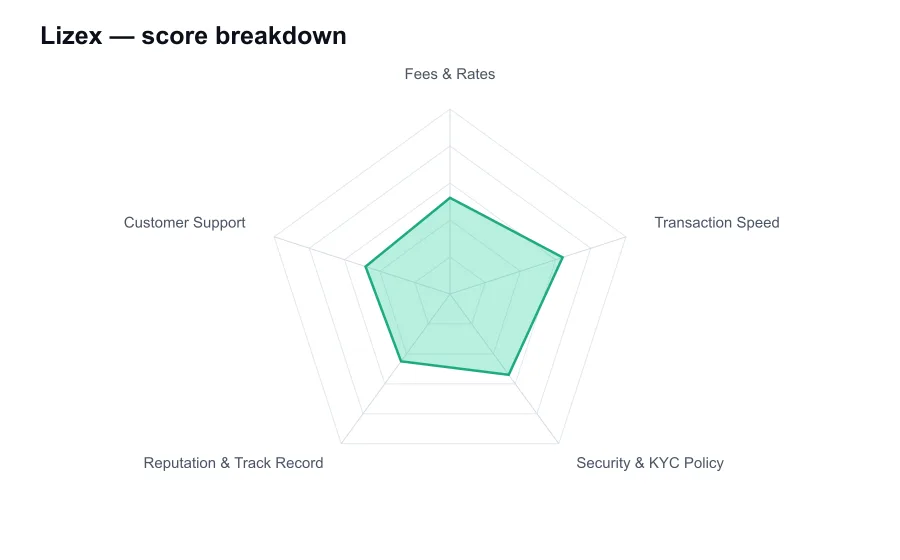
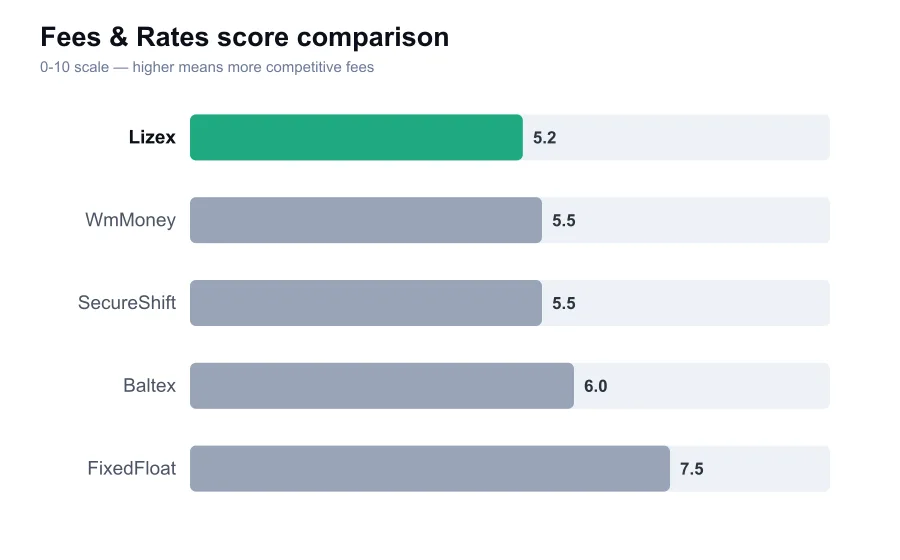
| Fees & Rates | 5.2 | Rate spread is harder to audit than a published trading fee |
| Transaction Speed | 6.4 | Fast on clear, liquid routes, network timing still rules |
| Security & KYC Policy | 5.4 | Non-custodial flow, but KYC holds may still occur |
| Reputation & Track Record | 4.5 | Limited public operating record versus major rivals |
| Customer Support | 4.8 | Online support is available, escalation evidence is limited |
In-Depth Review
Lizex is a small instant crypto exchange service aimed at people who want to swap one asset for another without opening a conventional trading account. It sits in the same broad category as ChangeNOW, SimpleSwap, LetsExchange and other non-custodial exchange aggregators. That is an attractive market position, but it is also a difficult one. A service like this needs exceptionally clear pricing, reliable liquidity partners and a public record that gives strangers confidence before they send irreversible funds.
The first thing to understand is that Lizex is not a deep order-book exchange where users can place limit orders or trade against other customers. The experience is transaction based. You choose a pair, enter a receiving address, send the quoted currency and wait for the requested asset to arrive. That simplicity is useful for a quick wallet-to-wallet conversion, particularly for users who do not want to leave balances parked on a centralized exchange.
The main problem is transparency. Lizex does not have the kind of long, independently documented fee schedule that experienced traders expect from Kraken, Coinbase Advanced or Binance. Its effective cost is normally built into the rate shown at checkout, along with network charges and the spread imposed by liquidity providers. That model is common, but it makes comparison shopping essential. A quote that looks convenient can still be noticeably worse than a direct market trade.
For small swaps, the difference may be tolerable. If somebody is converting a modest amount of USDT into BTC and values speed over squeezing every basis point out of the trade, a spread-based quote can be easier than transferring funds between platforms. Larger conversions are another matter. I would always obtain a live quote from at least two established alternatives before sending anything significant through Lizex. There is no compelling reason to accept an opaque rate without checking it.
Fixed-rate swaps are usually the safer choice where the option is presented. A floating rate can work well in a calm market, but it leaves the final amount exposed while the deposit waits for confirmations and the provider sources liquidity. Bitcoin congestion, a thin altcoin market or a sudden price move can turn a seemingly acceptable quote into a disappointing settlement. Users should read the displayed minimum, maximum and expected receive amount carefully before committing.
Transaction speed depends on the asset being sent far more than on the web interface. Swaps involving Litecoin, TRON-based USDT or other quick networks can settle in minutes if the provider has liquidity available. Bitcoin and Ethereum transactions can take considerably longer, especially when the sender chooses a low network fee or the network is crowded. A reasonable expectation for a standard swap is roughly 10 to 45 minutes after confirmation, not an instant transfer.
The weak point is what happens when a transaction falls outside the happy path. A delayed confirmation, an incorrect memo, a coin sent on the wrong chain or an automated compliance hold can turn a quick swap into a support case. Larger providers have mature tracking pages, detailed statuses and years of public evidence showing how such cases are handled. Lizex has a much thinner public footprint, which means users have less independent evidence to rely on if a transaction gets stuck.
Lizex presents itself as a no-account route for ordinary swaps, but that should never be read as a guarantee of permanent anonymity. Like virtually every exchange service that touches regulated liquidity, it can request identity documents or source-of-funds information where its risk controls flag a transaction. The practical concern is not that screening exists. Screening is normal. The concern is whether users understand that funds may be paused after they have already sent them.
That is why I would not use Lizex for funds whose timing is critical. Do not route rent money, a time-sensitive OTC settlement or funds needed to meet a collateral requirement through a relatively young service. Start with a small test transaction, confirm that the destination chain is right and retain the transaction hash, order ID and screenshots of the original quote. Those basic precautions matter more with lesser-known exchangers than with established exchanges.
On custody, the service has a structural advantage over a conventional exchange because it is designed for one-off conversions rather than long-term account balances. You send coins in and receive coins out. That reduces exposure to a prolonged custodial failure. It does not remove counterparty risk during the swap, though. For the period between deposit and payout, the operator and its liquidity path still control whether the trade completes smoothly.
Lizex has not built the reputation depth that would let it trade purely on name recognition. It lacks the long operating record, extensive regulatory disclosures and widely audited reserves associated with the biggest centralized venues. That does not prove it is unsafe. It does mean the burden of caution remains with the user. A small service should earn trust through consistent execution and transparent communication, not simply through a polished exchange widget.
Customer support appears to be centered on online contact channels rather than a large, always-visible support operation. That is adequate for routine questions, but it is not the same as having phone escalation, comprehensive help-center material and a proven around-the-clock incident response team. Before making a large swap, I would test the support channel with a practical question about limits, KYC triggers or a particular network. Response quality is a useful signal.
The service has a place for people who understand non-custodial swapping and are willing to compare quotes. It is not a venue I would recommend to a complete beginner looking for maximum reassurance. Beginners are better served by a regulated exchange with clear account recovery, predictable support and extensive documentation, even if the onboarding is more cumbersome.
My take is straightforward. Lizex can be useful as a convenience tool for a small, routine conversion, but it has not earned the blind trust that users sometimes give to familiar exchange brands. Treat each quote as a quote, not as a guaranteed bargain. Keep transaction sizes sensible, choose fixed pricing where available and use a more established platform for large conversions or anything that cannot tolerate a support delay.
Pros & Cons
| Pros | Cons |
|---|
Does Lizex require KYC?
Routine swaps may not require an account or upfront identity check, but Lizex can request verification under AML and transaction-risk controls. Do not assume every transaction is anonymous.
How long does a Lizex swap take?
Many liquid routes complete within 10 to 45 minutes after the incoming transaction confirms. Bitcoin congestion, low sender fees, thin liquidity and compliance review can make it much longer.
Are Lizex fees shown separately?
The practical cost is generally reflected in the quoted conversion rate and network charges rather than a simple maker-taker table. Compare the final amount received, not just the headline rate.