Editorial independence: our scores and rankings are produced using the fixed criteria above and are not influenced by advertisers. This is an independent ranking site and is not operated by, or affiliated with, any provider we list.
Affiliate disclosure: some links on this page may earn us a commission at no extra cost to you. This does not affect our rankings.
Live market data via CoinGecko, for informational purposes only. Not financial advice.
| Best for | Not for |
|---|---|
| Clear published floating and fixed fee tiers | Major 2024 security incident |
Criteria Breakdown
| Criterion | Score | Notes |
|---|---|---|
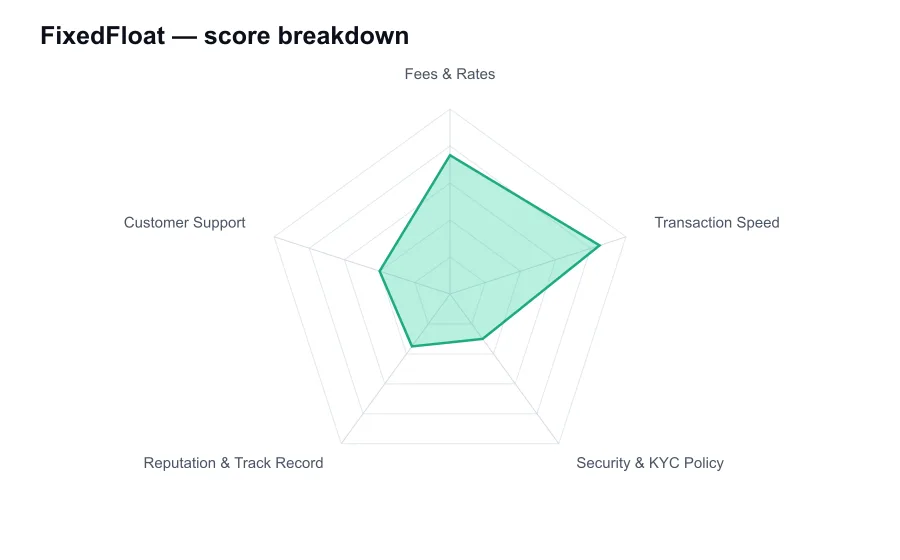
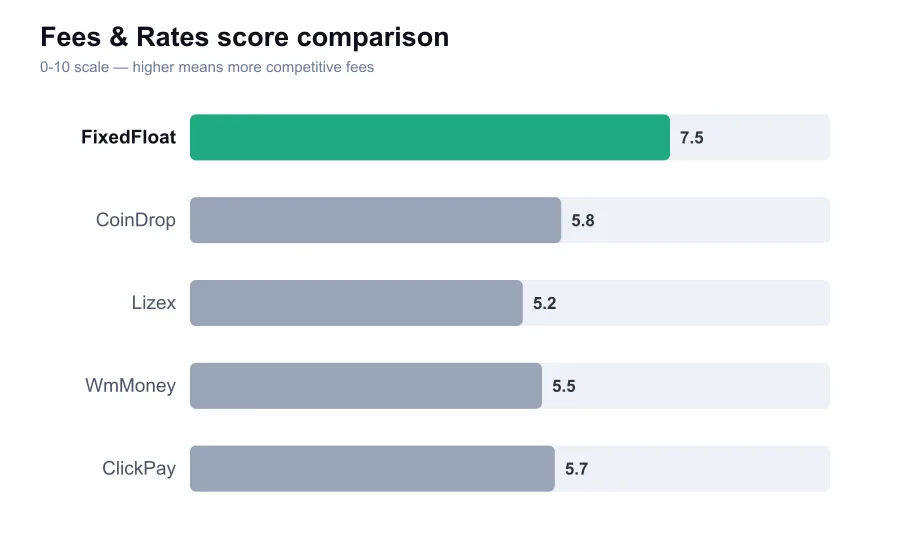
| Fees & Rates | 7.5 | Published 0.5% floating and 1% fixed fee tiers |
| Transaction Speed | 8.5 | Automation and Lightning support can be very fast |
| Security & KYC Policy | 3.0 | Major 2024 security incident severely damages confidence |
| Reputation & Track Record | 3.5 | Useful product, but major trust and transparency concerns |
| Customer Support | 4.0 | Automated model offers limited reassurance in disputes |
In-Depth Review
FixedFloat built its audience around a direct proposition: fast, account-light crypto swaps with a clean interface and clear choices between floating and fixed exchange rates. It has been especially popular with users moving Bitcoin, Litecoin, Monero, Ethereum, and stablecoins between wallets. In the instant-exchange market, it positioned itself as more technical and less corporate than Changelly, with an emphasis on automation, Lightning Network support, and a no-registration workflow.
That proposition was compelling for a reason. FixedFloat generally let a user select a pair, enter a destination address, and receive a deposit address without creating a conventional account. Its API and automated processing appealed to wallet users and merchants as well as casual traders. There was little ceremony. If the route had liquidity and the sender followed the instructions, the service could feel exceptionally quick.
The fee structure was unusually easy to understand compared with many broker-style swap platforms. FixedFloat publicly described a 0.5% fee for floating-rate exchanges and a 1% fee for fixed-rate exchanges, with network fees added separately. A clean published fee is better than pretending that a quote has no fee at all. Still, users should judge the full result, not just the percentage. The spread in the conversion rate and the cost of the payout transaction can change the economics, especially on Ethereum-based assets.
For small and medium transactions, the floating option often made sense if the market was calm. The fixed option cost more, but it could be worthwhile when a user needed to know the approximate outcome before transmitting funds. That said, a fixed-rate swap is only as useful as the conditions around it. Sending late, sending an incorrect amount, or waiting through a volatile period can create complications. People who want absolute execution precision should use a liquid exchange with limit orders, not an instant swap broker.
Speed was historically one of FixedFloat's best arguments. Its Lightning Network support enabled near-immediate movement for compatible Bitcoin payments, a real advantage over waiting for on-chain confirmations. Other routes were limited by the blockchains involved. Litecoin and many established networks could be swift, while Bitcoin on-chain deposits or congested Ethereum transactions naturally took longer. FixedFloat's processing could be automated, but it could not repeal confirmation mechanics.
The service also offered choices that showed it understood practical crypto use. Users could generally select a network fee level for some payout routes, accepting either a lower-cost slower transaction or paying more for priority. That flexibility is useful, though it puts responsibility on the customer to understand what they are selecting. Saving a few dollars on a low-fee Bitcoin payout is not clever if the coins are needed within the hour.
The serious problem is trust, not interface design. In February 2024, FixedFloat reported a security incident involving substantial unauthorized outflows, widely reported at roughly $26 million. The incident was a major blow to a service that asks users to send funds into a temporary exchange flow. Even if a platform does not operate like a custodial balance exchange, security failures around its infrastructure, wallets, or operational controls matter directly to every user.
That episode is impossible to treat as a minor footnote. FixedFloat's public communications around the event and subsequent service availability became part of the story, while blockchain investigators and media reports connected the platform to concerns around illicit-fund flows. Not every allegation about a crypto service should be accepted uncritically, and blockchain attribution can be messy. But a reviewer should not ignore repeated risk signals merely because the website remains attractive or a few swaps complete normally.
FixedFloat has also been associated with a strong privacy-oriented image because it historically did not require standard registration or blanket KYC for ordinary use. That does not mean a customer has an enforceable promise of anonymity. Compliance systems, network analytics, sanctions concerns, law-enforcement requests, and transaction-specific risk controls can all change how a service handles funds. More importantly, absence of KYC is not itself a security model. It gives the user fewer administrative hurdles, not stronger recourse.
For users, the practical security question is painfully simple: if a transaction is delayed, misrouted, flagged, or affected by an operational problem, who is accountable and how easily can they be reached? FixedFloat's anonymous, automated design was excellent for frictionless normal cases. It is much less reassuring in abnormal ones. There is no familiar regulated-exchange relationship, no broadly visible executive accountability, and limited comfort for someone trying to recover a significant transfer.
Support has historically relied heavily on automated order pages, documentation, and online contact channels. That may be sufficient for a transaction that simply needs another confirmation. It is not the same as having robust, accountable case management. Reports about response quality vary sharply, which is common in this sector, but the downside has more weight after a major security incident. A fast bot response is not a substitute for transparent resolution of a difficult case.
FixedFloat still has genuine strengths. Its interface is efficient, published fee tiers are clearer than many rivals, and Lightning support is not cosmetic. A technically capable user making a small test swap may find it more convenient than a big exchange. The product idea was good, and at its best the execution was impressively fast. But a good product idea cannot be separated from the operator's security record and the confidence users can reasonably have when things go wrong.
I would not make FixedFloat my primary conversion venue or use it for meaningful holdings. The service may suit someone who understands the operational risk, verifies the live site carefully, and is making a small, non-urgent swap where Lightning or a specific route is useful. It does not suit beginners, businesses, compliance-sensitive users, or anyone who needs a dependable escalation path. Those people should pay a little more for a platform with stronger transparency and institutional accountability.
My view is blunt: FixedFloat's speed and low-friction design remain attractive, but the risk profile has changed. The 2024 incident and surrounding reputational concerns mean its previous reputation as a clever, efficient swap tool cannot be scored as if nothing happened. Use only funds you are prepared to place in a high-risk service flow, confirm the current operating status before sending, and start with a tiny test. There are easier ways to exchange crypto. There are also safer ones.
Pros & Cons
| Pros | Cons |
|---|
What are FixedFloat's stated fees?
FixedFloat has publicly listed a 0.5% fee for floating-rate exchanges and 1% for fixed-rate exchanges, plus relevant blockchain network fees.
Does FixedFloat support Bitcoin Lightning?
FixedFloat has historically supported Lightning Network routes, which can make compatible Bitcoin transfers much faster than ordinary on-chain settlement.
Is FixedFloat safe after the 2024 incident?
The reported 2024 security incident is a material risk factor. Do not treat the service as low risk, and avoid sending amounts you cannot afford to have exposed or delayed.