Editorial independence: our scores and rankings are produced using the fixed criteria above and are not influenced by advertisers. This is an independent ranking site and is not operated by, or affiliated with, any provider we list.
Affiliate disclosure: some links on this page may earn us a commission at no extra cost to you. This does not affect our rankings.
Live market data via CoinGecko, for informational purposes only. Not financial advice.
| Best for | Not for |
|---|---|
| Access to less common payment directions | No simple universal fee schedule |
Criteria Breakdown
| Criterion | Score | Notes |
|---|---|---|
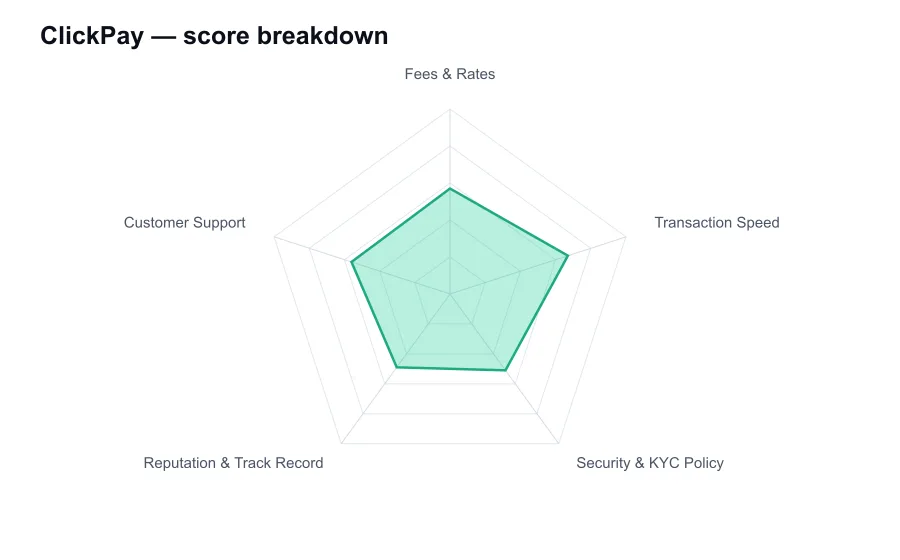
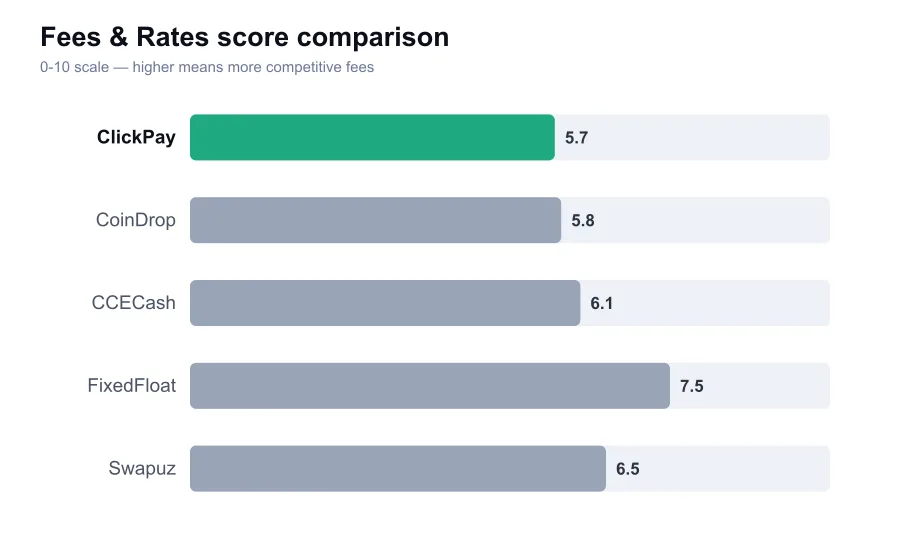
| Fees & Rates | 5.7 | Payment-route spreads can be wider than they first appear. |
| Transaction Speed | 6.7 | Quick on clean automated orders, variable on cards. |
| Security & KYC Policy | 5.1 | Use official channels and expect risk-based checks. |
| Reputation & Track Record | 4.9 | More of a regional exchanger than a proven global brand. |
| Customer Support | 5.6 | Response quality matters heavily on exception cases. |
In-Depth Review
ClickPay sits in the crowded category of online exchangers that connect crypto, electronic money, cards, and regional payment methods through a simple order form. The name sounds like a mainstream payment company, but customers should approach it as an exchange desk, not as a card network or a bank. That distinction affects everything from price transparency to dispute rights. You are accepting a conversion quote and relying on the operator to settle the other side.
The attraction is obvious. A user can often find payment directions that are awkward or impossible on Coinbase, Kraken, or a large domestic bank app. Local cards, wallet systems, and certain cashless rails still matter to people who are paid outside traditional banking. ClickPay is aimed at that practical gap, and its interface is likely to feel more direct than opening a trading account, completing a full onboarding process, and navigating an order book.
The fee question takes more work than it should. A service like ClickPay may not present a clean, universal percentage because the cost varies by direction, reserve, volatility, and settlement risk. The visible rate can include the operator's margin. That is not inherently deceptive, but it means users should calculate the all-in result. Enter the same amount at two or three competing exchangers and compare how much reaches the receiving account.
Card directions deserve special suspicion. Card acquirers, fraud controls, chargeback exposure, and local banking restrictions make them expensive for exchangers to support. A quote that looks fine for USDT to an e-wallet may be poor for Bitcoin to a card. Do not assume the difference is ClickPay's stated fee alone. Network charges, payment-provider deductions, and a conversion spread can each affect the final figure.
For modest, routine amounts, convenience may justify a less aggressive rate. It usually does not justify skipping the comparison step. A five-minute check on a reputable monitor or a direct comparison with an established competitor can expose a surprisingly wide gap. Users making frequent transfers should keep their own record of quotes, because a service that is competitive one week may not be competitive on the same direction after reserves or market conditions change.
Speed is one of ClickPay's more plausible selling points, but only under the right conditions. A crypto deposit cannot be paid out before the operator is comfortable with its confirmations, and a card or bank transfer may not appear instantly at the recipient end. The words instant or automatic should be read as an operational aim, not a contractual guarantee. The best-case experience is fast. The difficult cases are what reveal the service's true quality.
The common causes of delay are mundane: an incorrect memo, an underpayment caused by a network fee, a transfer from a third-party account, an outdated card number, or a payment sent after the rate window closed. ClickPay cannot fix every one of these instantly. What it can do is communicate clearly, preserve the transaction record, and tell the customer whether a recalculation, refund, or extra verification is required. That is the standard I would apply.
ClickPay should not be treated as a wallet. Complete the exchange and move on. Leaving a balance with a small exchanger creates unnecessary counterparty risk without gaining the protections offered by regulated custodians or self-custody. Use a wallet you control for crypto, and use a bank account in your own name for fiat payouts. Those simple habits reduce the chance that an operational problem becomes an argument over ownership.
KYC is another area where customers often make the wrong assumption. Many exchanger flows begin with very little registration, which is convenient, but payment compliance does not disappear. An unusual transaction, a sanctioned address alert, or payment details that do not match can lead to a document request. That can feel inconsistent if the site initially looked anonymous, but it is a reality of handling cards and bank-connected funds.
The service's security should therefore be assessed more by behavior than slogans. Does the order page show a unique identifier? Are support contacts consistent with the site domain? Is there a readable policy explaining rate recalculation and refunds? Can the user find a clear record of completed payment instructions? These are modest checks, yet they separate an orderly exchange operation from one that leaves customers dependent on screenshots and chat messages.
ClickPay's reputation is likely to be most relevant within exchanger directories and user communities rather than in the mainstream financial press. That is not automatically a disqualifier, because many regional operators never need a global brand. Still, it means prospective users must do more of the diligence themselves. Look for a sustained history, not a handful of recent positive comments, and read complaints for patterns involving delays, rate changes, or withheld payouts.
I would put more weight on how the company handles a bad transaction than on a string of successful small orders. Almost every exchanger can process the easy cases. A credible operator identifies the payment, explains the issue, and returns or completes funds according to published terms. A poor one lets the conversation drift into private messages and keeps changing the explanation. Never move an order discussion to an unofficial account simply because somebody claims it is faster.
Customer support is important at ClickPay because its target users often need help with the exact payment methods that create exceptions. Before sending a meaningful amount, ask one specific question through the official channel, such as whether a named bank or asset network is currently available. The quality and precision of the reply can tell you more than promotional copy. Vague answers are a reason to reduce the amount or choose another provider.
ClickPay can make sense for a user who needs a particular local payment route and is comfortable managing exchange risk. It is not the cheap, transparent solution for active trading, nor is it the best place for a large one-off liquidation. The service succeeds where accessibility matters more than institutional polish. My view is practical: test it with a small amount, insist on a clear final payout, and keep better-known alternatives ready.
Pros & Cons
| Pros | Cons |
|---|
Are ClickPay rates fixed?
That depends on the order terms and the selected direction. Read the rate window and recalculation policy before paying, since a delayed or incomplete payment may be repriced.
Why can a ClickPay card payout take longer?
Card and bank rails can require fraud checks and may have their own posting times. A completed exchange order does not always mean the receiving bank shows funds immediately.
Should I send crypto from an exchange account?
Use care. Some services require exact amounts, tags, or sender details. A self-controlled wallet gives you a clearer transaction record and reduces third-party transfer complications.