Editorial independence: our scores and rankings are produced using the fixed criteria above and are not influenced by advertisers. This is an independent ranking site and is not operated by, or affiliated with, any provider we list.
Affiliate disclosure: some links on this page may earn us a commission at no extra cost to you. This does not affect our rankings.
Live market data via CoinGecko, for informational purposes only. Not financial advice.
| Best for | Not for |
|---|---|
| Useful for WebMoney-related conversion routes | Final cost is less transparent than exchange trading fees |
Criteria Breakdown
| Criterion | Score | Notes |
|---|---|---|
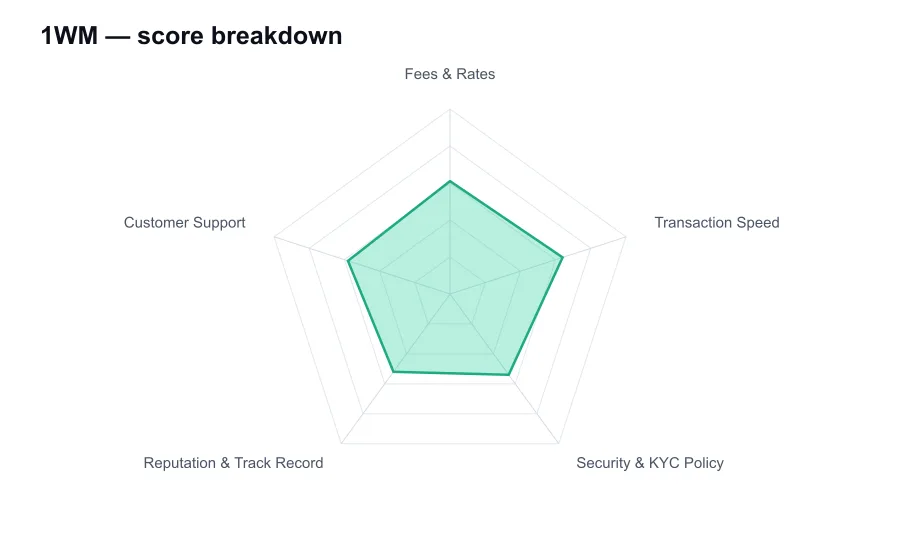
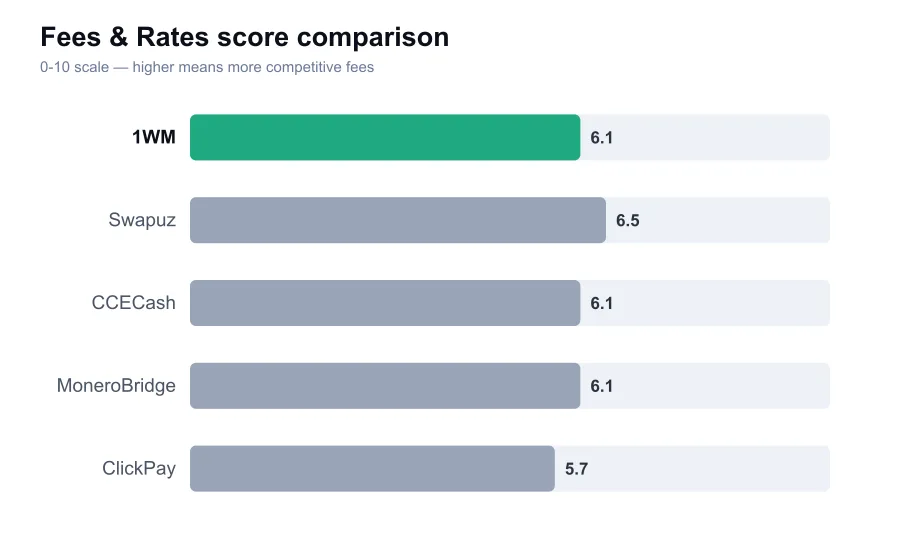
| Fees & Rates | 6.1 | Rates are quote based, so compare the final payout. |
| Transaction Speed | 6.4 | Automated routes can be quick, manual payouts can lag. |
| Security & KYC Policy | 5.4 | Small exchanger risk and possible compliance checks. |
| Reputation & Track Record | 5.2 | A niche operator with a limited public footprint. |
| Customer Support | 5.8 | Support is most important for payment mismatches. |
In-Depth Review
1WM is a small online exchanger built around the WebMoney ecosystem and the familiar post-Soviet payment rails that grew around it. It is not trying to be Binance, Kraken, or a broad retail crypto platform. The service is for people who already know the difference between WMZ, WMT, bank cards, and local payment systems, and who want to move value between them without opening an account at a large exchange. That narrow focus is both its appeal and its limitation.
The first thing a prospective customer should understand is that 1WM operates more like a classic exchange desk than an order-book market. You select a direction, enter an amount and destination details, then accept the quote available at that moment. The rate is the product. A comparison with the mid-market Bitcoin or dollar rate is not enough, because the real cost sits in the spread, reserve conditions, and any fee charged by the sending or receiving payment system.
That makes 1WM hard to call cheap in an absolute sense. It can be competitive on an actively stocked, popular direction, especially WebMoney to local bank or e-wallet routes. On thinner routes, the quote can be noticeably less attractive than the headline rate at a major crypto exchange. This is normal for a small exchanger carrying settlement risk, but customers should still compare the final amount they receive, not the rate displayed in the first field.
There is no meaningful advantage here for someone converting large amounts of Bitcoin to USDT. Deep-liquidity exchanges win on transparent maker and taker pricing, even after withdrawal fees. 1WM's value is convenience around payment methods those platforms do not treat well. A person who needs to swap WebMoney funds into a usable local payout may reasonably pay more than a trader moving stablecoins between major venues.
Quote expiry matters. Crypto prices and payment-system reserves move quickly, so an exchanger can only hold a rate for a limited window. Send the exact amount requested and do not improvise with a different payment account, a partial transfer, or a delayed deposit. Those mistakes often turn a simple automated order into a manual support case. Small exchangers are far less forgiving of mismatched payments than a large exchange with a sophisticated reconciliation team.
Speed is strongest where both sides are automated. A completed crypto network confirmation and a standard e-wallet payout can be handled quickly, sometimes in minutes, provided the reserve is available and the order details match. Card, bank, or manually reviewed transfers are another story. Banking cutoffs, payment-provider checks, and recipient-bank rules can push completion well beyond the optimistic estimate displayed on an order page.
I would not use 1WM for a time-critical trade or to fund a position that depends on a fixed market price. The service can be fast, but it is not a trading venue with guaranteed execution infrastructure. Its sensible use case is a planned conversion where a few hours of variance will not hurt. For an emergency fiat withdrawal, a provider with a defined payout timetable and a well-staffed operations desk is safer.
Security at a service like this is partly technical and partly procedural. HTTPS and an order identifier are the bare minimum, not proof that funds are protected. Users should verify the domain carefully, confirm payment details from the order page rather than a message, and never trust a supposed manager asking for a transfer to a different wallet. Copycat exchanger domains and Telegram impersonators remain a real risk in this corner of the market.
The privacy proposition also deserves a less romantic reading than no-KYC marketing often receives. A low-friction order flow does not mean every transaction is anonymous or free from review. Blockchain analysis, payment-system controls, sanctions screening, unusual size, and a name mismatch can all trigger a request for information or a delay. Anyone who cannot tolerate verification should not send funds first and argue about it later.
1WM does not have the public corporate footprint, licensing visibility, or long independently audited record that gives established international exchanges a cushion of trust. Its reputation has to be judged through its operating history, its exchange-monitor listings where applicable, the consistency of its public contact details, and how it resolves complaints. That is a much thinner evidentiary base than a regulated platform's, so modest order sizes are the rational starting point.
The reserve display, if offered for a direction, is useful but should not be treated as a guarantee. A listed reserve can change before an order is accepted, and a large order may need to be split or pre-arranged. Ask support before sending anything substantial. A serious exchanger should be able to tell you whether the direction is available, what identification may be requested, and whether the quoted payout is realistically achievable that day.
Support is likely to matter most when something goes wrong, not when an order works normally. The practical test is whether staff can identify an order from its number, explain the payment status in plain language, and give a realistic next step. Short replies are fine if they are accurate. Silence, pressure to use an unverified messenger account, or vague promises that funds are being checked without a time frame are not fine.
For first use, I would make a small test exchange, save every receipt, and wait until the receiving balance is fully credited before attempting a larger transfer. Check the recipient wallet or card number character by character. With irreversible crypto payments, an error is rarely something customer support can simply undo. That discipline matters more here than it would with a card processor that offers formal chargeback procedures.
1WM is useful as a specialist conversion counter, not as a home for assets or a replacement for a major exchange. Its strength is access to WebMoney-adjacent payment flows and a direct order process. Its weakness is the opacity that comes with small-exchanger pricing, limited public accountability, and occasional manual handling. I would use it cautiously for a tested, ordinary-sized payment route, but I would not park funds there or make it my only off-ramp.
Pros & Cons
| Pros | Cons |
|---|
Does 1WM charge a separate exchange fee?
The effective cost is usually reflected in the quoted conversion rate, and the sending or receiving payment system may add its own charge. Check the final payout before paying.
How fast are 1WM exchanges?
Automated e-wallet and crypto routes may complete quickly after payment confirmation. Bank, card, or manually reviewed orders can take much longer.
Can 1WM request identification?
It may request information where payment details, transaction size, risk controls, or compliance screening require manual review. Low-friction ordering is not a guarantee of no verification.