Editorial independence: our scores and rankings are produced using the fixed criteria above and are not influenced by advertisers. This is an independent ranking site and is not operated by, or affiliated with, any provider we list.
Affiliate disclosure: some links on this page may earn us a commission at no extra cost to you. This does not affect our rankings.
Live market data via CoinGecko, for informational purposes only. Not financial advice.
| Best for | Not for |
|---|---|
| Specialist access to Monero swaps | Limited public transparency and track record |
Criteria Breakdown
| Criterion | Score | Notes |
|---|---|---|
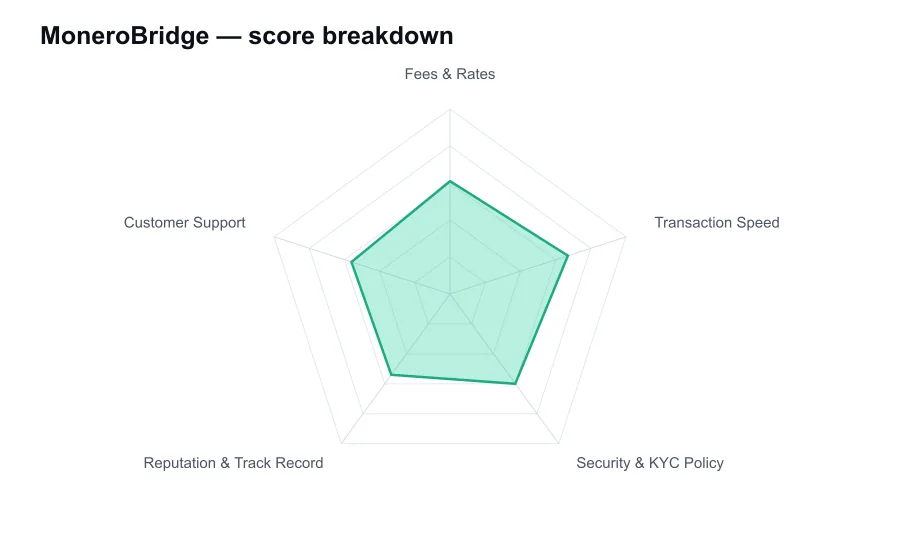
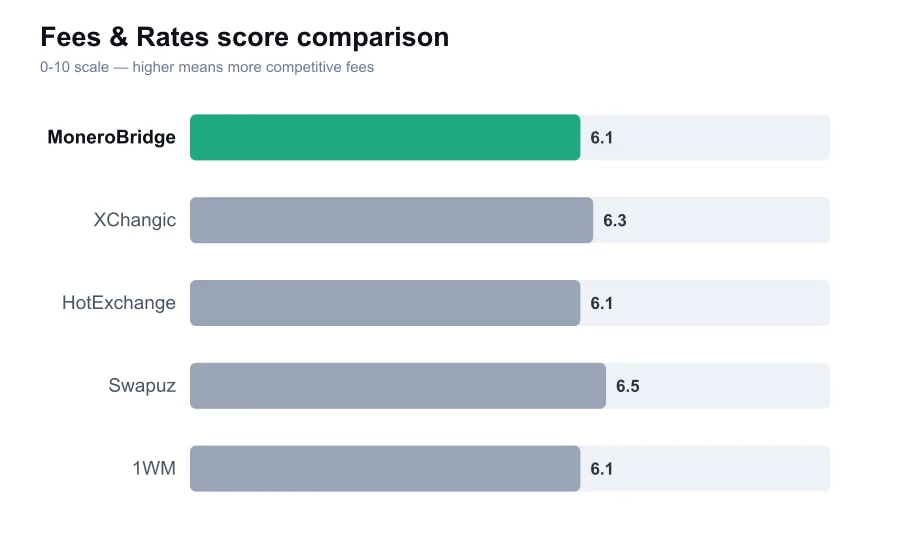
| Fees & Rates | 6.1 | XMR routing is useful, but all-in spreads need close comparison. |
| Transaction Speed | 6.7 | Reasonable for liquid routes, with XMR and payout-chain dependencies. |
| Security & KYC Policy | 6.0 | Wallet-to-wallet design, but limited public operational disclosure. |
| Reputation & Track Record | 5.4 | Recognized in a niche, with a lighter independent public record. |
| Customer Support | 5.6 | Direct online help, but limited evidence of robust escalation. |
In-Depth Review
MoneroBridge is a niche exchange service focused on bridging Monero with other cryptocurrencies. Its appeal is obvious to anyone who has tried to buy or sell XMR through mainstream platforms. Monero remains harder to access than Bitcoin or Ethereum because many centralized exchanges have delisted it or restricted it in certain regions. A dedicated XMR swap service can therefore fill a genuine gap, especially for self-custody users.
The service is not a full trading venue. It does not offer an order book, margin tools, a custody wallet or the broad product suite of a major exchange. Its job is narrower: receive one cryptoasset, exchange it and send the other asset to an address supplied by the user. That focus can be a virtue, but it also means MoneroBridge should be judged heavily on execution reliability, privacy handling and the quality of its public record.
Monero's privacy model makes this niche more complicated than a normal BTC to ETH conversion. XMR transactions obscure sender, receiver and amount information on-chain, while many liquidity providers and compliance systems are cautious about touching the asset. That can reduce the number of available routes and raise the cost of access. Users should be skeptical of any service that implies Monero liquidity is as cheap and frictionless as swapping two heavily traded transparent-chain assets.
MoneroBridge presents its service as an easy way to exchange XMR without a conventional account. That is attractive for Monero users who value financial privacy and prefer not to leave coins on a centralized platform. The exchange is wallet-to-wallet in concept. You provide a destination address and receive the output directly there rather than keeping it in a hosted balance. That arrangement is preferable to depositing XMR at a little-known custodial exchange.
Pricing is the first area where expectations need to be realistic. MoneroBridge's effective cost is shown through its quote, with network fees, route liquidity and the service's margin incorporated into the rate. A narrow public fee table would be better, but route-based pricing is common in the instant-exchange sector. The key question is whether the amount you receive is fair compared with alternatives, not whether a homepage uses the word low fee.
XMR pairs often cost more than major transparent-chain pairs because the available liquidity is thinner and the compliance burden is higher. That does not excuse a poor quote. It does mean a user should compare MoneroBridge against alternatives such as Cake Wallet's exchange partners, Trocador, a reputable peer-to-peer market or, where lawful and available, an exchange that supports XMR. A quote that is 3 percent away from the market may be acceptable in a difficult route. A much larger gap needs a reason.
Monero network fees themselves are usually modest. The bigger variables are the spread on the conversion, the fee on the other chain and whether the route uses an intermediary with limited XMR inventory. Small exchanges can be particularly inefficient because a fixed operational cost takes a bigger bite. MoneroBridge is better suited to a deliberate swap than a series of tiny conversions where the all-in cost becomes disproportionate.
Speed is also more nuanced than the instant-exchange label suggests. Monero confirmations are generally quicker and more predictable than Bitcoin's, but a conversion still requires the deposit to be recognized, liquidity to be sourced and the destination-chain payout to be broadcast. A simple XMR to LTC or XMR to a liquid stablecoin route may complete in a reasonable period after confirmation. Bitcoin outputs can take materially longer, and unusual pairs can be delayed by route availability.
Monero users should pay close attention to wallet details. Sending XMR requires a correct primary or subaddress and, for older integrated-address workflows, any required payment identifier must be handled properly. Receiving XMR also requires a valid Monero address, not an address from a tokenized Monero product or an exchange deposit system with extra instructions. A mistake in privacy-coin routing is difficult to reverse. Test with a modest amount if you have never used the destination wallet before.
The no-account design provides a measure of privacy, but it does not mean MoneroBridge can guarantee no KYC in every situation. Services that interact with liquidity providers may apply automated risk controls, freeze an order for review or request documentation. That tension is particularly acute for Monero. The reason many users seek XMR is privacy, while the reason many providers limit XMR routes is compliance exposure. Anyone claiming that this conflict has vanished is selling fantasy.
For a user whose priority is avoiding a permanent exchange identity profile, MoneroBridge's model has clear value. For a user who requires absolute certainty that no questions will be asked, it is a risky choice by definition. Once coins have been sent to any intermediary, the user is dependent on that intermediary's policy. A dedicated privacy-coin exchange should explain that reality in precise language. Privacy-friendly design and guaranteed anonymity are not interchangeable concepts.
Security disclosure is modest. The platform's noncustodial transaction flow limits the risk of a stored account balance being compromised, but it does not reveal much about the company's internal controls, reserve arrangements or liquidity counterparties. That is a meaningful concern because users are trusting it with an asset that can be hard to replace through ordinary regulated venues. I would like to see more concrete public information about operations, incident response and legal responsibility.
Reputation is the most difficult part of this review. MoneroBridge has recognition among some privacy-coin users, but it does not have the broad, extensively documented customer history of large exchange brands or even the public footprint of SimpleSwap. Niche services can develop loyal users without producing a huge review trail. Still, limited visibility makes due diligence harder, and that should translate into more cautious usage rather than blind trust.
The absence of a giant corporate profile is not automatically a defect in the Monero ecosystem. Many XMR users actively prefer smaller, privacy-oriented tools. But the lack of transparency becomes more serious when a service handles swaps rather than open-source software. You are not just downloading code. You are sending value to an operator and waiting for them to complete a payout. That requires a higher bar for proof of reliability.
Support options appear oriented around direct online communication, which is normal for a specialist exchanger. For a routine transaction, an order ID and transaction hash should allow staff to identify the issue. The real test comes with an XMR deposit that is not detected, a payment ID mistake, a compliance review or an output transaction delayed on another chain. There is less public evidence of a mature escalation system than at larger services, and that is a material limitation.
MoneroBridge can make sense where its quote is good and the user specifically needs an XMR-focused bridge without opening an account at a conventional exchange. It is not a venue I would use casually for a large first transaction or for a deadline-sensitive payment. Start small, save every identifier, use a wallet you control and independently confirm the receiving chain. Those are sensible rules everywhere, but they matter more in a niche privacy-coin market.
My view is cautious rather than dismissive. MoneroBridge serves a real need created by the shrinking availability of Monero at mainstream exchanges. Its narrow focus and wallet-to-wallet design are positives. Yet the service's limited public transparency, opaque all-in pricing and lighter reputation footprint mean it has not earned the same confidence level as a mature large provider. It is a useful specialist tool for informed users, not a platform to trust on marketing alone.
Pros & Cons
| Pros | Cons |
|---|
Can MoneroBridge be used without an account?
The service is designed around direct wallet-to-wallet exchanges rather than a traditional trading account. It may still apply transaction screening or request information if an order is flagged.
Why can XMR exchange rates be less favorable?
Monero has fewer liquidity routes than major transparent-chain assets, and providers face added operational and compliance constraints. Compare the final payout with several XMR options.
How long does a MoneroBridge swap take?
Timing depends on Monero confirmations, route liquidity and the destination network. Liquid routes can complete fairly quickly, while Bitcoin outputs, unusual pairs or reviews can take longer.