Editorial independence: our scores and rankings are produced using the fixed criteria above and are not influenced by advertisers. This is an independent ranking site and is not operated by, or affiliated with, any provider we list.
Affiliate disclosure: some links on this page may earn us a commission at no extra cost to you. This does not affect our rankings.
Live market data via CoinGecko, for informational purposes only. Not financial advice.
| Best for | Not for |
|---|---|
| Direct route for specialized conversions | Limited transparency compared with major exchanges |
Criteria Breakdown
| Criterion | Score | Notes |
|---|---|---|
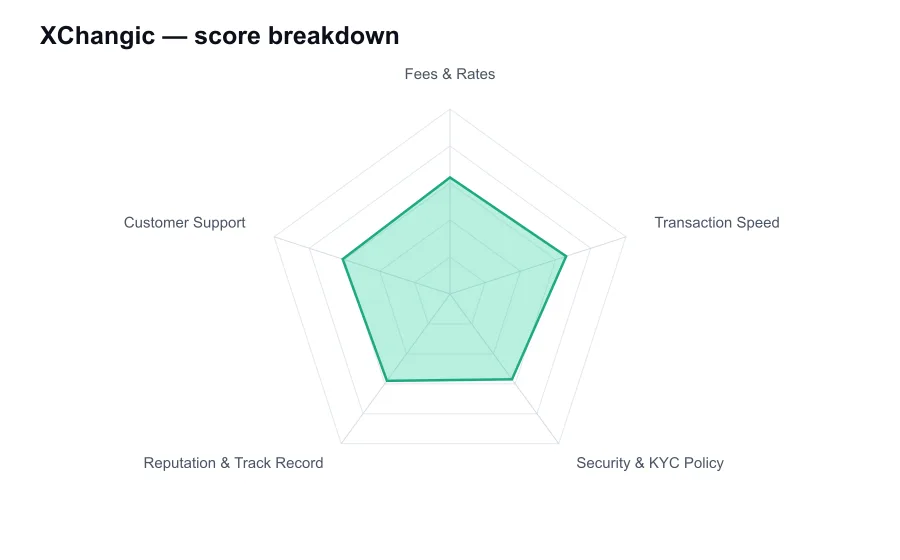
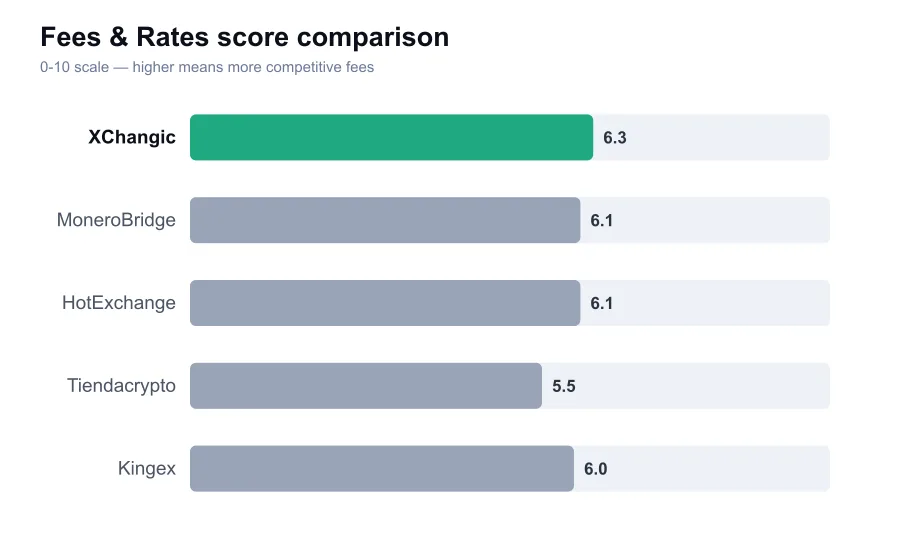
| Fees & Rates | 6.3 | Rates vary materially by route and payment method. |
| Transaction Speed | 6.6 | Standard crypto orders can be prompt, fiat routes vary. |
| Security & KYC Policy | 5.7 | Short-term counterparty exposure and conditional verification. |
| Reputation & Track Record | 5.8 | Needs more public transparency to inspire higher confidence. |
| Customer Support | 6.1 | Pre-sale responsiveness is worth testing before a large order. |
In-Depth Review
XChangic is a smaller crypto exchange service aimed at users who want a direct conversion rather than a full account at a large trading platform. That puts it in a crowded market. Plenty of providers can display an attractive rate calculator, but the ones worth using are those that settle cleanly, explain their limits honestly, and respond intelligently when something goes wrong. XChangic's appeal is its narrowness. It tries to make a specific exchange route easy. It is not pretending to be an all-purpose financial institution.
That focus can be helpful for users dealing with a payment method or regional currency that major exchanges handle poorly. A centralized exchange may have excellent liquidity in USDT or Bitcoin yet offer no convenient bridge to a particular card, wallet, or local transfer method. XChangic can fill that gap. The customer is paying for access and execution, not for a public order book. Anyone evaluating it should begin there, because it explains both the service's usefulness and its limitations.
Fees are embedded in the final rate, which is common in this category but not especially transparent. There may be no single percentage that describes what XChangic costs across every direction. The spread changes with asset liquidity, network charges, payment-provider costs, volatility, and reserve conditions. That makes a live comparison more honest than quoting a generic fee figure. Enter the exact amount you want to send, then compare the amount you will receive after all deductions with other providers.
XChangic can be attractive when its quoted destination amount is strong on a route that larger platforms do not offer. It is less convincing if you are simply swapping liquid crypto assets. For BTC to USDT, ETH to USDC, or another mainstream pair, the price difference between a specialist exchanger and a high-volume exchange can be significant. The extra convenience may not be worth it. A good user chooses XChangic for access to a particular payout path, not from habit.
Transaction speed depends heavily on whether the exchange can stay on its standard workflow. A correctly funded crypto order on a fast network may move briskly once confirmations arrive. A fiat payment route can be less predictable, because the provider may need to check a transfer or wait on its banking partner. That is not unique to XChangic. It is the operational reality of moving between irreversible blockchain transactions and systems designed around fraud prevention and business-hour controls.
Customers should pay attention to the confirmation requirement before assuming an order is delayed. Bitcoin and Ethereum confirmation times can vary, and blockchain congestion is outside an exchanger's direct control. With stablecoins, selecting the correct chain is just as important as speed. A low-fee network can reduce cost and waiting time, but only if XChangic explicitly supports it for that order. Never infer support from an asset ticker alone. USDT and USDC exist on multiple chains with incompatible deposit addresses.
Security starts with recognizing the custody sequence. XChangic does not need to hold a long-term user balance for an ordinary exchange, which is preferable to leaving coins on a website. Yet the customer still transfers the sending asset to the operator before receiving the other side. That creates a short but real counterparty exposure. The sensible response is not panic, it is procedure: use the verified site, double-check the address, save the order page, and test a new route with a small amount.
The service should not be treated as a privacy guarantee merely because its order form may be simpler than a major exchange's registration process. XChangic can apply AML and anti-fraud controls, and it may ask for identity or payment ownership evidence where risk signals require it. This is most likely to matter around larger values, problematic blockchain histories, card-related fraud indicators, or inconsistent sender details. A user who wants to avoid surprise should ask about the likely KYC threshold and documentation process before sending funds.
There is a practical difference between a review policy and arbitrary obstruction. A credible operator explains what it needs, keeps communication tied to the order, and resolves the request within a reasonable period once documentation is provided. A poor operator gives generic replies and leaves the customer without a clear next step. Because public information about small exchangers is inevitably thinner than it is for a regulated global platform, prospective XChangic users should pay close attention to recent reports about exactly this part of the experience.
Reputation is where XChangic needs a more cautious score than a large, long-established exchange. The service may have a workable user base and can appear across exchange-monitoring ecosystems, but that is not equivalent to years of audited financial reporting, public security disclosures, or broad regulatory supervision. Monitoring listings are useful discovery tools, not guarantees. Read recent customer narratives, look for consistency in the service's identifying details, and see whether its support responses address facts rather than simply deny complaints.
I would place more trust in a pattern of modest, detailed feedback than in an unusually polished reputation score. Reviews that mention the pair exchanged, timing, and a support interaction are informative. So are complaints that identify a repeated issue. Be skeptical of both extremes: anonymous one-line praise and dramatic accusations with no transaction context. The point is not to demand perfection from a small service. It is to establish whether ordinary users can get a clear resolution when ordinary mistakes occur.
Support appears central to the XChangic proposition. An exchanger can automate the happy path, but customers judge it on the unhappy one. If a payment is under the minimum, sent late, or missing a memo, the customer needs a human who can explain the options. Before placing a meaningful order, I would test the contact channel with a precise pre-sale question. A fast, relevant answer is not proof of reliability, but a slow or evasive one is useful warning evidence.
The best way to use XChangic is methodically. Confirm that the receiving card or wallet belongs to you and accepts the incoming asset or currency. Make sure the network and memo requirements match. Review the displayed rate and payout amount immediately before paying. Keep a copy of the transaction hash and order number. These are basic steps, but they reduce most of the disputes that make users believe a service has failed when the original issue was a network or input error.
XChangic has a legitimate place for customers who need a direct, specialized conversion and are willing to do the diligence that small exchangers require. It is not the best home for a large portfolio, and I would not call it the easiest choice for a complete beginner. The service's advantages are convenience and route flexibility. Its constraints are quote-based pricing, conditional verification, and a thinner public track record than the largest names. Used with a small first order and realistic expectations, it can be useful. Used carelessly for a high-value, urgent transaction, it is a risk I would avoid.
Pros & Cons
| Pros | Cons |
|---|
Are XChangic exchange rates fixed?
That depends on the specific order terms. Check whether the displayed quote is fixed or recalculated after the incoming payment receives confirmations.
Should I use XChangic for a large transaction?
A large transaction deserves extra caution. Test the route first, confirm reserve and verification expectations with support, and consider a better documented major provider.
What details should I save after creating an order?
Keep the order number, quoted receive amount, payment instructions, transaction hash, screenshots, and any support messages until settlement is complete.