Editorial independence: our scores and rankings are produced using the fixed criteria above and are not influenced by advertisers. This is an independent ranking site and is not operated by, or affiliated with, any provider we list.
Affiliate disclosure: some links on this page may earn us a commission at no extra cost to you. This does not affect our rankings.
Live market data via CoinGecko, for informational purposes only. Not financial advice.
| Best for | Not for |
|---|---|
| Built around regional and Ukrainian payment needs | Quote spread must be checked order by order |
Criteria Breakdown
| Criterion | Score | Notes |
|---|---|---|
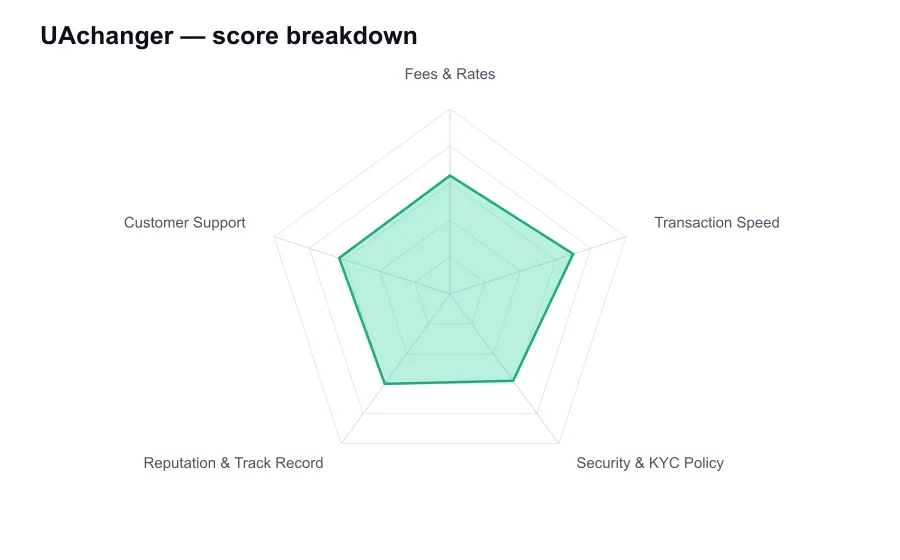
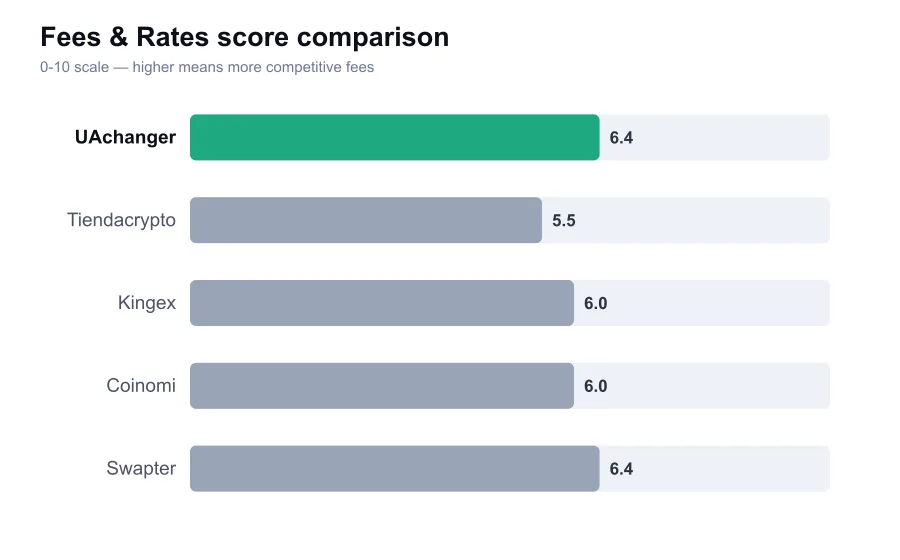
| Fees & Rates | 6.4 | Local-route convenience can justify a moderate spread. |
| Transaction Speed | 7.0 | Strongest on ordinary local payouts after confirmation. |
| Security & KYC Policy | 5.8 | Use small tests and expect compliance review if flagged. |
| Reputation & Track Record | 6.0 | A focused regional proposition, not an institutional brand. |
| Customer Support | 6.3 | Clear local payment guidance is especially valuable here. |
In-Depth Review
UAchanger is positioned squarely in the Ukrainian and regional exchange market, where customers often need to bridge crypto, hryvnia-linked payment options, bank cards, and electronic money. It is a practical service category born from real payment friction. A global exchange can offer deep Bitcoin liquidity and still leave a customer wondering how to turn funds into a useful local payout. UAchanger addresses that final-mile problem rather than trying to be a complete investment platform.
That local orientation is its strongest asset. A specialist operator can understand domestic bank behavior, payment-method naming, and the habits of customers who use regional wallets better than a foreign exchange with a translated support page. It can also be more flexible about exchange directions that are not commercially important to a global platform. People who regularly convert between crypto and Ukrainian payment methods may find that focus genuinely useful.
Price needs to be judged with the same discipline applied to any exchanger. UAchanger is not an order book where the fee is neatly separated from the market price. Its economics are generally expressed through the offered rate, which may include the service margin, network costs, local settlement costs, and a buffer for volatility. The amount that arrives at the destination is the figure that matters. Do not settle for a favorable-looking BTC or USDT price alone.
For popular stablecoin directions, the spread may be reasonable enough to justify the convenience. USDT, especially on lower-cost networks, often fits these services better than volatile assets because it reduces the price risk between payment and payout. Bitcoin transfers can be more awkward during periods of high network fees or slow confirmations. If you are converting a volatile asset, decide whether the rate is fixed or floating before sending, and understand what happens if the market moves.
Local bank card routes can be efficient, but they come with limits that are outside an exchanger's control. A bank may flag an incoming transfer, impose a daily limit, or delay a credit. That does not automatically mean UAchanger failed to pay. Customers should distinguish between the operator marking an order complete and the recipient bank making the funds available. Screenshot the order details and keep the transaction hash or payment reference until the money is settled.
The speed profile is therefore mixed but understandable. Straightforward crypto-to-e-wallet or crypto-to-bank-card orders can be completed promptly once the deposit is confirmed and the destination information is valid. Orders involving manual banking operations, unusual amounts, or compliance questions can take far longer. UAchanger is best used for a payment that has some time buffer. It is not where I would execute a market-sensitive trade just before a deadline.
The difference between an honest delay and a poor service response is communication. A good exchanger will say that it is waiting for confirmations, that a bank transfer is in queue, or that it needs a specific document. It will not leave customers guessing whether anyone has seen the order. Before relying on UAchanger for a larger amount, test the support channel during business and off-hours. A prompt reply with concrete instructions is a useful sign.
Security is not only about whether a site has a padlock icon. The decisive risks are incorrect payment details, phishing, and the irreversible nature of crypto transfers. Type the site address yourself or use a saved bookmark. Do not follow an advertisement or a message claiming a changed wallet address. Confirm the asset network carefully, because sending USDT through the wrong chain can turn an ordinary exchange into a costly recovery request.
The KYC picture should be treated realistically. UAchanger may offer an accessible order process for ordinary customers, but financial crime controls and banking relationships create circumstances in which identification can be requested. Larger amounts, suspicious transaction patterns, wallet-risk flags, and payments from a third party are all common triggers across the industry. Customers who need predictable compliance treatment should choose a fully regulated exchange and complete verification before they are in a hurry.
The company does not have the same public disclosure, audited custody arrangements, or institutional governance profile as a large regulated exchange. That is the central reason to limit exposure. Regional exchangers can operate legitimately for years and still offer little recourse if a complex dispute turns ugly. The rational approach is not panic, it is sizing. Do a small exchange first, then increase only if the route, support, and payout behavior meet your expectations.
UAchanger's reputation should be checked through more than a star score. Search for transaction-specific feedback, especially comments describing delayed orders, refunds, and interactions after a mistake. A service with a few unhappy users is not unusual. A repeated pattern of unexplained recalculations, ignored tickets, or requests to communicate only through unofficial social accounts is much more concerning. The date of feedback matters too, because ownership, liquidity, and payment rails can change.
Customer support carries unusual weight in this market because a local bank detail can be formatted several ways, and users often need confirmation before sending. I like operators that publish clear minimums, reserve information, working hours, and refund rules. Those details prevent arguments. If a rule is not stated, ask before paying, particularly about card ownership, payment comments, and whether a transfer from an exchange account will be accepted.
For a Ukrainian user who already understands crypto basics, UAchanger can be a more natural bridge to local money than a giant offshore exchange. Its niche is not glamorous, but it is useful. The trade-off is that customers give up the broad regulatory comfort, extensive liquidity, and polished support systems available at top-tier platforms. That is acceptable only if the route itself is worth it and the amount is proportionate to the service's risk profile.
My final view is favorable but guarded. UAchanger appears most sensible for routine, modest regional conversions, especially stablecoin payouts where speed and local access matter. It is a poor fit for asset storage, high-frequency trading, or a large transaction that cannot tolerate a compliance pause. Use it deliberately, compare the received amount against alternatives, and retain evidence of every step. That is how a specialist exchanger remains a convenience rather than a vulnerability.
Pros & Cons
| Pros | Cons |
|---|
Is UAchanger suitable for converting USDT to a local card?
That is the type of route regional exchangers commonly serve, but availability, limits, network choice, and the final payout quote should be checked on the order page first.
Why has my bank card not shown the payout yet?
The exchanger may have sent payment while the receiving bank is still processing it. Keep the order number and payment reference, then ask support for the transaction status.
Will UAchanger always avoid KYC?
No. A simple initial order flow does not prevent risk-based checks. Payment mismatches, large amounts, and compliance alerts can lead to an information request.