Editorial independence: our scores and rankings are produced using the fixed criteria above and are not influenced by advertisers. This is an independent ranking site and is not operated by, or affiliated with, any provider we list.
Affiliate disclosure: some links on this page may earn us a commission at no extra cost to you. This does not affect our rankings.
Live market data via CoinGecko, for informational purposes only. Not financial advice.
| Best for | Not for |
|---|---|
| Simple no-account exchange flow | Limited independent reputation data |
Criteria Breakdown
| Criterion | Score | Notes |
|---|---|---|
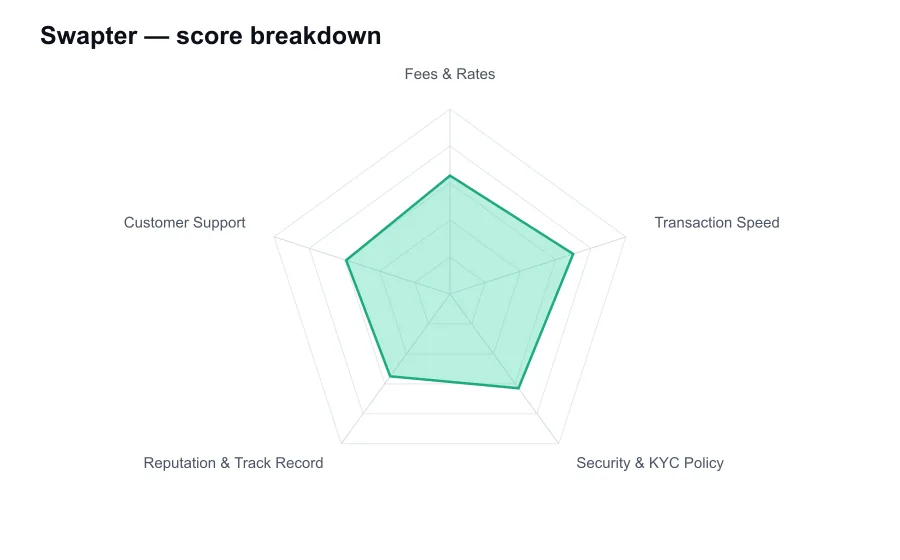
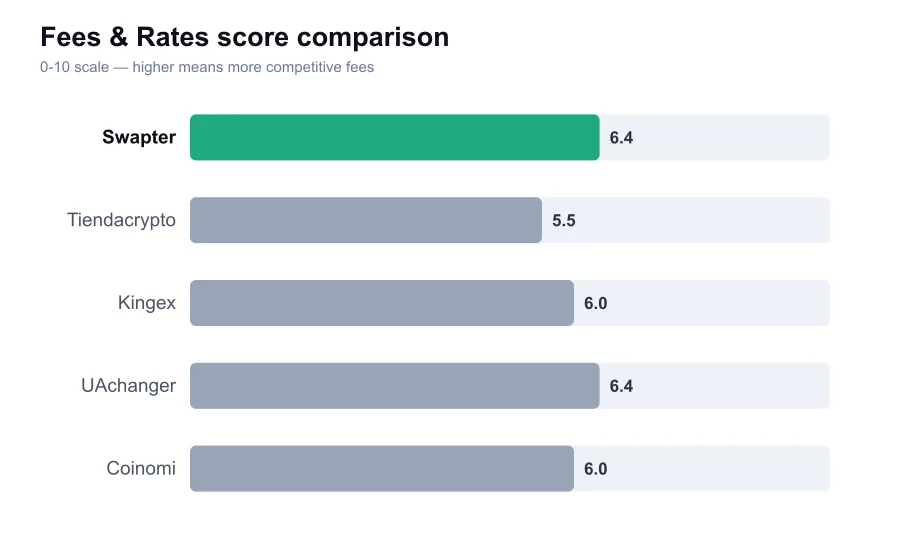
| Fees & Rates | 6.4 | Quote-based pricing can be competitive, but the spread is opaque. |
| Transaction Speed | 7.0 | Routine liquid swaps are quick, network and partner delays still apply. |
| Security & KYC Policy | 6.3 | No-account flow, but possible screening and limited public security detail. |
| Reputation & Track Record | 5.5 | A much thinner independent track record than leading swap services. |
| Customer Support | 5.9 | Online support exists, with limited evidence on hard-case resolution. |
In-Depth Review
Swapter is a smaller instant crypto exchange service that aims to remove the usual clutter from a simple coin conversion. It is not a conventional exchange with charts, custody balances or advanced orders. The pitch is straightforward: choose an asset, supply a receiving address, send the deposit and let the service route the trade. That places Swapter in competition with a long list of swap aggregators, though it has far less public visibility than the category leaders.
The stripped-back approach is appealing if you are already comfortable using your own wallet. There is no need to create a profile merely to turn BTC into ETH or move from one large-cap coin to another. For users who dislike handing personal data to every service in crypto, that frictionless start is Swapter's main attraction. It is also the area where a small platform has to earn trust most carefully.
Swapter's website has historically promoted fast exchanges, no account requirement and a broad selection of currencies. Those are common claims, so they should not be mistaken for proof of deep liquidity. A coin appearing in a selector does not mean the route is as robust as BTC to USDT or ETH to LTC. Before sending anything, check the minimum, maximum, expected receive amount and whether the chain is exactly the one your destination wallet supports.
Pricing is quote-driven. Swapter does not offer the kind of transparent public commission table that would let a customer say, with confidence, that every trade carries a fixed 0.5 percent or 1 percent fee. The cost is embedded in the rate and can include network charges, liquidity-provider pricing and Swapter's own margin. That is normal for instant exchanges, but it is less consumer-friendly than a clearly separated service fee.
The practical result is that Swapter can look inexpensive on one route and mediocre on the next. Small trades exaggerate network fees, especially on Bitcoin and Ethereum, while less liquid altcoin combinations can hide a larger spread. Do not judge it from one attractive quote. Compare the final receive amount against Exolix, SimpleSwap, ChangeNOW or a direct decentralized exchange where one exists. Swapter needs to win that comparison to justify choosing a lesser-known brand.
Floating-rate orders are the default logic of this market. The amount shown before payment is an estimate that can change as prices move and as the deposit waits for confirmations. If Swapter offers a fixed-rate route for a pair, the fixed quote is generally safer for users who need a predictable outcome, even if it is slightly less generous. A buyer who sees a price move after choosing floating has not necessarily been cheated, but they may still have picked the wrong tool.
Speed depends first on the blockchain, then on the liquidity route. A fast-chain deposit and a liquid pair may settle in minutes after the incoming transaction is detected. Bitcoin deposits usually require patience, and Ethereum can become slow or costly during network pressure. A service that claims instant exchange is describing its internal conversion, not abolishing block confirmation rules or the possibility that a partner has to source liquidity.
Swapter is best treated as a convenience venue, not a guaranteed time-critical execution route. If you need to meet a payment deadline or arbitrage a price discrepancy, use a liquid exchange where you control order placement and can see the market. For a personal wallet rebalance, a 15 to 45 minute window may be perfectly acceptable. Those are different jobs and should not be confused.
Its privacy policy deserves a realistic reading. Swapter has promoted no-registration exchanges, which means routine users can often begin without a login and without standard KYC. That does not mean the service is outside AML screening. Like most services that touch external liquidity providers, it can flag a transaction and ask for identity information or extra documentation. The uncomfortable part is that this can happen after the customer has sent the deposit.
That policy is not automatically a red flag. Compliance screening is a fact of the current crypto exchange landscape. The concern is that a smaller, less documented provider gives the user fewer public signals about how reviews are handled, how long they last and what happens if a partner rejects a route. If you need certainty around compliance treatment, a regulated exchange with a clear onboarding process is more honest than relying on a no-KYC slogan.
Swapter's noncustodial structure reduces the danger of leaving a permanent balance on the platform. You provide a destination address and the output is sent there after execution. But it is not trustless. The deposit moves through Swapter's process, and customers remain dependent on the service until the outgoing transaction is broadcast. Use a wallet you control, keep records of the order and never confuse temporary noncustodial routing with the security model of an on-chain atomic swap.
Public reputation is Swapter's biggest limitation. It has a much smaller independent footprint than SimpleSwap or Exolix, and that matters in a business built on sending irreversible funds to a website. A lack of prominent scandals is welcome, but it is not the same as years of large-scale, independently visible customer history. The available feedback is thinner, making it harder to distinguish a genuinely strong operation from a service that simply has not been tested at scale.
That does not make Swapter unusable. It does change how I would use it. A small first transaction is sensible, especially with a new asset or destination network. If the quote is meaningfully better than established alternatives, test the workflow with an amount you can afford to have delayed. If the saving is only a few dollars, the deeper track record of a better-known service is usually worth more.
Customer support appears to rely on online contact channels rather than the mature, heavily staffed support operation of a major exchange. That can be enough for simple questions about a transaction ID or a payout hash. The harder test is a deposit sent on the wrong network, a transaction under review or a partner-side delay. Smaller services often have fewer escalation paths, and public evidence about Swapter's handling of difficult cases is limited.
The interface itself is refreshingly simple. It asks for less from the user than a traditional exchange, and that is a virtue for a straightforward conversion. It can also encourage careless behavior. There is no elaborate trading screen to slow you down before you paste an address. Check the network, minimum amount and final output address twice. An instant exchanger cannot recover coins sent to an incompatible chain simply because the form looked uncomplicated.
Swapter has a place for privacy-conscious wallet users who find a clearly favorable quote and are willing to manage the risk of using a smaller operator. I would not make it my first recommendation for a large transfer, a first-ever crypto purchase or funds that must arrive at a precise time. The service needs a stronger public track record and more transparent pricing disclosure before it can stand comfortably beside the better-known instant exchange brands.
Pros & Cons
| Pros | Cons |
|---|
Does Swapter require registration?
Swapter has promoted an exchange flow without routine account registration. It may still request KYC or transaction information if compliance screening flags the order.
How are Swapter fees charged?
Costs are generally included in the exchange quote rather than shown as one fixed public commission. Compare the final amount you receive with several instant exchange services.
Should I use Swapter for a large swap?
It is safer to test the service first with a small amount. For large transfers, a platform with deeper liquidity, clearer policies and a longer public record is the safer choice.