Editorial independence: our scores and rankings are produced using the fixed criteria above and are not influenced by advertisers. This is an independent ranking site and is not operated by, or affiliated with, any provider we list.
Affiliate disclosure: some links on this page may earn us a commission at no extra cost to you. This does not affect our rankings.
Live market data via CoinGecko, for informational purposes only. Not financial advice.
| Best for | Not for |
|---|---|
| Very broad multi-asset support | Integrated swaps can have weak pricing |
Criteria Breakdown
| Criterion | Score | Notes |
|---|---|---|
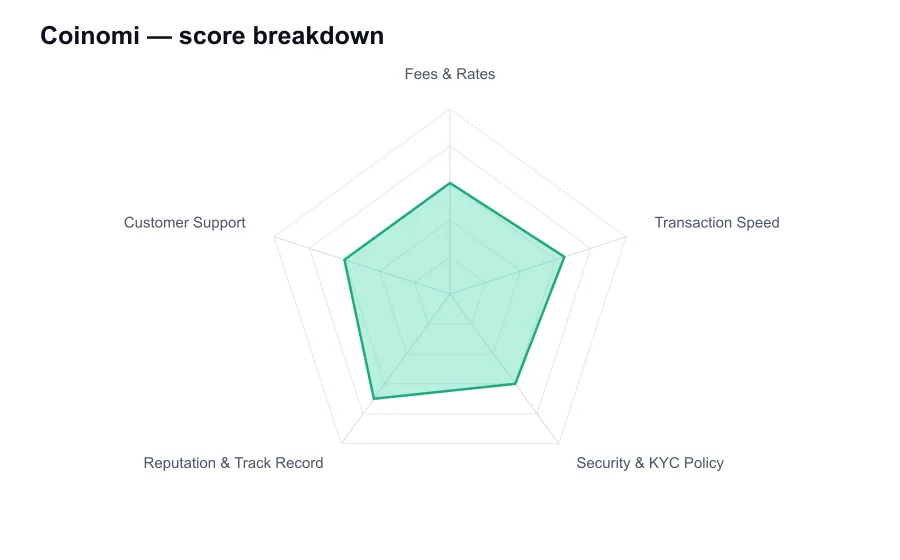
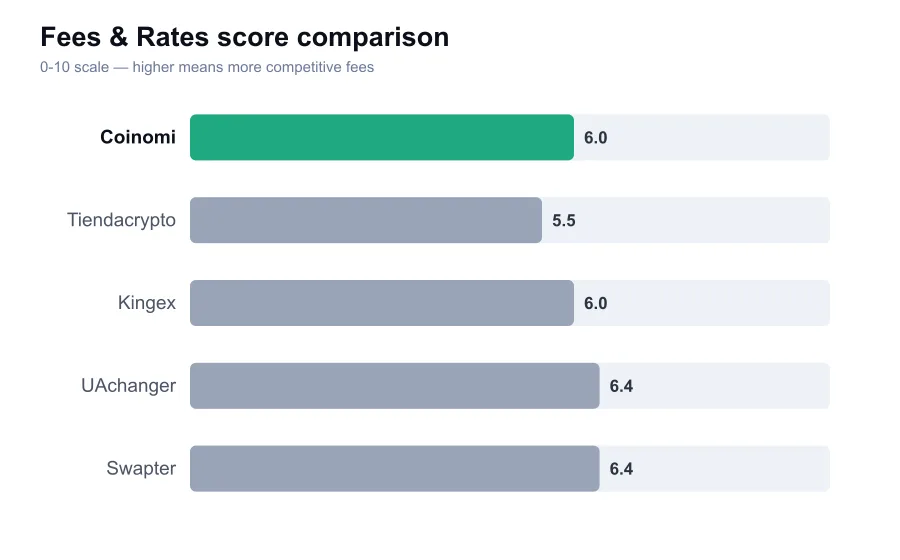
| Fees & Rates | 6.0 | Wallet use is free, but partner swap spreads can be costly |
| Transaction Speed | 6.5 | Network and third-party swap processing determine settlement |
| Security & KYC Policy | 6.0 | Self-custody is strong, but hot-wallet and past concerns remain |
| Reputation & Track Record | 7.0 | Established multi-asset wallet operating since 2014 |
| Customer Support | 6.0 | Help resources are solid, but support is not premium-grade |
In-Depth Review
Coinomi is a non-custodial multi-chain cryptocurrency wallet, not a conventional centralized exchange. It has been around since 2014, which gives it far more history than the typical wallet app that appears during a bull market and disappears afterward. Its main appeal is breadth: one application can manage a wide range of coins, tokens, and network formats without requiring users to maintain separate wallets for every ecosystem.
That distinction matters before discussing fees or speed. Coinomi does not run an order book in the way Coinbase or Kraken does, and it does not hold customers' private keys in the normal setup. The wallet provides access to networks and can integrate third-party exchange or swap services. The quality, cost, compliance rules, and settlement process of those services are not identical to Coinomi's core wallet function.
The wallet supports an unusually large number of assets and chains. For users with an old mix of Bitcoin, Ethereum tokens, Litecoin, Dogecoin, and lesser-known altcoins, Coinomi can be convenient. It has long been one of the wallets people turn to when a newer app supports only a fashionable handful of networks. That broad compatibility is its strongest practical selling point.
Coinomi's wallet itself is generally free to download and use. You pay blockchain network fees when sending assets, and those fees are determined by the relevant network rather than by Coinomi as a custody charge. On Bitcoin, users may be able to choose transaction fee settings according to the wallet's available options. A cheap fee can mean a slow confirmation, while a higher fee can improve priority during congestion.
The built-in exchange experience deserves more scrutiny than the wallet. Coinomi has historically connected users to third-party providers such as Changelly and other exchange partners, depending on jurisdiction and availability. Those providers may quote spreads, service fees, minimums, and network costs that make a swap notably more expensive than trading on a liquid exchange. Always inspect the final quote rather than assuming a wallet-integrated swap is cheap.
Speed also depends on the transaction type. Sending crypto from Coinomi is only as fast as the blockchain being used. A Solana or Litecoin transfer can settle quickly, while Bitcoin may require multiple confirmations and Ethereum transfers can be delayed by gas conditions. A third-party swap can take longer because it may involve deposits, partner processing, liquidity sourcing, and compliance checks.
Coinomi's non-custodial design is attractive because users retain control of their recovery phrase and private keys. In a normal wallet setup, Coinomi cannot freeze your balance, and an exchange insolvency does not put your coins into a creditor queue. That is a meaningful advantage over leaving long-term holdings on a centralized platform. It also makes personal security non-negotiable.
If you lose the recovery phrase, there is no password-reset department that can recreate it. If malware records your phrase, a fake support agent persuades you to reveal it, or you install a counterfeit app, self-custody can turn from freedom into permanent loss. Coinomi offers security tools such as password protection and biometric options on supported devices, but these are layers around the fundamental requirement to protect the seed phrase offline.
Coinomi has faced a public security controversy in its history. In 2019, a researcher alleged that the desktop wallet sent seed phrases to a spell-check API, potentially exposing them. Coinomi disputed key aspects of the claim and stated it addressed the issue. The episode is old, but it should not be erased from an honest assessment. Wallet users should judge security not just by features, but by how seriously a provider handles sensitive-data design and disclosure.
The wallet's longevity is a real reputational positive. Coinomi has operated through several crypto cycles and supports legacy assets many newer competitors overlook. It has not had the brand momentum of MetaMask for Ethereum users or Trust Wallet for mass-market mobile users, but it remains recognizable among multi-asset wallet users. Longevity alone does not prove safety, though it does suggest the product is not a temporary marketing exercise.
Its interface is functional rather than beautiful. Coinomi makes sense once you have used wallets before, but it can feel busy and dated beside polished competitors such as Exodus. That is not necessarily a deal-breaker. Some users would rather have broad coin support than animated charts and simplified navigation. Newcomers, however, may find it too easy to select the wrong network or misunderstand the difference between a wallet balance and an available swap route.
KYC is not normally required just to create and use the wallet. That is one of Coinomi's advantages for basic storage and onchain transfers. Third-party exchange partners can ask for identity verification, impose geographic restrictions, or pause a transaction for compliance review. Users should not assume that launching a swap from a non-custodial wallet guarantees a completely anonymous or instant service.
Customer support is middling. Coinomi has guides, a help center, support contact channels, and a long public knowledge base, which is better than many abandoned wallet projects. But response quality and speed are not comparable with a premium financial service. Users also need to be vigilant about impersonators. Real support will not need your recovery phrase, and any request for it should end the conversation immediately.
For basic storage, Coinomi is more credible than its age and plain design might suggest. It works well as a multi-asset utility wallet, especially for users who hold coins outside the narrow Ethereum and Bitcoin mainstream. I would be more cautious about relying on its in-app swap partners for large conversions. The convenience premium and partner risk can be significant, and a dedicated exchange or DEX route may offer better pricing.
My take is that Coinomi is useful, but it should be used with the restraint appropriate to any hot wallet. Keep a modest working balance, secure the recovery phrase, verify downloads from the official site, and test new routes with a small amount. For substantial long-term holdings, a hardware wallet remains the better answer. Coinomi's breadth is valuable, but broad asset support does not replace cold-storage discipline.
Pros & Cons
| Pros | Cons |
|---|
Does Coinomi require KYC?
Creating and using the Coinomi wallet does not normally require KYC. Third-party exchange providers accessed through the wallet may request verification.
Are Coinomi swaps cheap?
Not always. Third-party swap quotes can include spreads, service fees, and network costs. Compare the final amount received with an exchange or DEX before approving a large swap.
Is Coinomi safe for long-term storage?
Coinomi is a self-custody hot wallet, so safety depends heavily on device security and seed phrase handling. A hardware wallet is generally safer for substantial long-term balances.