Editorial independence: our scores and rankings are produced using the fixed criteria above and are not influenced by advertisers. This is an independent ranking site and is not operated by, or affiliated with, any provider we list.
Affiliate disclosure: some links on this page may earn us a commission at no extra cost to you. This does not affect our rankings.
Live market data via CoinGecko, for informational purposes only. Not financial advice.
| Best for | Not for |
|---|---|
| Useful niche payment directions | Rates are not a simple published percentage |
Criteria Breakdown
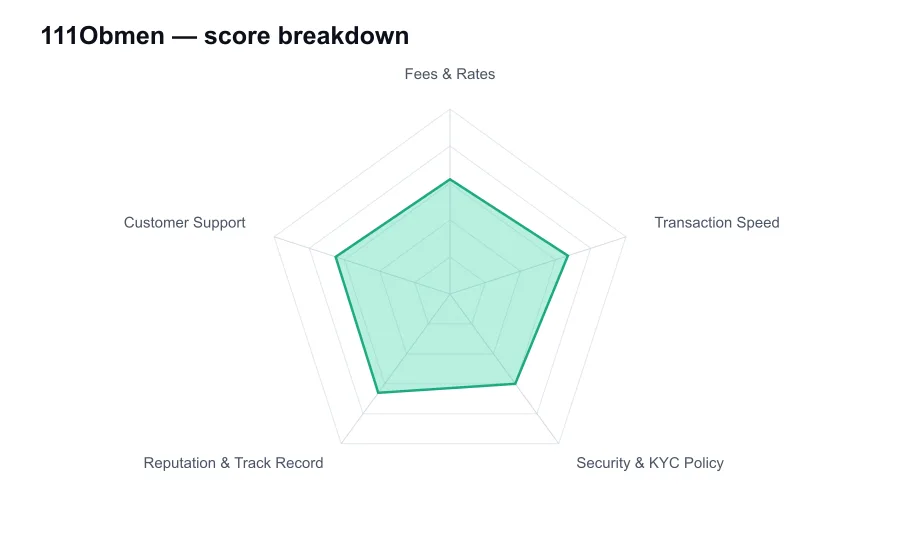
| Criterion | Score | Notes |
|---|---|---|
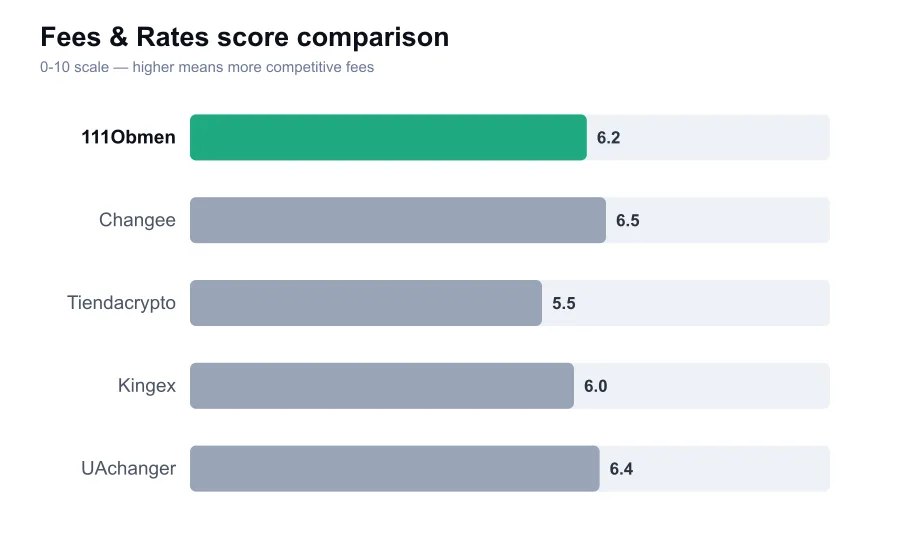
| Fees & Rates | 6.2 | Competitive only after route-by-route comparison |
| Transaction Speed | 6.7 | Timing varies by bank and payment rail |
| Security & KYC Policy | 6.0 | Counterparty and payment-method risks remain |
| Reputation & Track Record | 6.6 | Recognizable exchanger-market presence |
| Customer Support | 6.5 | Important for manual payment exceptions |
In-Depth Review
111Obmen belongs to the exchange-service category that is especially familiar to users moving between cryptocurrency, bank transfers, electronic payment systems, and cash-oriented settlement methods. It is not trying to be Coinbase or Kraken, and judging it as though it were a regulated global trading exchange would miss the point. Its value is practical access to exchange directions that larger platforms often do not serve. That niche can be useful, but it carries a different set of risks and requires more careful verification from the customer.
The first thing to understand about 111Obmen is that its exchange rate is the product. There is rarely a neat percentage fee line that can be separated from the transaction. The rate includes the service's margin, market conditions, payment-processor costs, liquidity risk, and sometimes the cost of handling a particular banking method. Users who see an attractive rate should check the amount they will actually receive, including any banking or network fee that appears after the order is created. A headline rate by itself is not enough.
This rate model can work well for a person who needs a payment direction unavailable on a mainstream exchange. If someone must convert a supported cryptocurrency into a regional bank method or electronic payment system, convenience may matter more than shaving a few tenths of a percent from execution. But it is not a bargain hunter's dream by default. Rates on smaller exchange services can move quickly and vary dramatically by reserve level, payment method, and order size. Comparing several reputable listings is part of the job.
Reserve information deserves attention too. Exchange offices often display available reserves for each direction, but users should treat that as a guide rather than a legally binding guarantee of instant settlement. A large order may require confirmation, manual processing, or a split payment. If you are converting a meaningful sum, ask support before funding the order whether the amount can be completed at the displayed rate and within the stated time. That is far better than sending first and discovering the desk needs additional liquidity.
Transaction speed at 111Obmen is not one number because each payment rail behaves differently. A crypto transfer may be visible quickly but still require multiple confirmations. A bank card or electronic wallet payout can be immediate in the best case, then delayed by the bank's anti-fraud controls in the worst case. Manual operating hours, if applicable to a payment direction, can also matter. The service may process the crypto side promptly while the receiving bank takes its own time to credit funds.
For ordinary, correctly formatted orders, an exchange office can feel surprisingly fast. The process is often more direct than funding a large exchange, waiting for a trade, and arranging a withdrawal. The weakness appears with exceptions. A payment sent from a third party, a bank transfer without the required reference, an amount that differs from the invoice, or a transaction flagged for review can turn a quick exchange into a support case. Users should follow the payment instructions literally, particularly on fiat and electronic-payment directions.
111Obmen's security assessment has to begin with its business model. It is a transaction intermediary and users need to send funds to it before receiving the countervalue. That is more direct counterparty exposure than self-custody swapping through a decentralized protocol. A legitimate operating service can still be safe enough for routine use, but customers should never confuse an exchanger's website security with protection against business or settlement risk. A strong password on your email account and careful address verification are equally important.
Identity checks are another practical reality. Some exchange-office customers expect total anonymity because the site may allow an order without a permanent user account. That expectation is risky. Payment providers, banks, anti-money-laundering rules, and transaction-monitoring systems can all create a need for verification. 111Obmen may request documents or additional information where its rules require it. Do not use funds that you cannot document, and do not send a payment from someone else's account if the rules call for the sender's name to match the order.
The service has a more recognizable footprint than a brand-new anonymous swap page, particularly among users of exchanger-monitoring ecosystems. That is a positive, but it should not be exaggerated into a blanket endorsement. Listings, reviews, and years in operation are useful signals, yet they do not replace independent due diligence. Review dates matter. So do the details of complaints. A complaint about a banking delay is different from a complaint about a missing payout, and a provider's response can be more revealing than the rating average.
Reputation in this segment is built transaction by transaction. I look for clear rules, consistent contact details, a visible reserve policy, and support that can answer a specific question before money is sent. 111Obmen's strongest argument is that it serves practical exchange directions in a market where users want options beyond major global exchanges. Its weakest point is the unavoidable opacity around an exchanger's internal banking and liquidity arrangements. Customers are not buying an audited financial institution. They are buying a service execution promise.
Support is therefore central, not an accessory. A useful team should be able to confirm available reserve, explain a payout schedule, identify the correct network, and track an order using its number. The quality of support matters most during a failed or delayed payment, when generic advice is not enough. Before placing a large order, test how easy it is to contact the service. A pre-sale question about reserve or timing is a reasonable way to judge whether communication is likely to be practical later.
111Obmen is better suited to carefully planned conversions than impulsive market trading. It can fill a genuine gap for users who need a specific fiat, card, bank, or payment-system direction. But that same flexibility introduces more moving parts than a simple Bitcoin purchase on a major exchange. Keep documentation, use your own payment account, and save proof of payment. The more complex the route, the less wise it is to treat the exchange as an anonymous vending machine.
I would also avoid splitting attention across multiple browser tabs and changing order details midway through the process. Generate the order, verify the exact receiving details, pay the exact requested amount, and wait for the stated confirmation path. If a rate has a limited validity period, respect it. Users can create needless disputes by sending after an invoice has expired and expecting the original terms to apply. Exchange-office systems are less forgiving of mismatched amounts than people assume.
My take is that 111Obmen can be a useful specialist service, especially where mainstream exchanges do not offer the desired settlement method. Its reputation is better understood through its practical niche than through the standards of a global regulated exchange. The pricing can be reasonable, but only after comparison. Its convenience should not lead customers to relax their due diligence. Use it for a well-defined exchange direction, keep orders manageable, and expect compliance rules to apply if the transaction attracts scrutiny.
Pros & Cons
| Pros | Cons |
|---|
Are 111Obmen fees shown separately?
The effective cost is typically reflected in the exchange rate and may also be affected by network or payment-system charges. Check the final receive amount and compare several services.
Why might a 111Obmen payout be delayed?
Crypto confirmations, bank processing, payment-provider checks, reserve availability, incorrect payment details, or a mismatched transfer amount can all delay an order.
Can 111Obmen ask for identity documents?
Yes. An order without a permanent account does not rule out verification. Compliance, banking, or risk checks may require information for a particular transaction.