Editorial independence: our scores and rankings are produced using the fixed criteria above and are not influenced by advertisers. This is an independent ranking site and is not operated by, or affiliated with, any provider we list.
Affiliate disclosure: some links on this page may earn us a commission at no extra cost to you. This does not affect our rankings.
Live market data via CoinGecko, for informational purposes only. Not financial advice.
| Best for | Not for |
|---|---|
| No standing exchange balance required | Spread costs are quote-dependent |
Criteria Breakdown
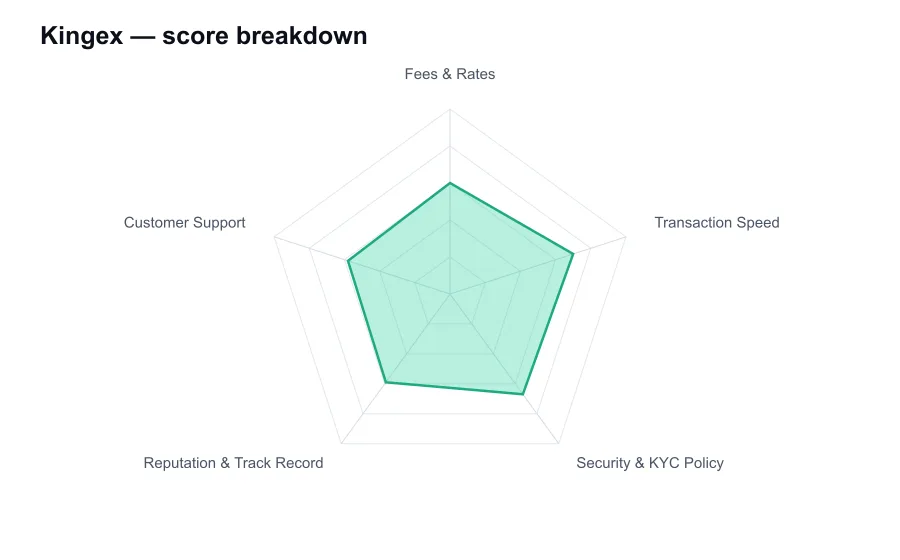
| Criterion | Score | Notes |
|---|---|---|
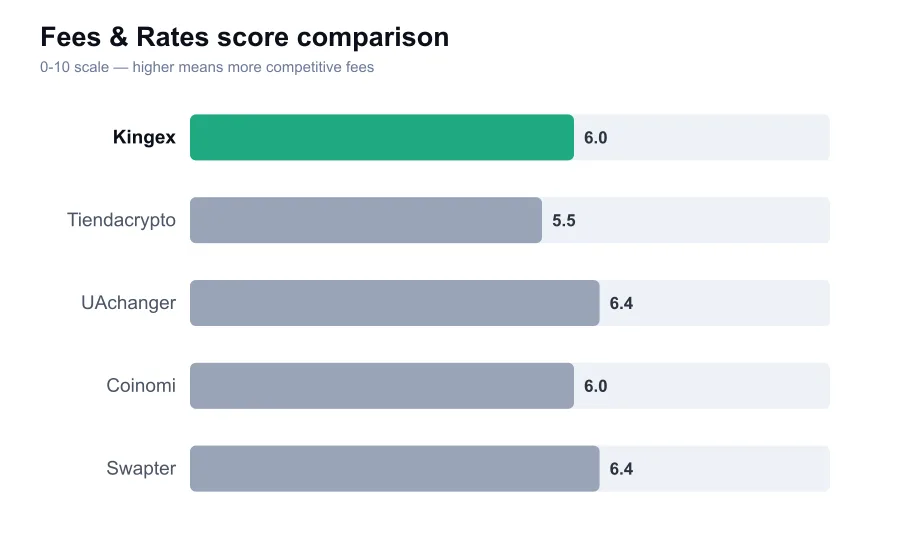
| Fees & Rates | 6.0 | Live quotes are convenient, but spreads need comparison. |
| Transaction Speed | 7.0 | Common swaps can be quick after network confirmations. |
| Security & KYC Policy | 6.7 | Non-custodial flow, with possible transaction risk reviews. |
| Reputation & Track Record | 5.9 | Smaller public footprint than leading swap brands. |
| Customer Support | 5.8 | Useful for status issues, limited escalation confidence. |
In-Depth Review
Kingex is a smaller instant crypto exchange service aimed at people who want to swap one asset for another without opening a full trading account. Its pitch is familiar: choose a pair, enter a destination wallet, send funds and receive the converted asset. That puts it closer to ChangeNOW, SimpleSwap and other non-custodial swap interfaces than to Coinbase or Kraken.
The attraction is obvious. There is no order book to learn, no portfolio dashboard demanding attention and usually no need to leave coins sitting on a platform after the exchange is complete. Kingex is built for a practical job, converting crypto quickly. For someone who already holds coins in a personal wallet and wants to change an asset once, that can be a cleaner experience than transferring funds into a large exchange.
The important caveat is that an instant exchange is not necessarily a cheap exchange. Kingex's pricing is quote-based. The rate shown includes the economics of liquidity sourcing, market movement and the service's margin. A user sees the amount expected at the end, which is useful, but cannot assume it matches the mid-market price on a major order book. The real comparison is the number of coins delivered after all network costs.
Kingex generally offers fixed-rate and floating-rate exchange choices for supported pairs. A fixed quote can be helpful in a volatile market because it reduces the chance that a price swing changes the final amount while your transaction confirms. It can also carry a wider spread. Floating rates may look more attractive at the start, but the final amount can shift if the market moves or the incoming payment arrives late. Neither option is automatically better.
For small convenience swaps, the cost can be fair enough. For a large Bitcoin-to-stablecoin conversion, it is much harder to justify paying an opaque spread when a liquid exchange can execute the trade more cheaply. Kingex does not publish the kind of granular volume pricing that professional users expect. That is not unusual in this category, but it means price-conscious users must obtain a live quote and compare it against at least one competitor.
Speed depends on more than Kingex's own systems. After the service detects a deposit, it has to wait for sufficient network confirmation, source the outgoing asset and broadcast it to your destination. Fast chains and liquid pairs can settle in minutes. Bitcoin deposits, congested networks, unusual tokens and manual risk checks can take much longer. Any site promising instant exchange is describing the interface, not abolishing blockchain settlement.
Kingex is most reliable for common pairs and sensible transaction sizes. Sending an obscure asset, using the wrong network or entering a token contract that the service does not support can create a difficult recovery case. Check the deposit address, memo or destination tag, network selection and minimum amount before sending. Instant swap services have very little room to rescue a transaction that was sent incorrectly.
Its KYC approach is a major part of the appeal, but users should understand the limits of that claim. Kingex can allow many swaps without a conventional account registration process. That does not mean every transaction is beyond compliance review. Like other exchange services that source liquidity and screen transactions, it may request identification or further information where automated risk controls flag an operation.
That conditional model is less intrusive than opening a full centralized exchange account, yet it can be painful if a transaction is paused. A user who needs guaranteed no-document processing should not rely on any service that reserves a compliance review right. The sensible practice is to read the terms, avoid sending funds from questionable sources and never use a swap service for a payment that has a hard deadline.
Kingex's non-custodial structure is a real positive. It does not ask users to maintain a standing balance in a hosted account, so the usual risk of leaving a large portfolio on an exchange is reduced. But the word non-custodial should not be romanticized. Funds are still sent to the service during the exchange process, and users depend on its liquidity partners, wallet operations and support if the transaction goes wrong.
Its public footprint is modest compared with the household names in this market. That is not proof of poor conduct, but it does reduce the amount of independent evidence available to a reviewer. I would give more credit to a smaller service that has a clear legal identity, transparent terms and years of visible operating history than to one that merely has polished branding. Kingex clears the basic legitimacy test better than an anonymous Telegram exchanger, but it has not earned the institutional trust of Kraken or Bitstamp.
Support is available through the website and commonly through live chat or ticket-style contact. For a simple status query, this is usually enough. The real issue is escalation. Smaller instant exchanges rarely have the deep compliance, recovery and phone support infrastructure of a major platform. If your swap is delayed because of an AML hold or an unusual network event, patience may be required.
Kingex works best as a tool, not a home for your crypto. Use a fresh personal wallet, start with a small test transaction and preserve the transaction ID and original quote. Don't send your entire balance because the homepage says the swap will be quick. That is sound practice with every instant exchanger, but it matters more when the provider has a smaller public reputation.
My view is that Kingex is a reasonable option for ordinary wallet-to-wallet conversions, especially when its live quote is competitive and a full exchange account would be overkill. Its convenience is genuine. Its weak point is the usual instant-exchange combination of opaque spread pricing and limited recourse if compliance or network issues interrupt the flow. It deserves a place in a comparison tab, not blind loyalty.
Pros & Cons
| Pros | Cons |
|---|
Does Kingex require registration?
Many exchanges can be started without creating a traditional account. However, Kingex may request KYC information if its automated risk and compliance controls flag a transaction.
How long does a Kingex swap take?
Timing depends on the asset, blockchain confirmations, liquidity and the selected rate type. Common fast-chain swaps may complete quickly, while Bitcoin deposits or reviews can take considerably longer.
Are Kingex rates fixed?
Kingex offers rate options for supported pairs. A fixed rate gives greater certainty at the quoted terms, while a floating rate can change with market conditions before completion.