Editorial independence: our scores and rankings are produced using the fixed criteria above and are not influenced by advertisers. This is an independent ranking site and is not operated by, or affiliated with, any provider we list.
Affiliate disclosure: some links on this page may earn us a commission at no extra cost to you. This does not affect our rankings.
Live market data via CoinGecko, for informational purposes only. Not financial advice.
| Best for | Not for |
|---|---|
| Simple alternative to a full trading exchange | Pricing may trail liquid exchange markets |
Criteria Breakdown
| Criterion | Score | Notes |
|---|---|---|
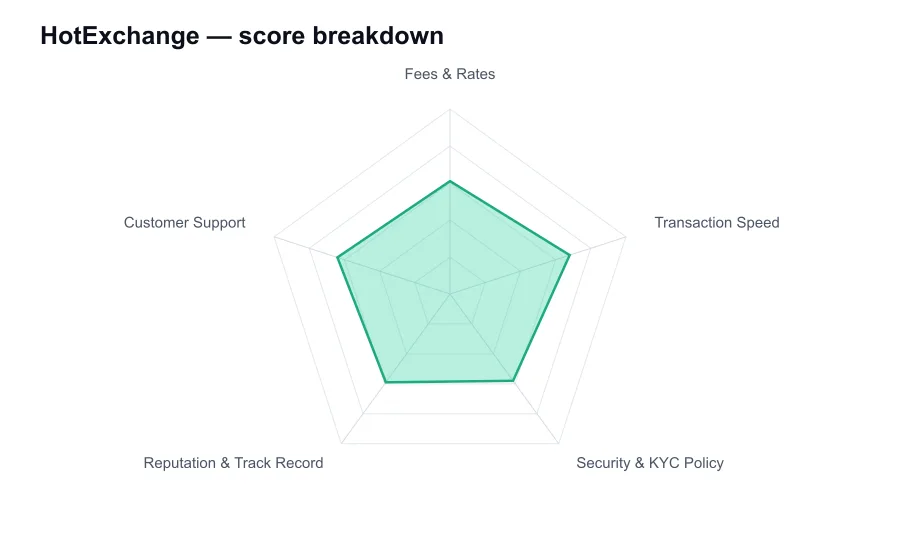
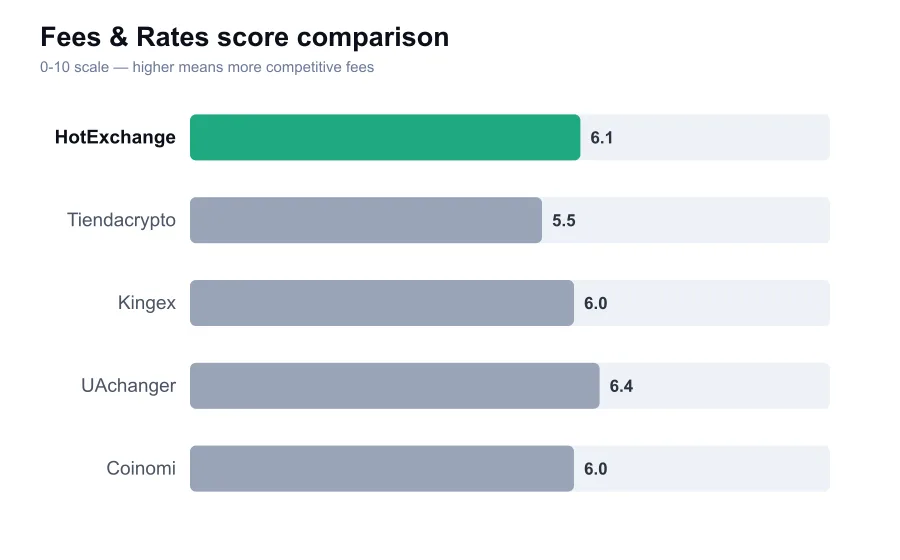
| Fees & Rates | 6.1 | Convenience is priced into a quote-based spread. |
| Transaction Speed | 6.8 | Fast for standard orders, exceptions depend on manual handling. |
| Security & KYC Policy | 5.8 | No standing balance needed, but counterparty risk remains. |
| Reputation & Track Record | 5.9 | Limited public transparency versus major exchange brands. |
| Customer Support | 6.4 | Support quality is critical for delayed or mismatched orders. |
In-Depth Review
HotExchange belongs to the independent online exchanger category, where the service is judged by execution rather than by a complex product ecosystem. It is designed for converting one asset or payment method into another, often without forcing the customer through a conventional exchange account and trading interface. That makes it approachable for a user who just wants to swap or cash out. It also means HotExchange should be assessed as a payment intermediary with counterparty risk, not as a high-liquidity global marketplace.
The main attraction is convenience. A traditional exchange asks customers to deposit funds, navigate markets, trade, withdraw, and sometimes wait through layered verification. HotExchange reduces that process to a direction and an order. For a customer with a clear destination, that can be a better experience. The trade-off is pricing. The service is not matching your order against a public order book. It is giving you a quote that includes its own operational margin and the risks involved in settling the two sides.
That quote can be fair, but it should never be accepted without comparison. I would open at least two other exchange calculators and compare the exact received amount for the same network, amount, and payout method. HotExchange is most likely to justify a higher spread on a hard-to-find route, a smaller regional payment method, or an order where convenience matters. For liquid assets such as BTC, ETH, or USDT exchanged into another major crypto asset, the premium can be harder to justify against large venues or well-known instant-swap services.
A fixed quote, if one is offered on a particular order, is valuable only if the conditions are clearly stated. Crypto prices can move between order creation and payment confirmation. Customers should know whether the rate is recalculated after funds arrive, whether an underpayment is accepted, and what happens if the transaction lands after the payment window expires. Those details matter more than a colorful rate widget. A service earns confidence by making them understandable before the customer commits funds.
HotExchange's likely performance advantage is that standard orders do not require a public exchange account or manual trading. On a fast blockchain and a well-supplied route, that can mean a smooth experience. The likely weakness is the same as with any operator-led exchanger: exceptions are slower. An address mismatch, a bank check, a slow blockchain confirmation, or a payment that does not match the order precisely may need a person to intervene. Users who need deterministic settlement should not confuse a typical processing time with a service-level guarantee.
Bitcoin transactions deserve special caution. During high-fee periods, the network can take much longer to confirm than an exchange page makes emotionally comfortable. Stablecoin users should also check the exact chain before sending. A cheap TRC20 or other low-cost network can be fast, while ERC20 may carry materially higher network costs. HotExchange cannot rescue a customer who sends an asset over an unsupported chain without a potentially difficult recovery process. The safest habit is to copy the deposit details only from the active order page and verify the first and last characters.
Security is adequate only if both sides act carefully. The provider may use HTTPS, order tracking, and internal controls, but customers still face the central fact that they send assets before receiving the payout. That is the normal exchanger model. It requires trust in the operator's ability and willingness to complete the order. Do not treat an independent exchange page like self-custody. Keep no standing balance there, use a unique password where an account is required, and do not reveal recovery phrases to anybody claiming to represent support.
KYC expectations should also be grounded. A friction-light interface does not remove anti-money-laundering obligations or fraud controls. HotExchange may process many standard transactions without an elaborate onboarding sequence, while still reserving the right to request identity documents or evidence of payment ownership in higher-risk cases. This is especially relevant for card-related payments, unusually large transactions, and funds flagged by blockchain analytics. If your transaction cannot survive a delay for verification, use a provider whose compliance procedure you can assess beforehand.
I would score HotExchange below the best-known global alternatives on transparency simply because smaller exchangers usually disclose less about ownership, reserves, jurisdiction, security testing, and complaint handling. That is not a claim that the service is dishonest. It is a distinction between operating reliably and demonstrating reliability at institutional standard. Kraken can point customers to a broad compliance and security structure. HotExchange asks users to rely more heavily on its transaction history, monitor listings, and direct support response.
Reputation research needs to be current. Search for recent, detailed feedback and distinguish complaints about a quoted rate from complaints that an order was never settled. Read the provider's response where one exists. A good sign is a specific explanation tied to an order process. A bad sign is a recurring pattern of users reporting that they cannot get a clear answer once a transaction deviates from the normal path. Old review totals are less meaningful than how the service handles the last few difficult cases.
Support is therefore not a peripheral feature at HotExchange. It is part of the product. The company should be able to identify an order from its number and transaction hash, explain the current stage, and tell the customer what document or correction is needed. Customers should arrive prepared. Keep the payment receipt, wallet transaction link, and any correspondence. It is easier to resolve a genuine mistake with evidence than with a vague claim that money was sent somewhere.
The interface generally suits users who value simplicity, though simplicity can hide important conditions. Before payment, I would want to see the minimum and maximum limits, current reserve, expected payout, required confirmations, network choice, and the cancellation policy. If any of those is unclear, stop and ask. This is not excessive caution. Irreversible crypto payments punish assumptions, and the majority of avoidable disputes begin with a customer treating a payment instruction as a suggestion.
HotExchange is most defensible as a transactional tool for someone who has done this before. It may be convenient for a defined conversion and can avoid the overhead of a full exchange account. It is not a venue for leveraged speculation, sophisticated order execution, long-term custody, or giant transfers. There are stronger choices for each of those jobs. Trying to make one small exchanger cover all of them is how users end up disappointed.
My final view is moderately positive but disciplined. HotExchange can offer a straightforward path from one value system to another, and that is more useful than it sounds when a payment route is awkward. I would use it only after verifying the live quote, the payment details, and the service's current feedback. The lack of major-platform disclosure and the possibility of review delays mean it should be approached with a test-first mindset. For routine modest conversions, that is a reasonable bargain. For a high-stakes transfer, it is not the risk profile I would choose.
Pros & Cons
| Pros | Cons |
|---|
Is HotExchange an exchange for active traders?
It is better understood as an order-based conversion service. Users looking for charts, limit orders, deep liquidity, or derivatives should use a trading exchange.
What should I check before paying a HotExchange order?
Confirm the final receive amount, asset and network, recipient details, order expiry, minimum and maximum limits, and the stated processing conditions.
Can an order be delayed after crypto is sent?
Yes. Confirmation time, payment-route checks, mismatched amounts, reserve issues, and compliance review can delay settlement beyond a normal estimate.