Editorial independence: our scores and rankings are produced using the fixed criteria above and are not influenced by advertisers. This is an independent ranking site and is not operated by, or affiliated with, any provider we list.
Affiliate disclosure: some links on this page may earn us a commission at no extra cost to you. This does not affect our rankings.
Live market data via CoinGecko, for informational purposes only. Not financial advice.
| Best for | Not for |
|---|---|
| Straightforward asset-to-asset conversion | Pricing is mainly embedded in the quote |
Criteria Breakdown
| Criterion | Score | Notes |
|---|---|---|
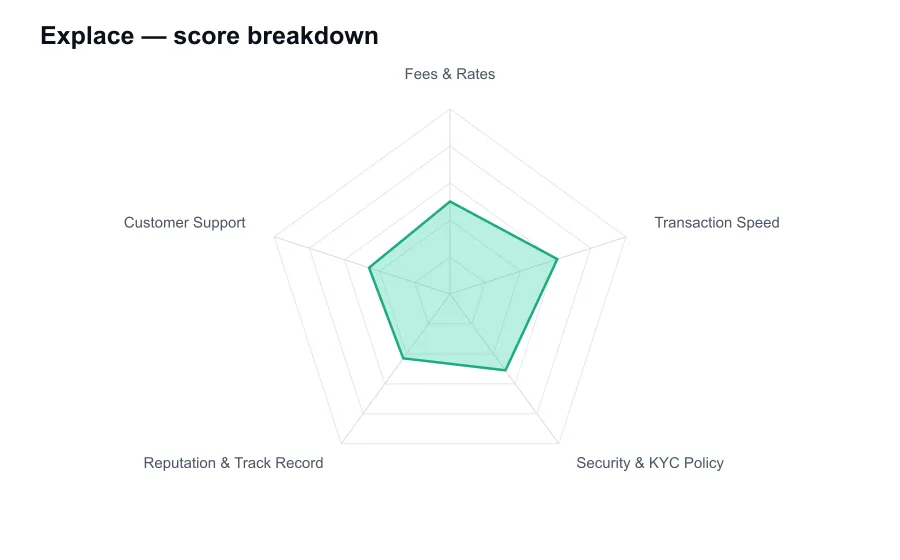
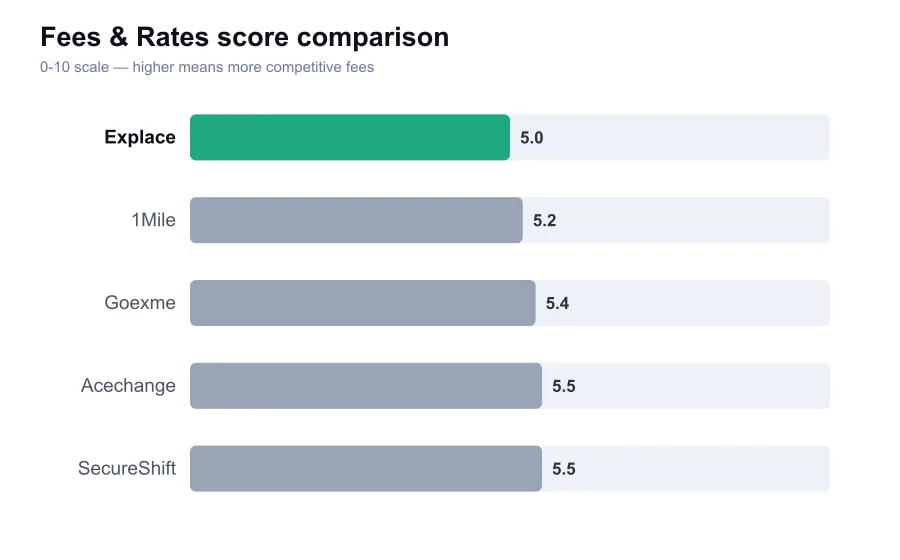
| Fees & Rates | 5.0 | Quote-based pricing requires live comparison shopping |
| Transaction Speed | 6.1 | Quick on fast chains, dependent on confirmations and liquidity |
| Security & KYC Policy | 5.1 | Short custody exposure, possible AML review |
| Reputation & Track Record | 4.3 | Small public footprint and limited long-term evidence |
| Customer Support | 4.6 | Adequate contact route, limited proof of escalation depth |
In-Depth Review
Explace is a compact crypto exchange service built around direct conversions rather than a full-scale trading terminal. It belongs to the fast-swap end of the market, where the promise is simple: select two assets, send one and receive the other without spending an afternoon setting up an exchange account. That approach is useful, but Explace remains much less established than the large names users will already recognize.
The service makes most sense for someone who already owns crypto and wants a practical route between chains or assets. It is not designed to compete with a professional exchange on charting, order types, advanced liquidity or fiat banking. Think of it as an execution layer for a one-off conversion. That distinction matters because the standards for judging it are different. Ease and settlement reliability matter more than candle charts, but price still matters a great deal.
Explace's fee presentation follows the common instant-exchange model. There is not a simple public maker and taker schedule in the style of an order-book venue. Instead, the cost is embedded in the conversion quote, the exchange rate supplied by liquidity sources and the blockchain network fee. This can be perfectly legitimate, but users should resist the temptation to call a swap cheap merely because the site does not show a large explicit commission.
The only figure that really matters is the amount that reaches your wallet. Check it against a second provider at the same moment, particularly for BTC, ETH, SOL and stablecoin swaps where competitive services are plentiful. In my view, Explace is most defensible when its rate is within a small margin of a larger alternative and its route is more convenient. If the quoted payout is materially lower, the simplicity is not enough to justify it.
The platform's speed claims should also be treated in practical terms. A transaction starts only after the incoming deposit is detected and confirmed. Fast networks such as Tron, Solana and Litecoin can make the experience feel close to immediate. Bitcoin, Ethereum and any token relying on a busy chain are another story. A standard swap can settle in minutes, but 20 to 60 minutes is not unusual, and occasional delays are part of the model.
There is a second layer of delay that users often overlook. Explace may need to source the outgoing asset or process the swap through a liquidity partner. During volatile periods, the quoted rate can change on floating-rate orders or the service may take longer to complete the trade. A fixed-rate order offers more certainty, but it may include a wider spread because the provider is accepting price risk. That trade-off is normal, not a defect.
Security is better understood as a mix of transaction design and company trust. Explace does not ask customers to keep a permanent wallet balance on a traditional exchange, which reduces long-term custodial exposure. Still, it takes possession of the deposited coins during execution. The fact that you do not create an account does not turn the process into a trustless on-chain swap. You are trusting a service to process and pay out correctly.
KYC is another area where marketing language needs careful reading. A no-registration experience can reduce friction, but it does not guarantee that an order will never be screened. Transactions can be flagged for AML review based on wallet risk, size, chain analytics or a compliance partner's rules. That is the reality across the instant-exchange sector. Anyone unable or unwilling to provide documents if requested should not send funds under the assumption that a review can never happen.
I would like to see more public detail from Explace about its operating entity, its compliance process and the handling of delayed or disputed swaps. Smaller exchange services often publish the essentials in terms pages, but important operational detail can remain vague until a customer has a problem. That is not a comfortable position for a user with several thousand dollars in transit. Clear procedures are part of security, not merely legal fine print.
Explace has a modest reputation footprint. There is no obvious equivalent of a decade-long exchange record, regular third-party audits or the volume of public reporting attached to top-tier platforms. That does not automatically disqualify it. New and small services can execute competently. It does mean that a polished interface should not be mistaken for the accumulated credibility of a platform that has survived multiple market cycles and public stress events.
Support is likely to matter most on exceptions, not normal swaps. If every address, memo and network selection is correct, the process should largely run by itself. If the deposit arrives late, a tag is missing or an order enters review, the quality of the human response becomes decisive. Explace's support channels may be sufficient for basic questions, but the public evidence of sophisticated escalation handling is limited compared with large exchanges that maintain dedicated support infrastructure.
For a first transaction, I would make a deliberately small test. Send an amount large enough to verify the full route but small enough that a delay is irritating rather than catastrophic. Confirm the destination address from the receiving wallet, check token contract and network, and save the order data. Crypto swaps are unforgiving of a wrong network choice, and support cannot always reverse an on-chain mistake.
Explace is more appealing to an experienced user who values a light workflow than to a newcomer buying their first crypto. Beginners need fee explanations, account recovery options and a support setup they can lean on. Active traders need transparent order books and lower marginal trading costs. Explace occupies the narrower middle ground of occasional wallet users who know exactly what they are doing.
My judgment is that Explace is workable, but it has not built enough visible institutional confidence to become a default recommendation. Use it selectively, compare its quote and do not make its apparent simplicity the reason for skipping basic due diligence. It can save time on a small swap. It should not be where you put blind trust or send money you cannot afford to have delayed.
Pros & Cons
| Pros | Cons |
|---|
Does Explace have a trading order book?
Explace is geared toward direct conversions, not advanced spot trading with limit orders and visible market depth. Users receive a swap quote rather than trade through a conventional order book.
Can an Explace order be delayed?
Yes. Blockchain confirmations, network congestion, liquidity sourcing and compliance checks can all delay a payout. Keep the order ID and transaction hash if you need support.
Is no registration the same as no KYC?
No. A service can allow a swap without account creation while retaining the right to request identity verification on transactions that trigger AML or risk controls.