Editorial independence: our scores and rankings are produced using the fixed criteria above and are not influenced by advertisers. This is an independent ranking site and is not operated by, or affiliated with, any provider we list.
Affiliate disclosure: some links on this page may earn us a commission at no extra cost to you. This does not affect our rankings.
Live market data via CoinGecko, for informational purposes only. Not financial advice.
| Best for | Not for |
|---|---|
| Simple wallet-to-wallet conversion flow | Limited public track record and transparency |
Criteria Breakdown
| Criterion | Score | Notes |
|---|---|---|
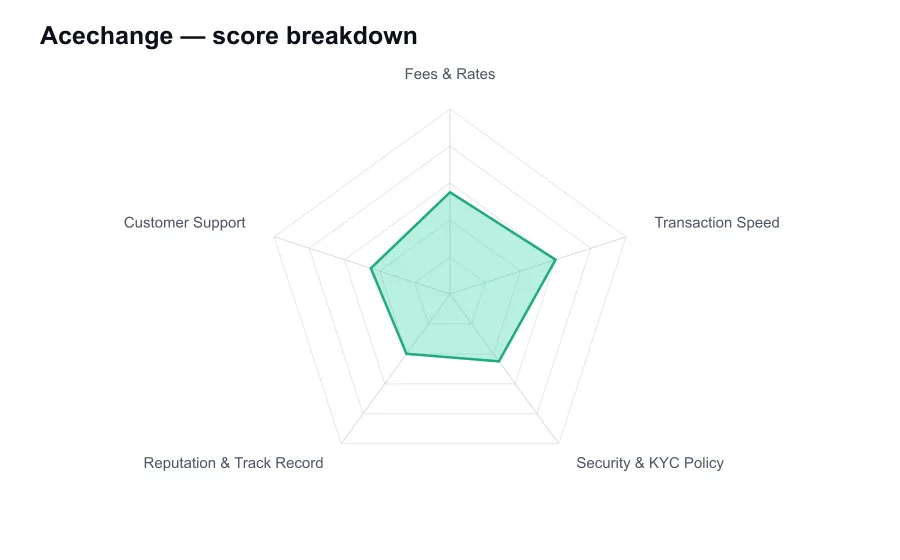
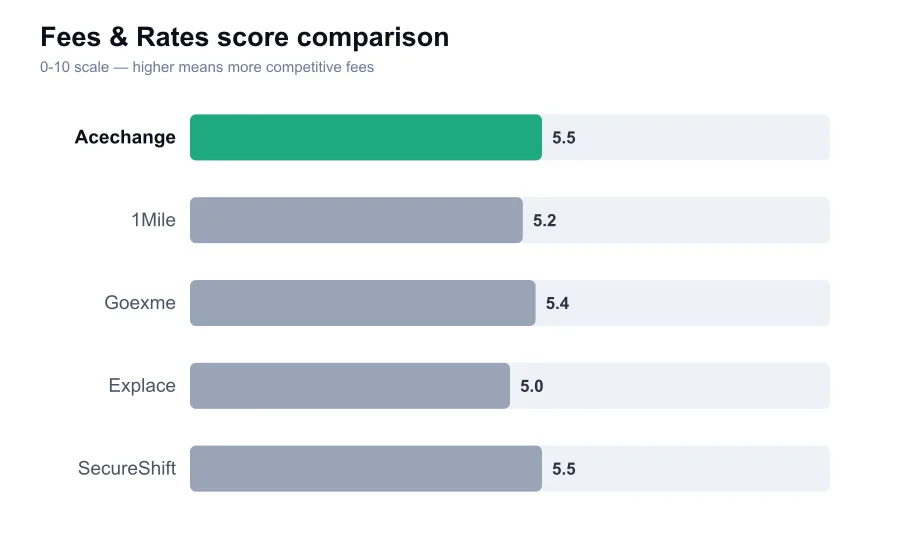
| Fees & Rates | 5.5 | Final quotes need comparison because spread disclosure is limited |
| Transaction Speed | 6.0 | Fast on simple routes, but chain confirmations still govern timing |
| Security & KYC Policy | 4.5 | Account-light swaps, but limited public security transparency |
| Reputation & Track Record | 4.0 | A much thinner public record than established exchange brands |
| Customer Support | 4.5 | Test support before trusting it with a meaningful transfer |
In-Depth Review
Acechange is a relatively obscure instant crypto exchange service aimed at people who want to swap one asset for another without opening a full trading account. It sits in the same broad category as ChangeNOW, SimpleSwap, StealthEX, and dozens of smaller conversion desks. That market is convenient but unforgiving. A polished widget means very little if liquidity, quote accuracy, and support are weak, and Acechange has not built enough public history to earn automatic trust.
The first thing to understand is that Acechange is not the sort of venue where you place limit orders, inspect a deep order book, or trade derivatives. You select a pair, send funds to an address, and receive the chosen asset at a destination wallet. For a simple wallet-to-wallet conversion, that can be appealing. The trade-off is that you are relying on a service layer between you and the liquidity source, with far less transparency than a major centralized exchange.
Its pricing is difficult to judge with the confidence possible at Binance, Kraken, or Coinbase. Instant exchanges commonly build their compensation into the quoted rate rather than presenting a clean maker and taker fee schedule. Acechange's quote should therefore be treated as the actual price, not merely a rate plus a small visible fee. Compare the final received amount against at least two alternatives before sending, particularly on popular pairs such as BTC to USDT, ETH to BTC, or SOL to USDC.
That lack of a plainly published, universal percentage fee is a real weakness. It does not prove the service is expensive, but it puts the burden on the user to price-shop. A service that says it charges no fee can still deliver a worse exchange rate through spread. On a small swap the difference may be negligible. On a four-figure conversion, a one percent gap against a competitor is no longer a rounding error.
Network fees are another area where users should read the screen closely. Bitcoin and Ethereum transactions can become costly or slow because of the underlying chain, regardless of what Acechange does. If the provider sends an ERC-20 token during a congested period, the network fee embedded in the output can materially affect the quote. Stablecoin users are often better served by comparing TRON, Solana, Base, Arbitrum, or other available rails rather than blindly choosing Ethereum mainnet.
Speed looks acceptable for uncomplicated swaps, but instant exchange is a marketing term rather than a guarantee. The service cannot release assets before the incoming transaction receives enough confirmations and before its liquidity partner processes the order. A typical fast-chain conversion may finish in minutes. Bitcoin deposits, high-fee Ethereum periods, manual compliance checks, or illiquid altcoin pairs can turn that into an hour or much longer.
Fixed-rate versus floating-rate treatment matters more than most first-time users realize. A floating quote leaves the final amount exposed to market movement between deposit and execution. That can work fine in stable markets, but it is a poor experience during a sharp BTC move. If Acechange offers a fixed-rate option for a pair, examine the premium. Paying a little more for certainty can be sensible, although a large premium defeats the purpose.
Security is where the service's smaller public footprint becomes hard to ignore. Non-custodial exchange language usually means the provider does not keep a conventional account balance for you after the transaction, not that there is no counterparty risk. You still send coins to an address controlled by the swap process. A typo, phishing clone, halted transaction, or dispute about a compliance flag can leave you dependent on the operator's response.
Acechange appears oriented toward account-light use rather than a lengthy onboarding procedure, which is attractive to privacy-conscious swappers. But no-KYC marketing should never be interpreted as a promise that identity checks cannot happen. Most exchange services reserve the right to request source-of-funds or identity information under anti-money-laundering procedures. If you cannot or will not provide that material, do not send a large amount assuming the transaction can never be paused.
There is also little independently verifiable public information about audits, reserves, corporate structure, or security architecture compared with the disclosures offered by larger regulated exchanges. That is common among instant swap providers, but common does not mean ideal. A cautious user should begin with a small test transaction, save the order ID and quoted amount, verify the domain character by character, and avoid clicking ads or unsolicited links.
Reputation is Acechange's softest area. It has nowhere near the multi-year visibility of ChangeNOW or the institutional recognition of Kraken, and it cannot lean on the open-source credibility that benefits decentralized protocols. A lack of famous incidents is not the same as a well-earned security record. The available public discussion is simply thinner, which makes it harder to distinguish an efficient small operator from a temporary interface backed by opaque partners.
Customer support is likely to matter only when something goes wrong, but that is precisely why it deserves scrutiny. A smooth swap needs no conversation. A delayed payout, wrong memo, expired quote, or compliance review needs a human who can locate an order and explain what happens next. Before relying on Acechange for anything meaningful, check whether it offers a visible support channel, ticket reference, response expectations, and a way to escalate a stuck order.
I would not use Acechange as a primary place to buy crypto, store assets, or execute a time-sensitive large conversion. It may be useful as a convenience option if its final quote is competitive and you are moving funds between self-custody wallets. The right benchmark is not whether the page looks fast. It is whether the all-in amount received, execution record, and support responsiveness beat established alternatives on the exact route you need.
My view is guarded rather than hostile. Acechange can fit a small, routine swap where you have tested the service and accepted that the quote includes its economics. It does not yet offer enough public transparency or track record to justify blind trust with substantial funds. Use a hardware or self-custody wallet, start small, keep transaction records, and choose a bigger, better documented venue if the money would be painful to have delayed.
Pros & Cons
| Pros | Cons |
|---|
Does Acechange require KYC?
The service appears designed for low-friction swaps, but users should not assume KYC can never be requested. Compliance reviews can occur, especially for flagged or unusually large transactions.
How long does an Acechange swap take?
Simple swaps can complete in minutes, but timing depends on the source chain, required confirmations, liquidity, and any review of the transaction. Bitcoin and congested Ethereum transfers can take much longer.
Are Acechange fees visible?
The most important figure is the final amount shown in the quote. Instant exchange services may include their compensation in the rate or spread rather than show one universal trading fee.