Editorial independence: our scores and rankings are produced using the fixed criteria above and are not influenced by advertisers. This is an independent ranking site and is not operated by, or affiliated with, any provider we list.
Affiliate disclosure: some links on this page may earn us a commission at no extra cost to you. This does not affect our rankings.
Live market data via CoinGecko, for informational purposes only. Not financial advice.
| Best for | Not for |
|---|---|
| Straightforward wallet-to-wallet workflow | Weak independent reputation record |
Criteria Breakdown
| Criterion | Score | Notes |
|---|---|---|
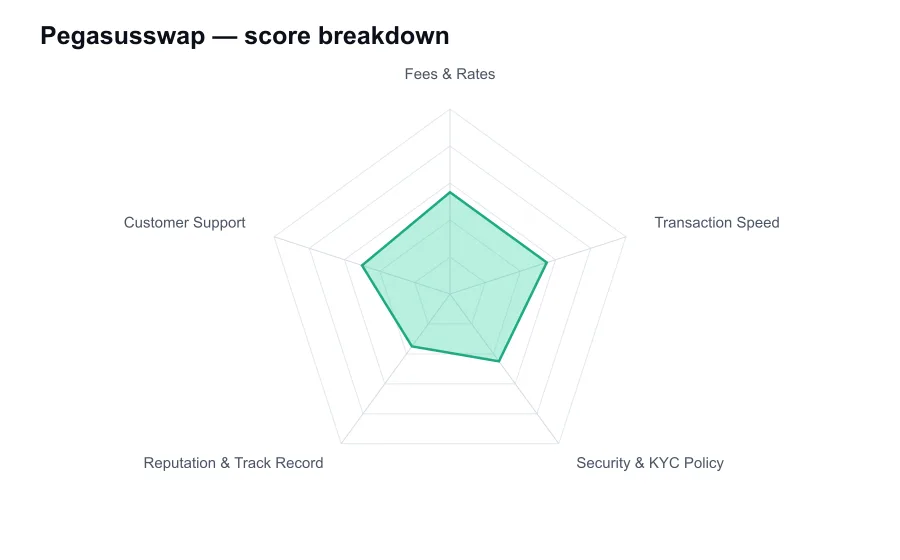
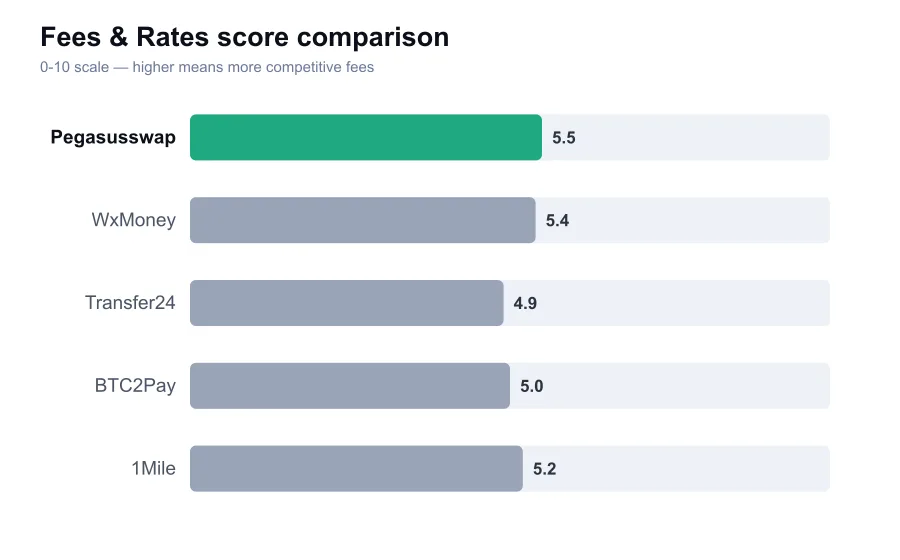
| Fees & Rates | 5.5 | Quote-based pricing needs careful external comparison |
| Transaction Speed | 5.5 | Normal swap mechanics, limited proven service history |
| Security & KYC Policy | 4.5 | Light onboarding does not remove counterparty risk |
| Reputation & Track Record | 3.5 | Too little independent long-term evidence |
| Customer Support | 5.0 | Test responsiveness before trusting meaningful funds |
In-Depth Review
Pegasusswap presents itself as an instant cryptocurrency exchange for users who want to convert one asset into another without the machinery of a conventional account-based platform. It belongs to a crowded market full of similarly styled swap sites, where the central promise is speed, convenience and minimal onboarding. That market has genuine utility, but it also demands a higher standard of skepticism than a household-name exchange with years of public reporting.
The service appears built for straightforward wallet-to-wallet exchanges rather than active trading. Users choose an asset pair, provide a destination address and send a deposit to complete the order. This can be more approachable than navigating an order book or bridging through a decentralized exchange. It also means the customer has limited control once funds are sent. There is no cancel button that can undo a confirmed blockchain deposit.
Pegasusswap's presentation is familiar enough to anyone who has used a no-registration swap provider. That is not praise or criticism by itself. Familiar interfaces can reduce user errors, especially for a first-time converter. But standard instant-exchange language, token logos and promises of fast execution do not establish operational strength. A reviewer has to ask what lies behind the interface, who runs it, how disputes are handled, and whether there is evidence beyond the company's own claims.
Price is the first area where users should be disciplined. Pegasusswap quotes an exchange outcome rather than offering a simple transparent maker or taker fee. The rate can incorporate liquidity-provider costs, service margin, network fees and volatility risk. That is common in this category, yet it makes fee claims difficult to verify in the abstract. The only meaningful comparison is the exact amount you receive for the same transaction at the same moment across several services.
Do not assume a small-looking service fee equals a cheap swap. A provider can advertise a low commission while offering a poorer exchange rate, especially on thin altcoin pairs. Compare Pegasusswap with LetsExchange, ChangeNOW, Godex and, where practical, a liquid centralized exchange. For a larger swap, even a one percent difference can be more important than a slick interface or a promise of instant processing.
If Pegasusswap offers a fixed quote for a particular pair, it can be useful in volatile conditions, but fixed quotes should be read carefully. They normally have a deposit time window and an exact amount requirement. Sending late or sending an incorrect amount may move an order to a floating rate or require manual support. That is not necessarily unfair, but a good service explains it prominently before users commit their coins.
Transaction speed depends on far more than the front-end website. The deposit must receive the required blockchain confirmations, then the service or its liquidity partner must execute the conversion, and finally the payout must be broadcast and confirmed. A stablecoin swap on a fast chain can be quick. A Bitcoin transaction, an obscure token route, or a period of wallet maintenance can turn an expected short exchange into an extended wait.
The key concern is that Pegasusswap has a much lighter independently verifiable operating record than the market leaders. There is less public evidence from years of high-volume trading, integration partners, detailed technical documentation and well-documented resolution of difficult cases. That does not prove misconduct. It does mean a user should not assign it the same trust level as a service with a long track record merely because both offer the same basic exchange form.
Like many instant exchange providers, Pegasusswap may advertise a no-KYC or registration-light experience. That can be attractive for a person who does not want to create another account for a one-time exchange. It should never be read as a promise that documents will not be requested. Anti-money-laundering monitoring, transaction screening and partner requirements can produce a compliance review, particularly if funds have a high-risk transaction history.
That issue matters more on a newer platform. If funds are paused, the quality of support and the clarity of the operating entity become central to the user's ability to resolve the situation. A mature provider may still frustrate customers, but it usually leaves a larger trail of public cases, policies and contact avenues. With Pegasusswap, I would want clear legal information, current terms, accessible privacy and AML policies, and a reachable support route before trusting it with a meaningful amount.
The non-custodial label also needs careful handling. It normally means Pegasusswap does not maintain a customer trading balance for long-term storage. During an exchange, however, the user sends funds into an operational flow that they do not control. That is counterparty exposure. It is lower than leaving a large balance on a centralized venue for months, but it is not the same as a self-executed decentralized swap from your own wallet.
Public reputation is Pegasusswap's weakest category. It lacks the deep, long-running body of independent user experience that lets a reviewer distinguish ordinary transaction delays from systemic behavior. Search visibility, promotional articles and isolated positive comments are not enough. I would be more comfortable if the company accumulated years of consistent service, transparent leadership or entity details, substantive integrations, and independently observable customer support performance.
Support availability is important for a platform at this stage. A live chat widget is helpful, but it is not a substitute for a documented escalation process. Before depositing, users should confirm that the order page records an ID, that the service offers a support contact, and that the exact payout address is correct. Save the deposit transaction hash. Those practical steps are essential if an order needs manual investigation.
My view is simple. Pegasusswap may be suitable for a small test conversion if its quote is genuinely superior and the user understands the counterparty risk. It is not a service I would recommend for a first large crypto transaction, a time-critical settlement, or funds that cannot tolerate a compliance delay. In this sector, reputation is part of the product. Pegasusswap has not yet supplied enough public evidence to offset the caution its limited track record deserves.
Pros & Cons
| Pros | Cons |
|---|
Is Pegasusswap a good choice for a large exchange?
I would not use it for a large first transaction. Its public track record is limited compared with established instant exchanges, so a small test swap is the prudent approach.
Does Pegasusswap have transparent fees?
The effective cost is generally reflected in the quoted payout rather than a universal flat trading fee. Compare the final received amount with several alternatives before depositing.
Can a no-KYC swap still be reviewed?
Yes. Registration-light services can still apply AML, sanctions and transaction-risk checks, which may lead to a request for information or a delayed order.