Editorial independence: our scores and rankings are produced using the fixed criteria above and are not influenced by advertisers. This is an independent ranking site and is not operated by, or affiliated with, any provider we list.
Affiliate disclosure: some links on this page may earn us a commission at no extra cost to you. This does not affect our rankings.
Live market data via CoinGecko, for informational purposes only. Not financial advice.
| Best for | Not for |
|---|---|
| Payment-oriented use case | Limited public company and technical documentation |
Criteria Breakdown
| Criterion | Score | Notes |
|---|---|---|
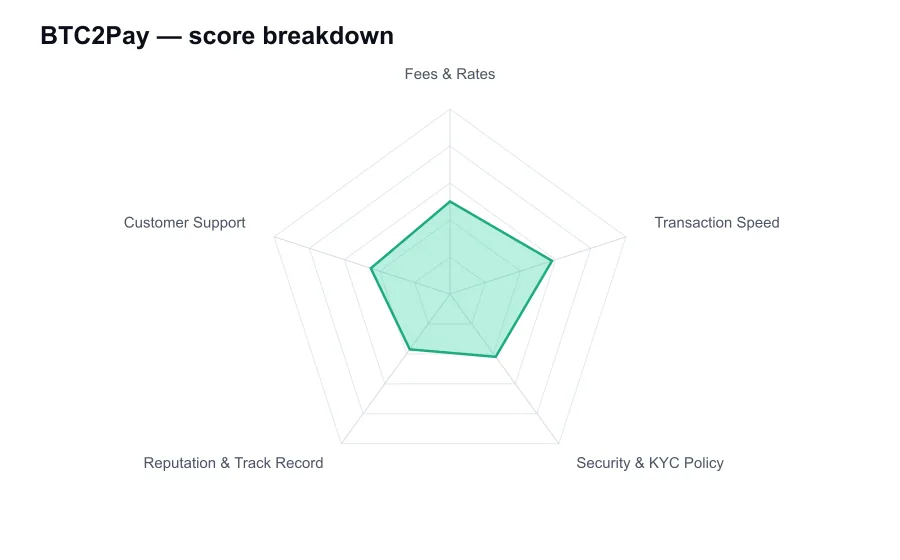
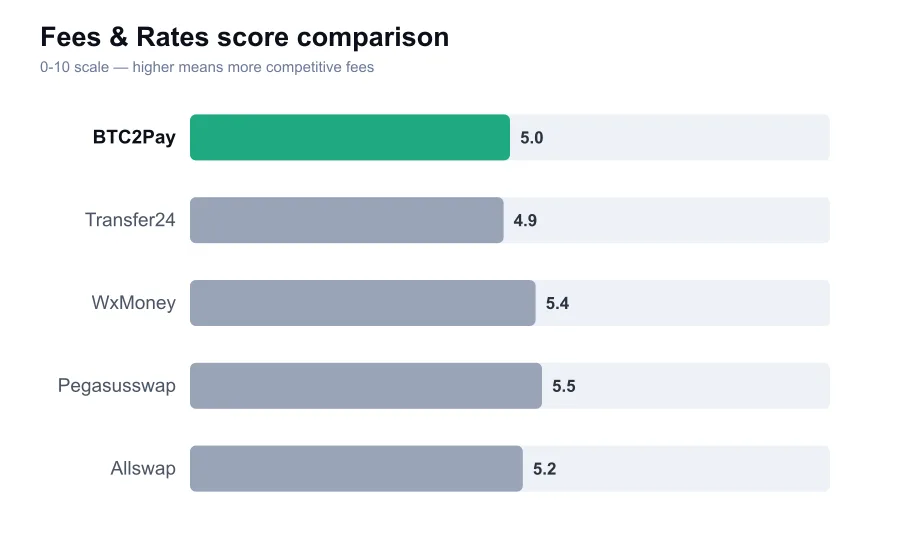
| Fees & Rates | 5.0 | Assess conversion spread, network costs, and payout terms, not just a headline fee. |
| Transaction Speed | 5.8 | Settlement still depends on the selected blockchain and confirmation policy. |
| Security & KYC Policy | 4.2 | Public information on business-grade controls is limited. |
| Reputation & Track Record | 3.7 | Less established and less documented than major payment processors. |
| Customer Support | 4.5 | Test response quality before relying on it for merchant revenue. |
In-Depth Review
BTC2Pay appears to occupy the crypto payments and exchange-service corner of the market, a space that attracts merchants, freelancers, and users who want digital-asset transfers without building a trading workflow around a major exchange. The name suggests a payment-first proposition, and that can be useful if the service actually delivers clear settlement, sensible conversion pricing, and dependable support. Those are difficult things to get right, especially for a smaller provider.
A payments brand lives or dies by operational clarity. A trader can tolerate a confusing interface if an order eventually fills. A merchant waiting for payment cannot. BTC2Pay therefore needs to be judged not only on whether it can process a conversion, but on whether users can see payment status, understand confirmations, retrieve records, and reach someone when a transfer does not behave as expected. Publicly available evidence does not put it among the better documented names in this area.
That lack of documentation is my central reservation. A credible payments provider should identify the legal entity operating the service, the countries it supports, its compliance policy, and the custody model behind customer funds. It should also explain whether it processes payments directly, routes them through partners, or operates mainly as a conversion interface. If those answers are hard to find, the customer is being asked to accept risk without enough information to price it.
Costs deserve close attention because payment products can conceal them in several places. There may be a transaction charge, a conversion spread, a network fee, a withdrawal cost, and occasionally a minimum payout rule. A stated low processing fee sounds attractive, but it is not meaningful if the exchange rate is weaker than alternatives. Anyone receiving stablecoins or converting proceeds into BTC should compare the final settlement figure with an established processor or with a spot-market conversion at Kraken or Binance.
For merchants, predictable pricing matters more than the lowest possible headline number. A payment processor that charges a little more but provides a locked invoice amount, a clear settlement report, and a usable refund procedure can be cheaper in practice than one with a thin advertised fee and unreliable execution. BTC2Pay does not have enough public, independently reviewable fee material for me to treat its pricing claims as proven. Ask for the complete schedule before integrating it into a business.
Speed is another area where the product category can mislead people. A crypto payment can be displayed as detected within seconds, while final settlement still depends on the underlying network and the number of confirmations required. Bitcoin can take an hour or longer in busy periods. Ethereum transfers can be rapid but costly, while token transfers on cheaper networks bring their own operational and address-format risks. A provider should separate payment detection from final settlement clearly.
If BTC2Pay is being used for customer payments, the most practical question is whether the merchant can safely deliver goods after a defined number of confirmations. The answer depends on payment value and chain risk. A serious processor explains its confirmation thresholds, invoice expiry rules, underpayment and overpayment handling, and conversion timing. I would not rely on a service that simply says transactions are instant. Blockchain settlement is not magic, and responsible payment platforms do not pretend otherwise.
The security assessment is middling because the public information needed for a stronger score is limited. Payment platforms have a lot of sensitive failure points, including API credentials, payout addresses, invoice tampering, staff access, and customer data. Two-factor authentication, withdrawal controls, signed webhooks, API permission scopes, and audit logs should be standard expectations. If a business cannot verify which of these controls BTC2Pay offers, it should not connect the service to a production checkout.
KYC and compliance need special care in payment processing. A service may allow a basic account setup yet request business documents, identification, or source-of-funds information before higher-volume settlement. That is ordinary in the sector, but it must be stated plainly. Sudden verification demands can disrupt cash flow, which is much more serious for a merchant than for a hobbyist making one small swap. BTC2Pay should be treated as verification-capable rather than assumed to be anonymous or fully no-KYC.
Reputation is not just about ratings. The useful signs are longevity, clear company communications, public technical documentation, merchant case studies that can be checked, and an observable history of responding to difficult issues. BTC2Pay has a much smaller visible footprint than processors such as BitPay, CoinGate, Coinbase Commerce, or NOWPayments. Smaller does not mean unsafe, but it means the buyer has to do more due diligence and should avoid becoming dependent on the service too early.
Support becomes especially important if money is moving for a business. A delayed payout can create an accounting problem, a customer-service problem, and a cash-flow problem all at once. I would expect clear ticketing, documented response times, and a support route that does not depend solely on a social-media message. Before any rollout, send a pre-sales question that requires a specific answer, then judge the quality and speed of the response. That test is more revealing than a polished homepage.
BTC2Pay might work for a small operator experimenting with crypto payments, provided the initial volume is low and the business retains an alternative processor. It is not where I would place the primary payment rail for a store, payroll process, or high-value digital-goods operation. Redundancy matters in crypto payments. Even strong providers experience outages, and a lightly documented provider gives fewer reasons to believe it will manage a stressful incident well.
The service can still have appeal for a user who values a compact setup and does not need advanced enterprise tooling. But convenience must not overpower prudence. Keep settlement balances low, export records regularly, confirm payout addresses through a secure procedure, and do not let a payment dashboard become a wallet. Crypto processors are transaction tools, not places to park company reserves.
My judgment is that BTC2Pay remains a speculative choice rather than a proven payments partner. It may be adequate for testing a modest crypto-payment flow, and a smooth trial is useful information. Still, the sparse public track record, uncertain pricing transparency, and unclear depth of security documentation limit its recommendation. Established payment providers are usually the better value once the cost of operational risk is honestly counted.
Pros & Cons
| Pros | Cons |
|---|
Is BTC2Pay suitable for accepting crypto payments in a store?
It may be suitable for a low-volume trial, but businesses should verify settlement rules, supported assets, reporting, and support channels before using it for routine revenue collection.
Are crypto payments through BTC2Pay instant?
Payment detection may be quick, but finality depends on the blockchain, network congestion, and the provider's required confirmations. Treat detected and settled as different stages.
Will BTC2Pay require business verification?
Payment providers may request identity, business, or source-of-funds documents, particularly as volumes rise. Read the current terms and do not plan around an assumption of permanent no-KYC access.