Editorial independence: our scores and rankings are produced using the fixed criteria above and are not influenced by advertisers. This is an independent ranking site and is not operated by, or affiliated with, any provider we list.
Affiliate disclosure: some links on this page may earn us a commission at no extra cost to you. This does not affect our rankings.
Live market data via CoinGecko, for informational purposes only. Not financial advice.
| Best for | Not for |
|---|---|
| Simple wallet-to-wallet swap flow | Limited public company and security information |
Criteria Breakdown
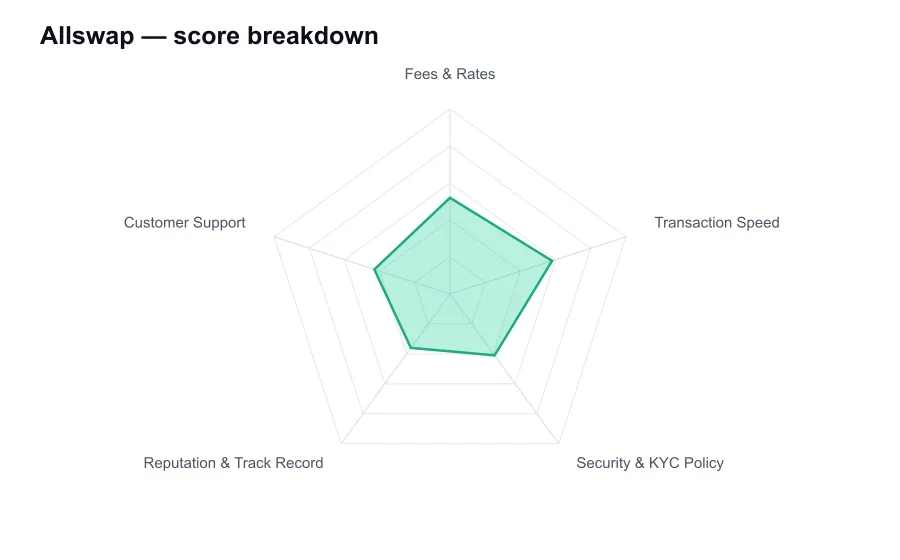
| Criterion | Score | Notes |
|---|---|---|
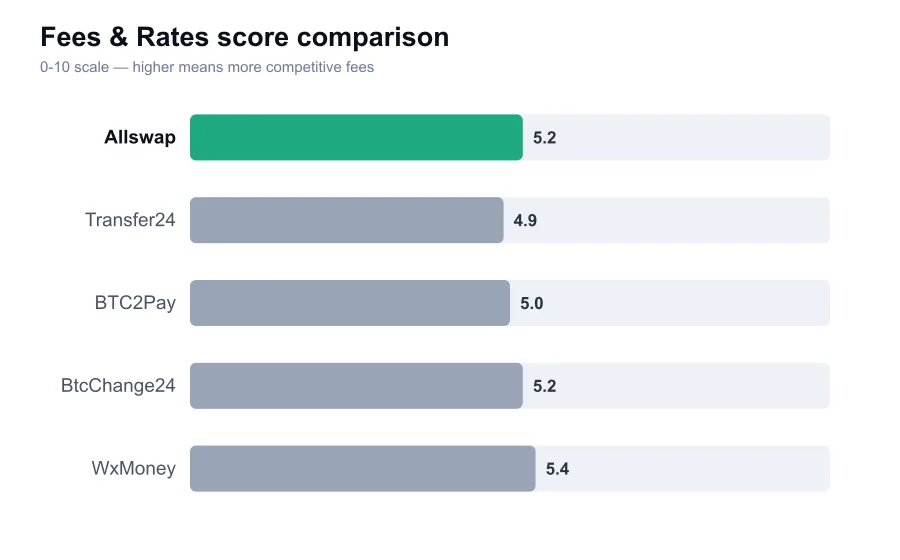
| Fees & Rates | 5.2 | Quote-based pricing needs comparison with rivals |
| Transaction Speed | 5.8 | Timing depends on chain confirmations and routing |
| Security & KYC Policy | 4.1 | Limited public security and compliance detail |
| Reputation & Track Record | 3.6 | Thin independently verifiable track record |
| Customer Support | 4.3 | Test support before trusting a large transfer |
In-Depth Review
Allswap presents itself as a simple crypto swapping service aimed at people who want to exchange assets without opening a conventional trading account. It sits in the crowded instant-swap corner of the market, alongside services such as ChangeNOW, SimpleSwap, StealthEX, and LetsExchange. That is a difficult market to break into because the product is easy to describe, but trust is everything. A swap widget and a long token list are not enough.
The first issue is identity. Allswap has a much lighter public footprint than established exchange providers, with limited independently verifiable information about the company, operating history, liquidity partners, ownership, or custody practices. That does not automatically make it unsafe, but it does make diligence harder. I would not treat an obscure swap brand as interchangeable with a business that has years of public operating history, documented policies, and a substantial body of customer feedback.
Its appeal is obvious for a certain kind of user. You select the asset you are sending, choose the asset you want to receive, provide a destination address, and fund the quoted transaction. There is no order book to interpret and no need to understand maker and taker fees. For someone converting one wallet balance into another, that can feel much cleaner than using Binance, Coinbase Exchange, Kraken, or a decentralized exchange manually.
That convenience does not mean the service is cheap. Instant-swap providers usually earn through a combination of quoted exchange spread, network costs, and liquidity-provider pricing. A platform may advertise low or zero service fees while still presenting a final rate that is worse than the mid-market rate visible on a major exchange. The meaningful number is not a fee banner. It is the number of coins expected at the receiving address after every deduction.
Allswap does not have the level of transparent, standardized fee disclosure I would want before regularly routing meaningful sums through it. A user should compare the quoted output against at least two alternatives before confirming. For liquid pairs such as BTC to USDT, ETH to USDC, or LTC to BTC, the difference can be material. A one or two percent pricing gap is easy to overlook in a simple interface and much harder to recover after the swap settles.
Fixed-rate and floating-rate quotes deserve particular attention. A floating quote may change as markets move or liquidity is sourced, which means the final amount can differ from the initial estimate. A fixed quote can reduce that uncertainty, but it may carry a wider spread or expire quickly. If Allswap offers both on a pair, I would use fixed pricing for time-sensitive transfers and compare the actual output, not just the labels.
Speed is similarly dependent on factors outside the front end. A swap involving fast chains can complete in minutes if liquidity is available and the incoming transaction receives the required confirmations. Bitcoin and Ethereum transfers may take longer, especially during congestion or if the deposit transaction uses a low network fee. Cross-chain routing adds another dependency. The provider has to receive, price, exchange, and send the output, so a blockchain confirmation is not the same thing as a completed swap.
I would be cautious about using Allswap for an urgent payment, a liquidation rescue, or a transfer with no room for delay. Better-known instant exchanges can also experience holds and liquidity delays, but they usually provide a clearer order-status page, more public troubleshooting material, and more established support channels. With a lesser-known provider, the same delay feels riskier because there is less evidence of how consistently edge cases are handled.
The KYC position should never be read as a promise of permanent anonymity. Services in this category can allow many routine swaps without account registration while still requesting identity verification if an automated compliance check flags a transaction. That is common across centralized swap providers. A user sending funds from a sanctioned, stolen, or high-risk source can find an order paused, regardless of the marketing language around privacy.
This matters because Allswap's public compliance and security documentation is not as mature or detailed as what I expect from a serious financial service. I want to see a clear legal entity, a usable privacy policy, an explanation of how transaction screening works, supported-country rules, and a defined process for disputed or held transactions. Sparse documentation is not merely a branding weakness. It leaves customers guessing what happens if funds are delayed.
There is also no strong public basis for treating Allswap as a custody-grade venue. Do not leave funds with an instant swap provider, do not send an amount larger than you can verify through a test transaction, and triple-check destination networks. A wrong network selection can be irreversible. Hardware-wallet users should also verify the receiving address on the device itself rather than trusting a browser display alone.
Reputation is where Allswap trails the recognizable names. It does not have the extensive, independently visible customer history, security record, or public incident reporting that helps readers judge an exchange over several market cycles. New firms can become good firms, but they have to earn that confidence. A polished site is not a substitute for years of reliable fulfilment during volatility, network outages, and compliance disputes.
Support is another area where a small provider needs to prove itself rather than promise it. Email or chat can be perfectly adequate for a normal swap, but a customer whose transaction is delayed needs prompt human answers, a transaction identifier, and a realistic explanation. Before depositing, I would test the available contact route with a basic question and save every quote, transaction hash, and order reference.
My view is straightforward. Allswap may be usable for a small, non-urgent conversion after comparing its quote with established competitors, but the lack of a deep, independently verifiable track record keeps it out of my recommended shortlist for large transfers. The service has the right basic idea, yet basic execution is not the same as proven reliability. If your funds matter enough to worry about, choose transparency first and convenience second.
Pros & Cons
| Pros | Cons |
|---|
Does Allswap require KYC?
A registration-free flow does not guarantee that every transaction avoids verification. Swap providers can request KYC after automated compliance checks or for a transaction they consider high risk.
How can I tell what an Allswap transaction really costs?
Compare the final amount shown for the same pair and amount at two or three providers. The quoted output captures spread, provider pricing, and most routing costs better than a headline fee does.
Should I use Allswap for a large transfer?
I would not use a lightly documented provider for a large first transaction. Start with a small test, preserve the order ID and transaction hashes, and consider a more established venue for substantial sums.