Editorial independence: our scores and rankings are produced using the fixed criteria above and are not influenced by advertisers. This is an independent ranking site and is not operated by, or affiliated with, any provider we list.
Affiliate disclosure: some links on this page may earn us a commission at no extra cost to you. This does not affect our rankings.
Live market data via CoinGecko, for informational purposes only. Not financial advice.
| Best for | Not for |
|---|---|
| No proven positive features can be safely attributed | Provider identity is ambiguous |
Criteria Breakdown
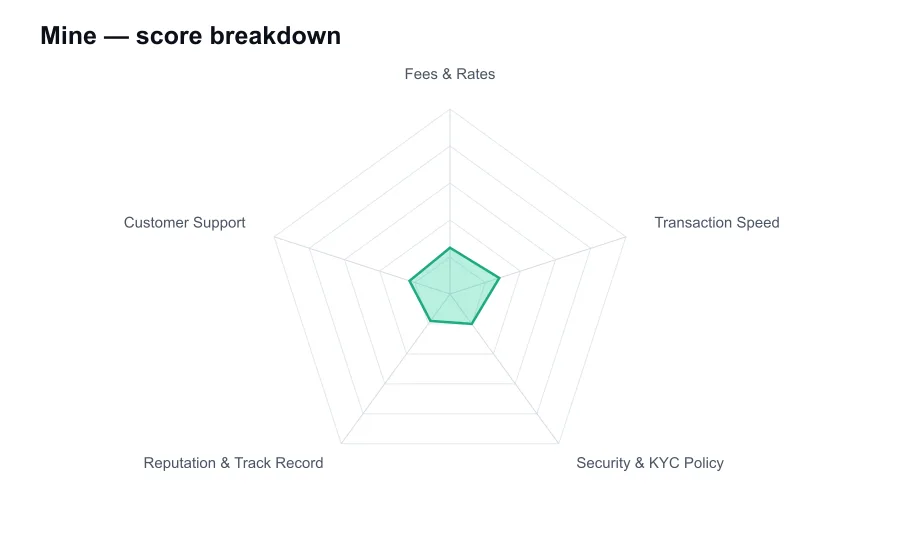
| Criterion | Score | Notes |
|---|---|---|
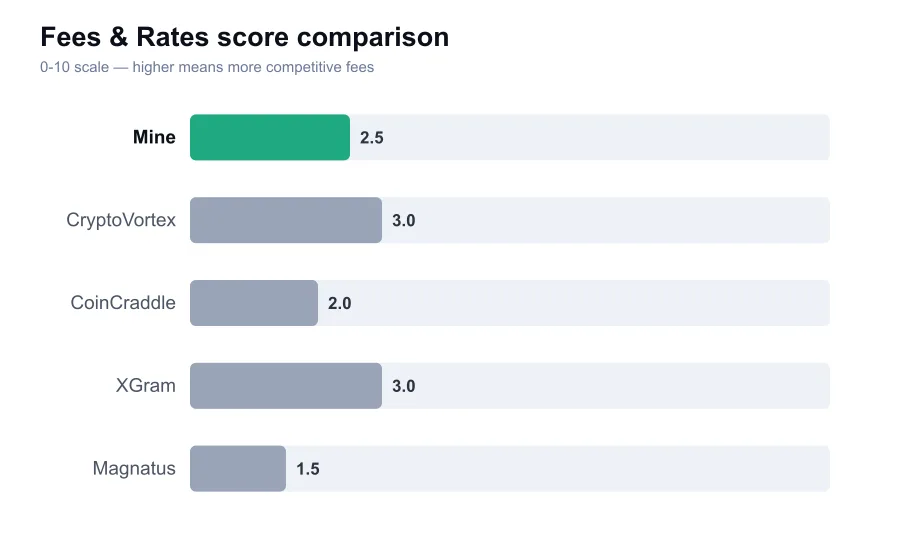
| Fees & Rates | 2.5 | No reliably attributable fee schedule can be assessed from the generic provider name. |
| Transaction Speed | 2.8 | No verified service-level record can be tied to one identifiable platform. |
| Security & KYC Policy | 2.0 | Do not deposit until the exact operator and official domain are verified. |
| Reputation & Track Record | 1.8 | The generic name prevents reliable attribution of public reviews or history. |
| Customer Support | 2.3 | Support quality cannot be verified without identifying the specific service. |
In-Depth Review
Mine is an unusually difficult provider to assess because the name is so generic. In crypto, "mine" can refer to mining hardware, mining pools, wallets, apps, token projects, exchanges, and countless unrelated websites. That ambiguity is not a minor branding inconvenience. It makes it harder for a user to establish which legal business, product, domain, and terms they are actually dealing with. A trustworthy financial provider should not leave that basic identity question unresolved.
For that reason, Mine begins from a position of caution rather than neutrality. I could not confidently tie the name alone to a single, well-established crypto exchange operator with a widely documented public record. There may be a specific product intended here, but a name without an unambiguous official domain and legal operator is not enough to assess custody, licensing, fees, service availability, or complaint history. It is not responsible to fill those gaps with assumptions.
That conclusion may sound harsh, but crypto has a long history of clone sites, similarly named apps, and projects borrowing credibility from generic terms. Search results can lead users toward the wrong entity, particularly when a provider has minimal public branding or operates through changing web addresses. Before depositing anything, a prospective customer should independently confirm the official domain from a verified company source, identify the operator in its legal terms, and verify that the contact details match.
Fee analysis is therefore limited. Any specific percentage attached to a generic brand called Mine could easily belong to a different product. Users should insist on seeing a live order preview that separately identifies the deposit amount, quoted rate, platform fee, network fee, withdrawal cost, and final receive amount. If the service cannot provide that information in a durable record before payment, it has failed a basic transparency test.
This matters even more if Mine advertises no fees. In crypto exchange services, zero commission often means the provider's compensation sits inside the spread. That can be reasonable, but only if the customer can compare the effective rate. Check the quote against a liquid exchange, an established instant-swap service, and the prevailing market price. For small amounts, the difference may be tolerable. For a serious transfer, an opaque spread is simply an avoidable expense.
Speed claims need the same skepticism. A provider can say it processes orders instantly while the user waits for a deposit to be credited, a compliance review to clear, or an outbound blockchain transaction to receive confirmations. None of that is inherently improper. The question is whether the service explains the sequence honestly. Without an identifiable platform and a documented service policy, there is no reliable benchmark for Mine's typical completion times.
If the intended Mine service deals with Bitcoin, network conditions alone can turn a supposedly quick transfer into an hour-long or longer process. If it uses Ethereum or stablecoins, gas conditions and token-network selection become important. If it is a payment tool, invoice expiry and confirmation thresholds matter. The details change by product, which is precisely why an ambiguous name prevents a meaningful one-size-fits-all performance score.
Security is the decisive issue here. Before trusting any crypto provider, users should establish whether they retain custody of their keys, whether the service has account protection such as two-factor authentication, whether withdrawal-address changes are protected, and whether there is a published incident-response process. For an exchange or hosted wallet, reserve disclosures and custody practices also matter. Mine, as identified only by this name, offers no reliably attributable public security record I can endorse.
The same applies to KYC. It is risky to rely on a label such as "no KYC" unless it comes from a current, specific policy attached to a known legal operator. Some services permit a first transaction without an account but reserve broad rights to request identification after a risk alert. Others impose regional restrictions that become visible only at withdrawal. A user who needs certainty about privacy or compliance should choose a provider with explicit and readily accessible terms.
Reputation cannot be transferred by name. A favorable comment about a mining app called Mine says nothing about an exchange using the same word. A review page without a company identifier may mix completely unrelated businesses. This is why I assign Mine a particularly weak reputation score, not because there is verified evidence of misconduct, but because there is inadequate evidence that a reviewer can confidently associate with one provider. Verifiability is part of reputation.
Support is also impossible to judge without knowing which Mine is in question. A visible email address alone does not prove that a team can resolve missing payments or account problems. Look for a support center tied to the official domain, a documented ticket system, response expectations, and a clear route for escalation. Do not send funds simply to test whether an anonymous contact form works. Ask questions before funding an account.
There is a practical way to approach a service with an uncertain identity. Start by identifying the exact URL and legal entity. Read the terms, privacy policy, fee policy, and supported-country list. Search the company name, not merely its brand, in corporate registries and credible news sources. Then make a tiny transaction only after confirming that the receiving address, network, and quoted settlement amount are all correct.
Mine might ultimately refer to a legitimate product with acceptable tools and pricing. If so, it should make that fact dramatically easier to establish. Good financial brands reduce uncertainty rather than asking users to do detective work. Until the provider can be identified with confidence, no potential convenience feature outweighs the danger of sending irreversible crypto to the wrong service.
My final view is simple: do not treat Mine as a recommended exchange provider based on the name alone. The identification problem is serious enough to block a proper positive review. Users who can provide the exact official domain may be able to evaluate a specific product, but everyone else should use a recognized exchange or payment service with a unique identity, clear ownership, and a long public operating history.
Pros & Cons
| Pros | Cons |
|---|
Why is Mine scored so low?
The name does not uniquely identify one exchange provider. Without a verified official domain and legal operator, fees, security practices, and user feedback cannot be reliably attributed.
Can I safely send a small test transaction to Mine?
Not until you confirm that you have the official service and correct deposit address. A test transaction still sends irreversible funds and can be lost to an impersonator or unrelated platform.
What should I verify before using a provider called Mine?
Verify the official domain, company name, jurisdiction, terms, support contact, fee preview, wallet network, and current compliance policy. Match these details through independent sources.