Editorial independence: our scores and rankings are produced using the fixed criteria above and are not influenced by advertisers. This is an independent ranking site and is not operated by, or affiliated with, any provider we list.
Affiliate disclosure: some links on this page may earn us a commission at no extra cost to you. This does not affect our rankings.
Live market data via CoinGecko, for informational purposes only. Not financial advice.
| Best for | Not for |
|---|---|
| Name may be easy to search and monitor | Official identity and website are not confirmed |
Criteria Breakdown
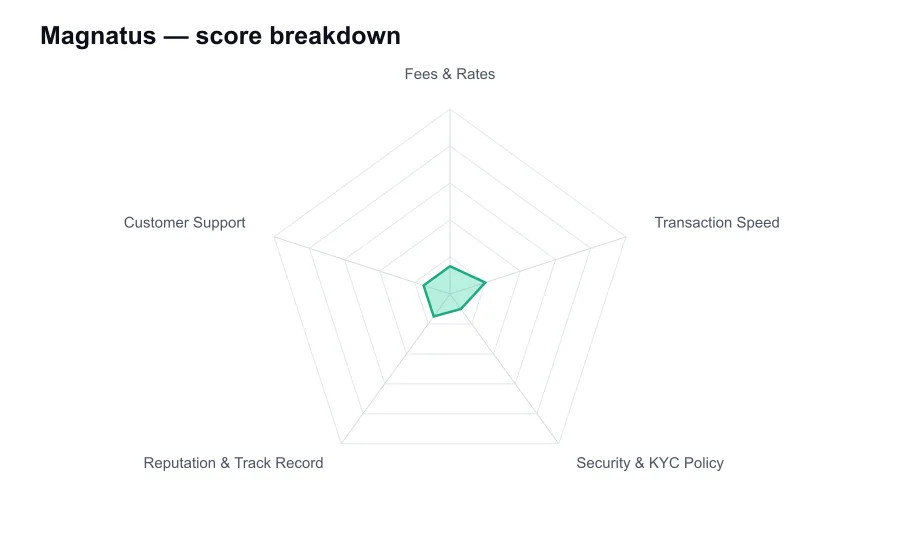
| Criterion | Score | Notes |
|---|---|---|
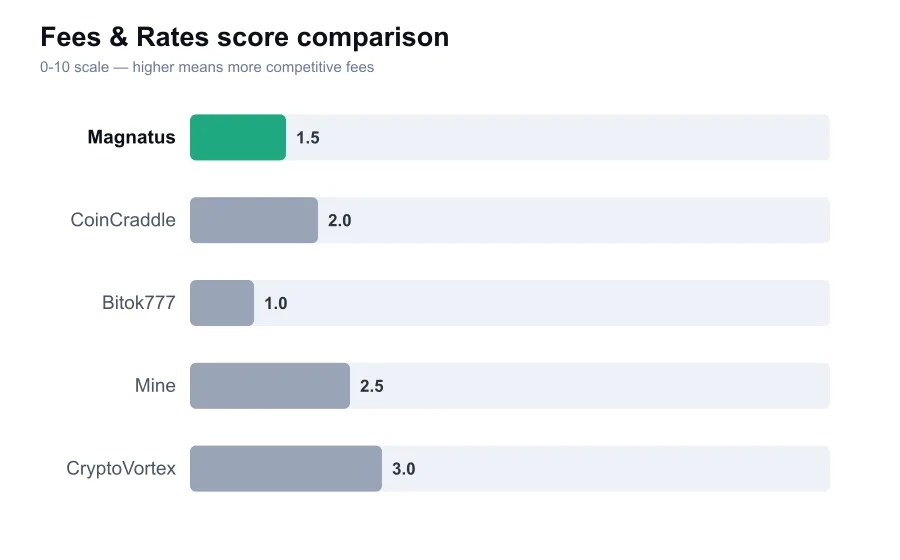
| Fees & Rates | 1.5 | No reliably verifiable public pricing disclosure |
| Transaction Speed | 2.0 | No substantiated withdrawal performance record |
| Security & KYC Policy | 1.0 | Security, custody and KYC evidence is insufficient |
| Reputation & Track Record | 1.5 | No established independently documented track record |
| Customer Support | 1.5 | No dependable public support framework found |
In-Depth Review
Magnatus is a name that does not have the broad, independently verifiable exchange footprint most crypto users should expect before depositing money. It is not a familiar regulated venue in the way Gemini, Coinbase, Kraken, Bitstamp, or Crypto.com are familiar. That does not automatically decide the question of legitimacy, but it does set the starting point for a review. With an obscure provider, the burden is on the operator to prove its identity, terms, and safeguards clearly.
I could not confirm a definitive official Magnatus exchange website, a clearly attributable corporate entity, or a reliable public record of regulatory permissions. That makes a conventional product review difficult because the basic facts are not settled. Readers should be wary of search ads, cloned sites, Telegram messages, and social accounts using the Magnatus name. In crypto, brand confusion is not a minor annoyance. It is one of the most common routes into impersonation scams.
The fee score is therefore low, not because I can verify an unusually expensive published commission, but because the cost of using Magnatus cannot be assessed to a professional standard. A trustworthy venue should show trading fees, card fees, conversion spreads, withdrawal minimums, and network charges before a user pays. If the price appears only in a private chat, a support message, or a payment page with no market reference, users cannot meaningfully compare it.
That lack of price clarity is particularly dangerous for instant-buy offers. A provider may show zero commission while applying a large conversion spread. It may also promise a fixed rate, then reserve the right to revise the payout after receipt of the deposit. There are legitimate reasons to adjust a quote when blockchain fees move sharply, but the policy needs to be explicit. I found no credible public documentation that lets a customer calculate Magnatus's all-in cost with confidence.
For anyone wanting to buy bitcoin, ether, stablecoins, or major altcoins, there are more accountable alternatives. Established exchanges may feel less glamorous, and verification can take time, but their pricing is visible. A customer can compare a quoted Magnatus rate against a live market rate on Kraken or Coinbase before proceeding. If the difference is unexplained, walk away. A vague promise of a better deal is not a fee policy.
Speed claims should be treated with exactly the same suspicion. A legitimate crypto withdrawal depends on internal approval, blockchain broadcasting, confirmation targets, and sometimes travel-rule or sanctions screening. Fiat withdrawals depend on banking rails. No service can honestly promise that all transfers will complete instantly under every condition. Without a public status page, documented processing windows, or a credible record of users reporting completed withdrawals, Magnatus has not demonstrated reliable speed.
The risks rise sharply if a representative says a deposit must be topped up to release profits, unlock a wallet, pay tax, or cover a liquidity fee. Those requests are a classic fraud pattern, not a normal exchange workflow. Real exchanges deduct legitimate trading or withdrawal fees from the balance or disclose them before an order. They do not repeatedly demand additional cryptocurrency to unfreeze a supposedly completed transaction.
Security is where Magnatus falls furthest below an acceptable recommendation threshold. I could not independently verify cold-storage arrangements, named custodians, proof-of-reserves, account security features, security audits, insurance, or incident disclosure. Even smaller operators can publish a basic security architecture and company contact information. Without that, there is no reason to assume customer deposits are segregated, recoverable, or protected from operational failure.
A missing or unclear KYC policy is not a privacy benefit. It can mean the operator has no coherent compliance process, or it can mean identity checks are introduced only after funds are received. Both possibilities are bad for a customer who needs predictable access to money. Users should know before depositing whether identification is required, which country restrictions apply, how long reviews take, and whether assets can be withdrawn while a review is pending.
Reputation is not merely a matter of star ratings. Real reputation is built through a history of complaints and resolutions, identifiable staff, licensing records, technical incident reports, and long-running independent discussion. Magnatus does not have enough of that material for a sound positive judgement. A handful of glowing reviews, especially ones with identical phrasing or no transaction detail, cannot substitute for a documented operating history.
Support is similarly unproven. Private messaging support can feel responsive before payment, then become useless once a user asks about a pending withdrawal. A reliable provider offers a help centre, ticket route, legal contact information, and clear escalation steps. I could not validate those basics for Magnatus. That means a customer facing a deposit issue may have no practical route to obtain an answer beyond the same channel that solicited the transaction.
The sensible approach is not to try to outsmart an opaque platform. Do not connect a wallet through an unsolicited link. Do not install remote-access software at a support agent's request. Do not share a seed phrase, recovery code, or two-factor code. A legitimate exchange will never need a wallet seed phrase to verify an account or release a withdrawal. If you have already sent funds, preserve wallet addresses, transaction hashes, screenshots, and every message.
Magnatus may be a trading name used somewhere in the market, but the public evidence available to me is insufficient to treat it as an established exchange provider. That is the review's central finding. The absence of verifiable basics prevents a meaningful endorsement on fees, speed, safety, or service. It would be irresponsible to fill the gaps with assumptions simply because the crypto market is full of polished but lightly documented websites.
My recommendation is to avoid sending Magnatus material sums until its official entity, regulation, fee schedule, and withdrawal record can be independently confirmed. There is no shortage of better-documented places to trade major assets. A lower quoted price is not attractive if the counterparty cannot be properly identified. In crypto, the safest decision is often refusing a transaction whose rules you cannot verify.
Pros & Cons
| Pros | Cons |
|---|
Is Magnatus a verified regulated crypto exchange?
I could not independently verify a clear regulated entity or official exchange identity. Confirm legal registration directly with the relevant regulator before sending any funds.
Should I pay an extra fee to unlock a Magnatus withdrawal?
Treat requests for extra deposits to release funds, profits, taxes, or withdrawals as a major warning sign. Preserve evidence and seek independent advice before paying anything.
Can support ask for my wallet seed phrase?
No. Never share a seed phrase, private key, recovery phrase, or two-factor authentication code. Anyone requesting them can take control of your assets.