Editorial independence: our scores and rankings are produced using the fixed criteria above and are not influenced by advertisers. This is an independent ranking site and is not operated by, or affiliated with, any provider we list.
Affiliate disclosure: some links on this page may earn us a commission at no extra cost to you. This does not affect our rankings.
Live market data via CoinGecko, for informational purposes only. Not financial advice.
| Best for | Not for |
|---|---|
| May present a simple exchange workflow | Very limited independently verifiable transparency |
Criteria Breakdown
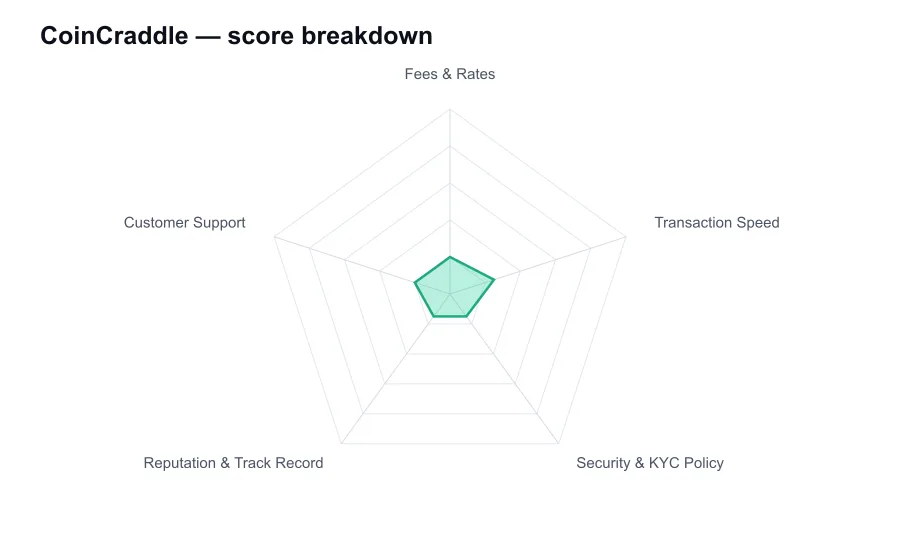
| Criterion | Score | Notes |
|---|---|---|
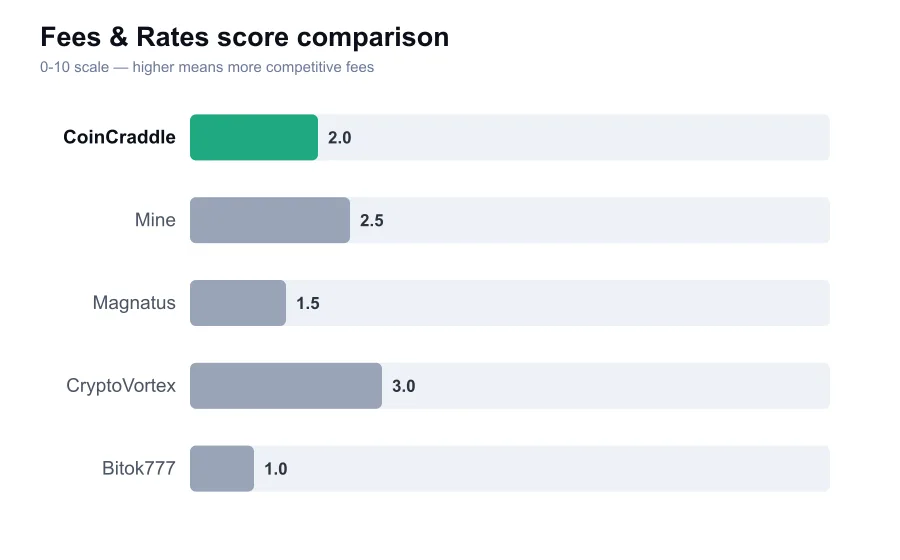
| Fees & Rates | 2.0 | Effective pricing and fee policies are not well verified |
| Transaction Speed | 2.5 | No dependable independent record of settlement performance |
| Security & KYC Policy | 1.5 | Insufficient verifiable security and operator disclosure |
| Reputation & Track Record | 1.5 | No established independently corroborated track record |
| Customer Support | 2.0 | Dispute and support performance cannot be confidently verified |
In-Depth Review
CoinCraddle is another provider for which the sensible starting point is caution, not enthusiasm. It does not have the recognizable market presence, documented history, or broad independent coverage of leading exchanges and established instant-swap services. That is not a cosmetic weakness. A crypto exchange provider takes control of a transaction at the exact moment a user can least afford uncertainty, after funds have left the originating wallet but before the replacement asset arrives.
I could not verify enough authoritative information about CoinCraddle's operator, long-term trading history, security practices, or customer-dispute record to write the kind of positive review that readers should demand. A website can call itself an exchange, display attractive rates, and offer dozens of assets without proving it has the liquidity, controls, or integrity to complete a swap reliably. In this sector, the absence of verifiable information is a risk factor in its own right.
Users should be wary of confusing presentation with credibility. Professional graphics, countdown timers, generic security claims, and purported customer reviews are easy to create. Meaningful trust comes from transparent legal ownership, a stable and verifiable domain history, clear terms, credible third-party reporting, responsive support, and a sustained pattern of successful user outcomes. CoinCraddle does not currently provide enough publicly corroborated evidence on those points for me to endorse it.
Fees are impossible to rate generously if the actual cost structure is unclear. Some little-known swap sites advertise no commission, then recover their margin through the conversion quote. Others quote a fee but provide no clear explanation of network charges, minimums, refunds, or what happens if the amount sent differs slightly from the order. For CoinCraddle, the proper approach is to assume nothing. The final receiving amount is the price, and any rate should be checked against a major liquid venue before a deposit is made.
A cheap-looking quote can be dangerous in a different way. It may be bait for a transaction that later encounters a supposed compliance hold, a request for another payment, or a demand for personal documents after funds are already in the provider's control. Legitimate compliance processes can exist, but they should be explained in accessible policies before the user sends money. Requests to pay an extra fee, tax, insurance charge, or deposit to release funds are classic danger signs, not normal exchange procedure.
Speed claims should also be treated as unproven until demonstrated by reliable evidence. Every crypto swap depends on blockchain confirmations and liquidity, but an established operator can usually explain a delay, provide transaction IDs, and communicate a realistic timeline. An opaque operator can simply leave the customer staring at an order page. CoinCraddle has not earned enough public confidence for a user to assume that a slow transaction will be resolved fairly.
A transaction tracker does not necessarily prove settlement capability. Anyone can generate an order number or show a progress bar. What matters is whether the deposit address can be tied to the order, whether outbound transactions appear on the destination chain, and whether users can obtain a clear answer if something fails. Before trusting any unfamiliar service, test whether its documentation explains confirmation thresholds, incorrect deposits, tag and memo assets, network mismatches, and refund rules in specific language.
Security is more than whether a site has HTTPS or a padlock icon. Those are basic web requirements, not proof of safe operations. A provider should make clear how it protects infrastructure, manages hot-wallet exposure, monitors fraud, handles user data, and responds to incidents. It should also identify the legal entity that a customer could contact or complain about. I do not have sufficient independently verifiable material to conclude that CoinCraddle meets those standards.
KYC is another area where users should insist on clarity. A service may appear to offer no-account exchanges, but that says little about whether it can freeze an order and require identification or source-of-funds evidence later. If CoinCraddle reserves such discretion, the exact process, timelines, and refund options need to be visible before funds move. If it does not explain them, that is not privacy. It is uncertainty transferred to the customer.
The provider's reputation cannot be built from anonymous testimonials or a handful of unverified review snippets. Crypto has a long history of clone sites, short-lived brokers, and affiliate-driven rankings that make weak operators look more substantial than they are. I look for a reputation that persists outside the provider's own marketing: independent reporting, technical community discussion, identifiable executives, and an observable response to criticism. CoinCraddle has not cleared that bar in the material I can verify.
Support is particularly important for a lesser-known exchange because it is often the only line between a recoverable error and a permanent loss. A real support operation provides traceable tickets, coherent answers, and a route for escalation. A generic chat window, a social-media account, or a single email address is not enough. With CoinCraddle, there is too little dependable evidence about response quality or dispute resolution to award confidence here.
Anyone who has already started a CoinCraddle transaction should be methodical. Save the order page, deposit hash, destination address, timestamps, and every support message. Do not disclose wallet seed phrases, private keys, or remote-device access. Do not send a second payment because someone claims it is needed to verify an account or release a pending withdrawal. If a problem arises, check the relevant blockchain explorer first, then seek advice from the wallet provider or an appropriate fraud-reporting channel.
There is no shortage of safer alternatives. A user who wants transparent pricing can use a major exchange's advanced trading interface. A user who wants a wallet-to-wallet swap can choose an instant-exchange provider with years of visible operations and extensive public documentation. A user who prioritizes self-custody can assess decentralized exchange routes, while understanding smart-contract and network risks. CoinCraddle offers no clearly verified advantage large enough to justify skipping those options.
My assessment is therefore severe but fair: CoinCraddle has not earned trust. It may be possible for a small transaction to complete, but a reviewer should not confuse possibility with reliability. Until the business, policies, security posture, and customer outcomes can be independently verified in far greater depth, I would avoid it entirely for meaningful crypto activity. The right response to an opaque exchange is not to hope it works. It is to choose a provider that does not require hope.
Pros & Cons
| Pros | Cons |
|---|
Is CoinCraddle safe for a large crypto swap?
I would not use it for a large swap. There is insufficient independently verifiable information about its operator, security controls, and customer-resolution record.
How can I tell whether an exchange quote is genuine?
Compare the final amount received against established exchanges and swap providers. Check all network fees, minimums, refund terms, and the provider's identity before depositing.
What should I do if an exchange asks for another payment to release funds?
Do not send it. Requests for extra deposits, taxes, insurance, or unlock fees are a serious fraud warning. Preserve records and verify the on-chain transaction independently.