Editorial independence: our scores and rankings are produced using the fixed criteria above and are not influenced by advertisers. This is an independent ranking site and is not operated by, or affiliated with, any provider we list.
Affiliate disclosure: some links on this page may earn us a commission at no extra cost to you. This does not affect our rankings.
Live market data via CoinGecko, for informational purposes only. Not financial advice.
| Best for | Not for |
|---|---|
| Low standard spot trading fees | KYC is integral to the platform |
Criteria Breakdown
| Criterion | Score | Notes |
|---|---|---|
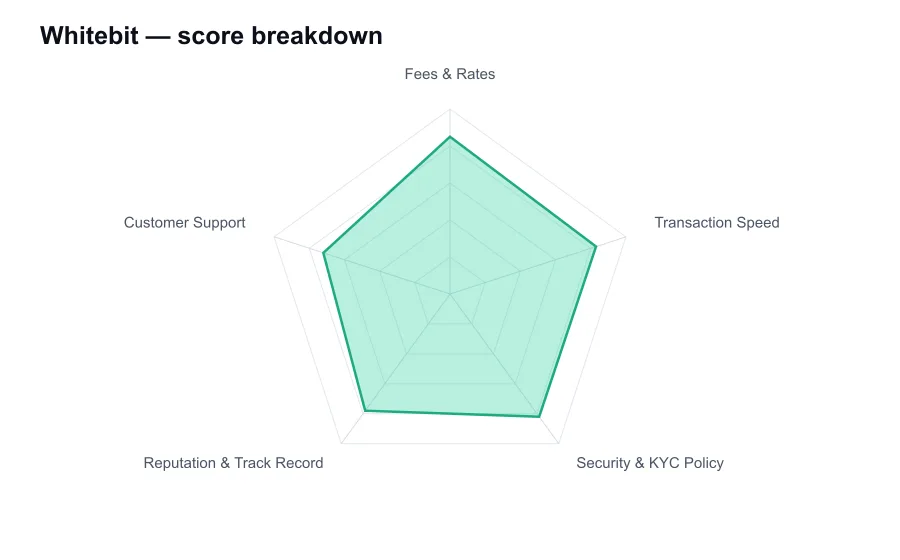
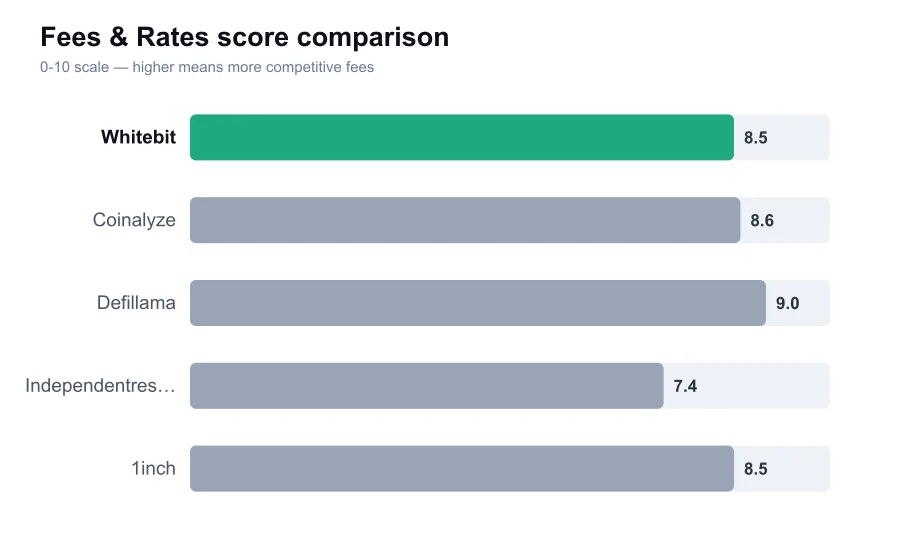
| Fees & Rates | 8.5 | Spot fees commonly up to 0.1%, though withdrawals vary by asset |
| Transaction Speed | 8.3 | Fast order matching on liquid markets, withdrawals depend on network checks |
| Security & KYC Policy | 8.2 | 2FA, cold storage claims, whitelisting and mandatory compliance controls |
| Reputation & Track Record | 7.8 | Large European presence, but less proven globally than top legacy exchanges |
| Customer Support | 7.2 | Good documentation, while compliance cases can take time |
In-Depth Review
WhiteBIT is a centralized cryptocurrency exchange with a very different proposition from the instant swap services in this group. It offers spot markets, a trading interface, fiat related services in supported regions, staking style products, and a sizeable selection of digital assets. Its strongest audience has historically been European retail users, particularly those looking for a relatively low cost alternative to the largest global exchanges without giving up familiar exchange features.
The exchange is not for somebody who wants to swap coins privately from one wallet to another. WhiteBIT requires account creation, and verification is a normal part of using the platform's full services. That can feel like friction after a no account exchanger, but it also places WhiteBIT in a more accountable operational category. Users receive an account history, formal withdrawal controls, and a clearer support trail if something goes wrong.
Fees are one of WhiteBIT's better selling points. Standard spot trading fees have commonly been advertised at up to 0.1 percent, with lower rates possible through fee schedules, liquidity programs, or selected trading pairs. That compares favorably with many retail exchanges and is far cheaper than the embedded spread of most instant conversion sites. A trader making repeated buys and sells will usually save meaningful money by using an order book rather than paying for one click convenience.
The caveat is that trading fees are not the whole bill. Withdrawal fees differ by asset and network, stablecoin withdrawals can change with network conditions, and a cheap trade can become expensive if the user moves small balances off the platform repeatedly. Deposit availability also depends on the asset and region. Before buying a token just because its spot fee looks appealing, inspect the withdrawal fee and minimum. That is where many exchanges quietly become less competitive.
Liquidity is respectable in the exchange's core markets, though not uniformly excellent across every listed asset. Major pairs such as BTC, ETH, USDT, and popular large cap coins generally offer a usable book and fast matching. Smaller altcoins can have wider spreads and thinner depth. WhiteBIT lists plenty of assets, but a listing should never be mistaken for a guarantee of deep, continuous liquidity. Limit orders are the right habit outside the busiest pairs.
Order execution itself is fast. For active users, the difference between WhiteBIT and an instant exchanger is night and day. A limit order that reaches the book can fill in seconds, and market orders on liquid pairs are near immediate. Withdrawals are another story, as they require blockchain processing and security checks. Crypto withdrawals may be approved promptly, but network congestion, wallet maintenance, or automated risk flags can extend the wait.
Security is a serious point in WhiteBIT's favor relative to smaller swap services. The platform promotes cold storage for the majority of customer assets, uses two factor authentication, email confirmation, anti phishing measures, address whitelisting, and withdrawal protections. These are standard defenses at a reputable centralized exchange, but they matter. A user who activates 2FA, uses a unique password, and enables withdrawal controls is far better protected than one relying on an email password alone.
Still, customers should not confuse security features with the absence of custodial risk. WhiteBIT controls the private keys to assets held on the exchange. It may have robust storage practices, but any centralized venue can face operational, regulatory, or counterparty risk. Long term holdings belong in a wallet where the owner controls the keys. WhiteBIT is a place to trade, convert, and access services, not a reason to abandon basic self custody discipline.
KYC is central to the WhiteBIT experience. Identity verification is expected, and users may face additional checks based on location, payment method, activity, or compliance requirements. For users who want a regulated style service, this is normal and arguably reassuring. For privacy first users, it is a decisive drawback. There is no honest way to treat WhiteBIT as a no KYC alternative, and people should not attempt to work around regional or verification rules.
The exchange has developed a substantial public profile, including brand partnerships and a broad European user base. That gives it more institutional weight than an obscure exchange launched around a single token cycle. WhiteBIT has also invested in a polished product ecosystem rather than only a basic buy and sell page. Its reputation is stronger than many offshore platforms, although it does not carry the same long global regulatory track record or public financial visibility as Coinbase, Kraken, or Bitstamp.
Its geographic and legal position deserves scrutiny. WhiteBIT operates through different entities and availability can vary by jurisdiction, so prospective users should check which service is offered where they live rather than relying on a generic global claim. Exchange regulation changes quickly, especially around derivatives, payment services, and stablecoins. A platform being accessible from a country today does not mean every product will remain available tomorrow.
Customer support is available through help resources and direct channels, and the exchange has put more effort into user facing documentation than many smaller competitors. Routine account questions and deposit issues are usually the kind of problem a centralized exchange can handle well because it has internal records. Account restrictions, KYC disputes, and compliance cases tend to be slower and less transparent. That is frustrating, but it is a familiar weakness across regulated exchanges rather than a WhiteBIT specific surprise.
The product range can also be a mixed blessing. WhiteBIT offers more than basic spot trading, including earn oriented and promotional products, but users should read every product term rather than assuming an advertised yield is equivalent to bank interest. Yield products carry counterparty and market risks, while promotional campaigns can distract from the simple question of whether the underlying trading market is good. The exchange is strongest at ordinary spot activity, not necessarily at every add on feature.
For a beginner, WhiteBIT's layout is friendlier than a professional derivatives platform, though there is still more to learn than on an instant swap site. The convert function is convenient, but the spot order book is often the better value for anyone willing to place a limit order. New users should also set 2FA before depositing, whitelist addresses if available, and complete verification before an urgent withdrawal is needed. Leaving these jobs until a problem arises is how avoidable stress begins.
WhiteBIT earns its place as a capable mid to upper tier centralized exchange, especially for European users who want low spot fees and a reasonably mature platform. It is not the privacy option, and it is not my first recommendation for holding large long term balances. But for trading liquid coins, converting funds, and moving money back to self custody, it has a much stronger practical foundation than a typical instant exchange. The best use of WhiteBIT is as an active trading venue, not as a permanent crypto vault.
Pros & Cons
| Pros | Cons |
|---|
Does WhiteBIT require identity verification?
Yes. WhiteBIT is an account based centralized exchange and verification is required for normal use of its services, subject to its jurisdiction and compliance rules.
What are WhiteBIT's spot trading fees?
Standard spot fees have commonly been listed at up to 0.1 percent. Rates can differ by pair, account conditions, and promotions, so check the current fee schedule before trading.
Is WhiteBIT safe for long term storage?
It has meaningful account security features, but it remains a custodian. For long term holdings, a hardware wallet or another self custodial solution is the safer default.