Editorial independence: our scores and rankings are produced using the fixed criteria above and are not influenced by advertisers. This is an independent ranking site and is not operated by, or affiliated with, any provider we list.
Affiliate disclosure: some links on this page may earn us a commission at no extra cost to you. This does not affect our rankings.
Live market data via CoinGecko, for informational purposes only. Not financial advice.
| Best for | Not for |
|---|---|
| Flexible isolated lending markets | Vault and market selection requires real due diligence |
Criteria Breakdown
| Criterion | Score | Notes |
|---|---|---|
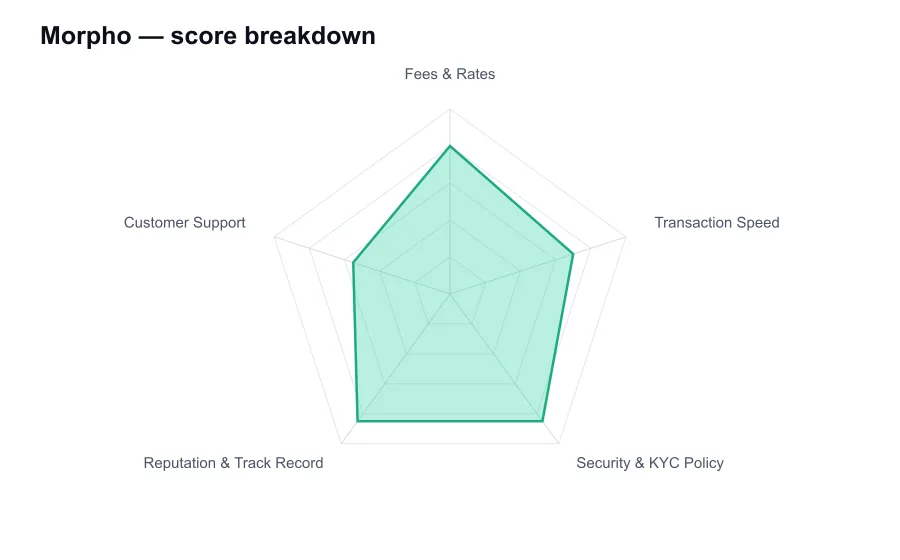
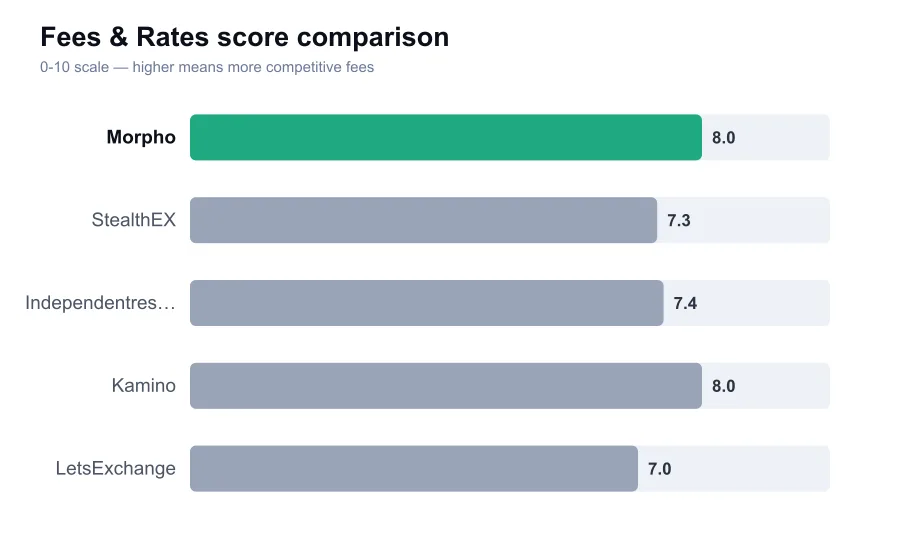
| Fees & Rates | 8.0 | Efficient core design, but vault fees and gas vary by market |
| Transaction Speed | 7.0 | Chain-dependent settlement and possible liquidity constraints |
| Security & KYC Policy | 8.5 | Strong technical posture, with market and curator risk remaining |
| Reputation & Track Record | 8.5 | A respected and increasingly important DeFi lending protocol |
| Customer Support | 5.5 | Good technical resources, but no personal liquidation rescue |
In-Depth Review
Morpho is a decentralized lending protocol that has become one of the more important pieces of modern DeFi credit infrastructure. It is not a conventional exchange, even though users can deposit assets, borrow against collateral, and earn yield. Morpho's core appeal is that it makes lending markets more configurable than older pool-based systems, giving curators and users room to define risk rather than accept one giant blended pool.
The protocol first gained attention by optimizing lending around established markets such as Aave and Compound. Its newer Morpho Blue architecture is the more important story today. Blue creates isolated, permissionless lending markets defined by a collateral asset, loan asset, liquidation loan-to-value ratio, oracle, and interest-rate model. This design is lean and flexible, but it places a bigger burden on market selection.
That trade is fundamental. Aave's large shared pools offer a familiar, curated environment, while Morpho lets specialists build vaults and markets with more tailored parameters. The upside is potentially better capital efficiency and risk control. The downside is fragmentation and complexity. Two markets that both lend USDC may have radically different safety profiles depending on collateral, oracle, liquidation terms, and the party managing the vault.
Fees on Morpho are not one neat number. Morpho Blue itself is designed to be minimal, while vault curators can charge management and performance fees, and borrowers pay market interest. Ethereum network gas is also a material cost. A headline APY is therefore only the start of analysis. Depositors need to ask what produces that yield, what curator fee applies, whether the rate is sustainable, and how quickly the vault can rebalance or withdraw.
For borrowers, the relevant cost is the annualized borrow rate plus gas, liquidation exposure, and any cost of sourcing or swapping collateral. The protocol can be highly competitive, particularly for users borrowing against blue-chip collateral in deep markets. But a low rate is no bargain if the collateral's volatility leaves little room before liquidation. DeFi borrowing punishes people who focus on interest while ignoring loan-to-value ratio.
Transaction speed is constrained by the chain. Morpho has a substantial presence on Ethereum and has expanded to other EVM environments, so normal actions settle according to the selected network's block times and congestion. On Ethereum mainnet, deposits, withdrawals, borrows, and repayments are usually straightforward but can be expensive at peak demand. On lower-cost networks, the same actions can feel much more accessible for smaller balances.
Borrowing speed should not be confused with instant economic certainty. The transaction can settle quickly, yet withdrawal liquidity may depend on borrowers repaying, liquidity being available in the market, or a vault reallocating funds. A lender can generally see this risk in advance, but it is easy to overlook. An advertised yield vault is not a bank savings account with guaranteed same-minute redemption under every market condition.
Security is a relative strength. Morpho's contracts have been developed with a serious security posture, including audits, formal verification efforts around core components, and bug-bounty practices. The protocol's lean design has attracted technically sophisticated users and curators. That said, DeFi security is never just a contract audit question. Oracle behavior, collateral liquidity, liquidator incentives, curator decisions, front-end risk, and governance all affect the real safety of a position.
Morpho Blue's permissionless nature deserves special emphasis. Anyone can create a market with arbitrary-looking parameters within the framework. That is innovation, but it means the Morpho name does not automatically make every market prudent. Users should favor recognized curators, transparent risk frameworks, reputable oracle configurations, and collateral they understand. A high yield on a tiny or exotic market is not evidence of opportunity. It is often evidence of risk demanding compensation.
KYC is not normally required for direct, self-custody interaction with the protocol. A wallet connects to the interface and transactions occur on-chain. As with other DeFi systems, no KYC does not mean anonymity, because blockchain activity is public and analytics firms can associate addresses with identities through other data. It also means there is no customer account desk that can reverse a bad signature or restore an inaccessible wallet.
Morpho has built an impressive reputation in a relatively short period. It is widely discussed alongside Aave, Spark, Euler, and other serious lending venues, and its vault-curator model has attracted recognizable DeFi risk managers. The project has also benefited from the market's move toward more explicit risk segmentation after years in which pooled lending sometimes obscured what depositors were financing. This is a protocol with real technical and market credibility.
Still, it is younger and more modular than the most conservative alternatives. Aave has a longer history of large-scale use and a simpler brand story for retail users. Morpho may offer a better fit for a sophisticated lender who wants differentiated exposure, but that sophistication is not free. You must decide whether to trust a curator, understand a vault allocation, and monitor changes. Passive users can drift into risks they never meant to take.
Support follows the usual DeFi pattern: documentation, community resources, and ecosystem channels instead of individualized financial support. That is sufficient for a developer or seasoned on-chain investor. It is not sufficient for someone who wants a phone number during a liquidation event. Be especially skeptical of direct messages from people claiming to be Morpho support. In DeFi, fake support is often more dangerous than the lack of official support.
I like Morpho most as a lending primitive and as a place for users willing to do credit work. It can provide excellent tools for collateralized borrowing and curated yield, but it does not absolve anyone from risk assessment. A stablecoin vault is only as sound as the loans, collateral, oracle, and curator behind it. That sounds obvious, yet it is precisely what yield dashboards encourage people to forget.
My final judgment is favorable for advanced DeFi users and cautious for everyone else. Morpho's architecture is elegant, its reputation is strong, and its configurable markets represent a real advance over one-size-fits-all pools. The same flexibility that makes it powerful can make it dangerous for a user who clicks the highest APY. Choose established vaults, keep collateral buffers generous, and treat borrowing as a position that requires monitoring, not a passive income feature.
Pros & Cons
| Pros | Cons |
|---|
Is Morpho a crypto exchange?
No. Morpho is primarily a decentralized lending protocol. Users can supply assets for yield or borrow assets against collateral, but it is not an order-book exchange or fiat on-ramp.
Does Morpho require KYC?
Direct use of Morpho's self-custody protocol normally does not require KYC. Transactions are public on the blockchain, and users remain responsible for legal and tax compliance.
Can I lose money lending on Morpho?
Yes. Risks include smart contract issues, oracle failures, bad debt, curator choices, market liquidity, and asset depegs. A high yield can reflect the risk carried by the lender.
What is Morpho Blue?
Morpho Blue is Morpho's permissionless isolated-market lending architecture. Markets are defined by specific collateral, loan asset, oracle, liquidation parameters, and interest-rate model.