Editorial independence: our scores and rankings are produced using the fixed criteria above and are not influenced by advertisers. This is an independent ranking site and is not operated by, or affiliated with, any provider we list.
Affiliate disclosure: some links on this page may earn us a commission at no extra cost to you. This does not affect our rankings.
Live market data via CoinGecko, for informational purposes only. Not financial advice.
| Best for | Not for |
|---|---|
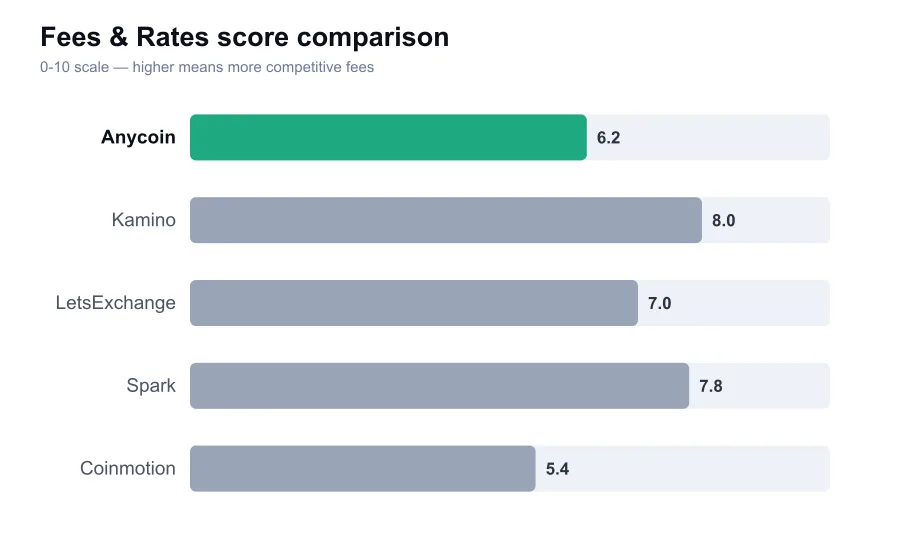
| Established Dutch broker operating since 2013 | Quoted rates can beat neither Bitvavo nor Kraken Pro |
Criteria Breakdown
| Criterion | Score | Notes |
|---|---|---|
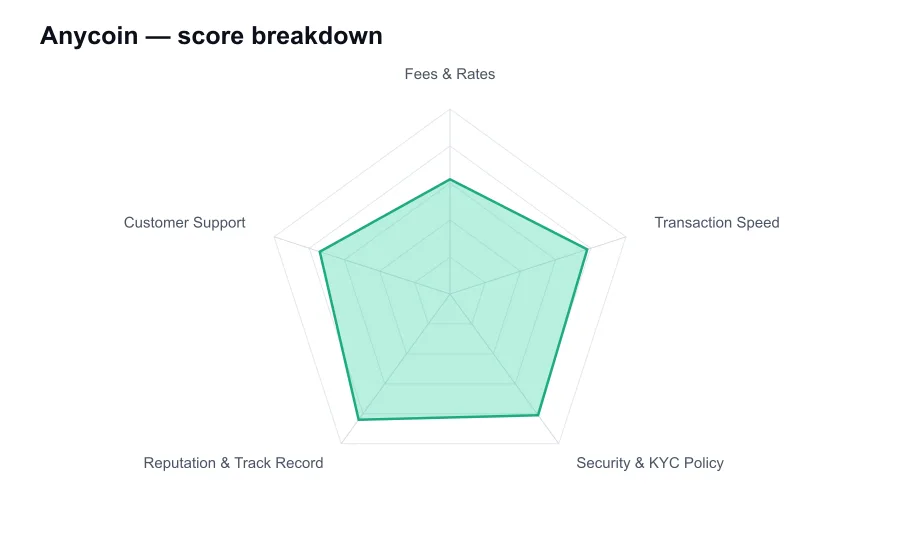
| Fees & Rates | 6.2 | Transparent quotes, but usually pricier than order-book exchanges |
| Transaction Speed | 7.8 | Fast with local payment rails, checks can delay first orders |
| Security & KYC Policy | 8.1 | Regulated KYC broker with direct external-wallet delivery |
| Reputation & Track Record | 8.4 | Dutch operator active since 2013 |
| Customer Support | 7.4 | Helpful for routine onboarding, not an instant rescue line |
In-Depth Review
Anycoin Direct is a Netherlands based crypto broker aimed at people who want to buy coins with euros without learning the mechanics of an exchange order book. It has been around since 2013, which gives it more history than many sleek broker apps that appeared during the last bull market. Its proposition is simple: choose an asset, pay by a familiar method, and receive it in your wallet. That simplicity remains its best feature, although it comes with the usual broker trade-off, a less competitive all-in price than an active trader can get on a deep exchange.
The service sits in the regulated European broker category alongside names such as Bitvavo, Coinmerce and Coinmotion. Anycoin does not try to be Binance. There is no serious derivatives venue, no charting suite for day traders, and no illusion that a casual buyer needs fifty technical indicators. The site is designed for a customer buying Bitcoin, Ethereum, Cardano or a handful of established altcoins and sending them to self-custody. That focus is sensible, but it also means experienced users can outgrow it fairly quickly.
Pricing needs a careful reading because Anycoin Direct does not present itself as a low-fee trading exchange with one neat maker and taker schedule. Its cost is built into the quoted rate, with payment method and transaction size affecting the final quote. The practical question is not whether a page advertises a zero fee, but how much crypto lands in your wallet for a given euro amount. On routine purchases, its spread has often been noticeably wider than the sharpest euro exchanges, particularly Bitvavo and Kraken Pro.
That does not make the pricing dishonest. Before confirming an order, the platform shows the amount, payment method and rate, and a buyer can decide whether convenience is worth the premium. But buyers should compare a live quote rather than assume that a familiar Dutch brand is automatically cheap. Card payments are normally the least attractive route because payment processing costs have to go somewhere. SEPA and Dutch bank transfer methods are generally the more sensible choice for users who care about the final number.
Anycoin's loyalty program, called Anycoin Direct Diamond, can improve rates for recurring customers. Higher membership tiers can bring discounts and other benefits, which makes more sense for someone making regular purchases than for a person buying crypto once a year. Still, loyalty discounts do not magically turn a broker into an order-book exchange. A regular investor should calculate the full annual cost, especially if they are buying monthly and could instead use a low-cost recurring purchase plan elsewhere.
Speed is usually good where the payment rail is good. Dutch customers using iDEAL have traditionally been able to complete a purchase quickly, and instant bank payment options can make the experience feel close to immediate. Crypto delivery still depends on the asset's network and the platform's compliance checks. Bitcoin can take longer than a quick payment suggests, while a transfer on a faster chain may arrive far sooner. A broker cannot repeal blockchain confirmation times, whatever its marketing copy says.
The less glamorous reality is that a first order, an unusual payment pattern, or a larger purchase may be reviewed manually. That can turn a quick purchase into a wait. It is not unique to Anycoin and it is not automatically a bad sign. In Europe, firms dealing with fiat and crypto are expected to look for fraud and money laundering. Anyone needing coins at a precise market moment should not rely on a broker transaction that may be subject to an extra review.
Anycoin Direct requires identity verification. That will disappoint privacy-focused buyers, but it is the normal price of using a regulated euro on-ramp. Users should expect personal details, identity documentation and, in some cases, questions related to a transaction or source of funds. The company has operated under Dutch and European compliance expectations and has publicly emphasized registration and regulatory obligations. This is a much more accountable setup than an anonymous swap site, but it also means there is no realistic path to buying large amounts anonymously.
The security model deserves a nuanced view. Anycoin lets customers supply an external wallet address, and that is a meaningful advantage over leaving a long-term holding at a custodial exchange. If you withdraw to a wallet you control, counterparty exposure after delivery is greatly reduced. The responsibility moves to the customer, though. Sending coins to a wrong address, choosing an unsupported network, or losing a recovery phrase is not something a broker can fix after the blockchain confirms the transaction.
For account protection, customers should use a unique password, enable available two-factor authentication, and treat every email requesting a wallet change or payment as suspicious until verified independently. The larger threat for many retail buyers is not a sophisticated attack on Anycoin, but social engineering. Scammers regularly persuade new crypto users to buy coins and send them to fraudulent investment platforms. A legitimate broker can screen for suspicious patterns, yet it cannot protect a user who insists on sending funds to a scammer.
Its track record is one of the stronger parts of the offering. Founded in 2013, Anycoin has survived multiple market cycles, banking pressure, regulatory changes and the collapse of several louder competitors. Longevity is not a guarantee of future performance, but it matters in a sector where plenty of providers vanish after a difficult year. The company has built a recognizable presence in the Netherlands and broader Europe rather than relying solely on affiliate hype.
That said, reputation should not be confused with universal acclaim. Customer feedback for crypto brokers often splits sharply between buyers whose order sailed through and buyers whose verification or payment was delayed. Anycoin is no exception. Complaints about requested documents, account limitations, or a transaction taking longer than expected are frustrating, but they need to be judged against the fact that regulated firms are supposed to intervene in suspicious cases. The more serious question is whether support explains the issue clearly and resolves it without endless scripted replies.
Support is available through the company's help resources and contact channels, with a reputation for being more approachable than an offshore exchange ticket queue. That is useful for first-time buyers who may need help with wallet addresses, payment methods or verification. It is not a substitute for immediate telephone intervention at any hour, and it should not be mistaken for investment advice. The help experience is strongest on ordinary account and purchase questions, not on fixing irreversible user mistakes.
The asset list is broad enough for mainstream investors, but selection should not be the reason to choose Anycoin. Newer tokens, obscure chains and speculative memecoins are not where this platform shines. That restraint can be a virtue. A beginner who has not yet learned why a token exists does not need a broker pushing hundreds of illiquid names. Still, users seeking broad market access, advanced orders, staking options or perpetual futures should look to an exchange built for those jobs.
There is also an important distinction between buying through a broker and trading on an exchange. With Anycoin, the customer generally accepts the rate offered for the transaction rather than placing a limit order into a live market. That means there is less control during volatile periods. If Bitcoin jumps while a payment is being processed, the final execution mechanics and quote expiry matter. Read the confirmation screen, do not assume the rate shown several minutes ago is locked forever.
For an investor in the Netherlands or another supported European market who wants a straightforward regulated route into self-custody, Anycoin Direct is a credible choice. It is especially suitable for people who value iDEAL style convenience, clear purchase flows and a company with a long local track record. It is not the cheapest venue for frequent trading, nor is it the right home for a large active portfolio that needs advanced tools. My view is that Anycoin earns trust through restraint and longevity, but buyers should pay close attention to the live quote because convenience is exactly what they are paying for.
Pros & Cons
| Pros | Cons |
|---|
Does Anycoin Direct require KYC?
Yes. Anycoin Direct is a regulated broker and requires identity verification before users can make purchases.
Are Anycoin Direct fees shown separately?
The effective cost is primarily reflected in the offered quote and can vary by asset, payment method and transaction size. Compare the final amount received.
Can I send crypto to my own wallet?
Yes. Customers can provide an external wallet address, which is preferable for long-term holders who want to control their own keys.