Editorial independence: our scores and rankings are produced using the fixed criteria above and are not influenced by advertisers. This is an independent ranking site and is not operated by, or affiliated with, any provider we list.
Affiliate disclosure: some links on this page may earn us a commission at no extra cost to you. This does not affect our rankings.
Live market data via CoinGecko, for informational purposes only. Not financial advice.
| Best for | Not for |
|---|---|
| Fast, low-cost Solana transactions | Leverage and liquidation risk can escalate quickly |
Criteria Breakdown
| Criterion | Score | Notes |
|---|---|---|
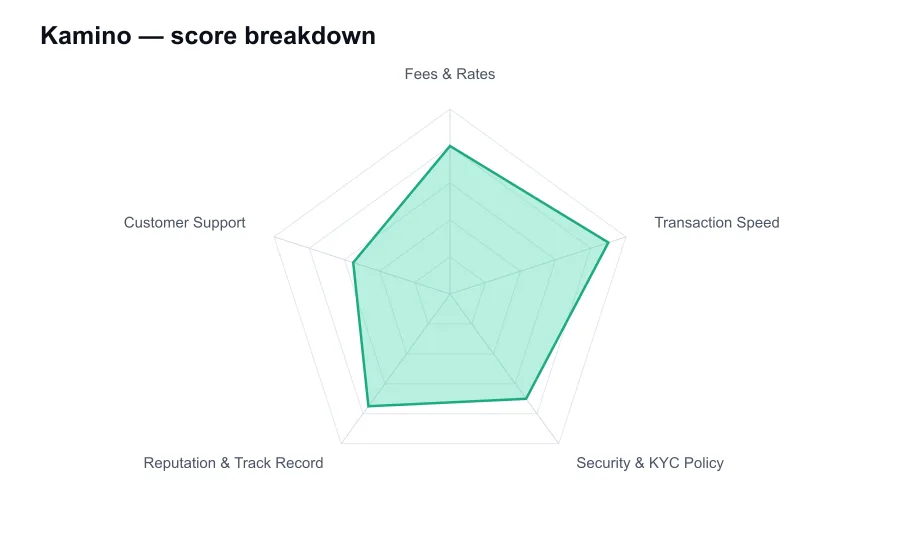
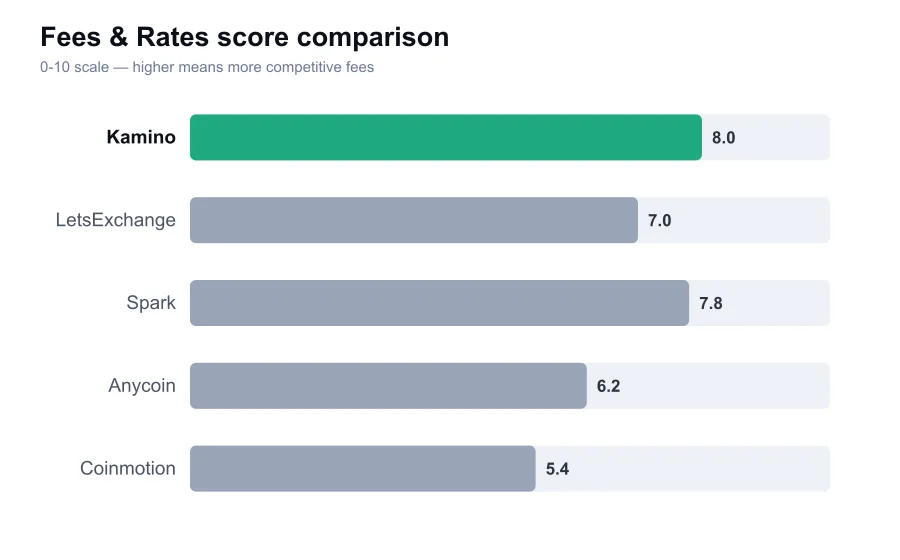
| Fees & Rates | 8.0 | Low Solana network costs, with product-specific borrowing and vault costs |
| Transaction Speed | 9.0 | Usually confirms in seconds on Solana |
| Security & KYC Policy | 7.0 | Audited and established, but lending and leverage add risk |
| Reputation & Track Record | 7.5 | A leading Solana DeFi name, though younger than Aave |
| Customer Support | 5.5 | Useful docs and community support, no transaction rescue |
In-Depth Review
Kamino is a Solana-native DeFi protocol that combines lending, borrowing, concentrated liquidity management, and leveraged strategy tooling. It is not a basic exchange despite the way some users first encounter it. Kamino sits closer to a financial operating layer for Solana power users, where deposits can earn yield, collateral can be borrowed against, and liquidity positions can be automated.
Its rise is tied to Solana's recovery as a serious DeFi ecosystem. Solana offers low transaction costs and fast confirmations, which makes strategies that would be impractical on Ethereum mainnet far more accessible. Kamino takes advantage of that environment well. Rebalancing a liquidity position or adjusting collateral is not free, but it generally costs pennies rather than the painful fees Ethereum users associate with active DeFi management.
Kamino Lend is the protocol's clearest product. Users can supply supported assets to earn variable interest or borrow against collateral. Rates are market-driven, changing with utilization, and that is a key point. A displayed supply APY is not a promise. It can drop quickly as borrowing demand changes, while a borrow rate can rise sharply during volatile markets or heavy leverage demand.
The interface is polished by DeFi standards. Health factors, collateral positions, projected rates, and available liquidity are presented in a way that gives users a better starting point than many early Solana applications did. But it still assumes financial literacy. A green health factor does not mean a position is safe forever, and a borrower who ignores price volatility can get liquidated surprisingly fast.
Fees vary by product rather than following one simple exchange tariff. Lending and borrowing costs are reflected mainly in dynamic interest rates. Liquidation penalties apply when positions breach risk parameters. Vault products can charge management or performance-related fees depending on the strategy, and swap execution carries the usual price impact and network costs. Solana's low base fees are excellent, but they should not distract from the much larger economic cost of bad leverage.
Transaction speed is a genuine advantage. Solana transactions often confirm in seconds, and Kamino's actions normally feel responsive when the network is healthy. During periods of intense memecoin activity, though, Solana has experienced congestion and failed or delayed transaction attempts. The chain has improved materially, but users relying on a last-second collateral top-up should not assume every transaction will land perfectly on the first try.
Kamino's automated liquidity vaults are appealing because concentrated liquidity on platforms such as Orca and Raydium can be labor-intensive. A managed vault can rebalance a range and compound fees without requiring constant manual intervention. That convenience comes with strategy risk. A vault is not a savings account, and concentrated liquidity can suffer from adverse selection, impermanent loss, and movement into a one-sided token position.
The protocol also offers Multiply-style leverage features in certain markets. These tools can make capital more efficient, allowing users to build amplified exposure to assets such as SOL or liquid staking tokens. They are useful for traders with a clear thesis and strict liquidation discipline. For many users, they are simply an easier interface for taking more risk than they can comfortably manage.
Security is respectable for a fast-growing Solana protocol, but it should be scored as strong rather than untouchable. Kamino has used third-party audits and has operated a bug bounty program, while its code and risk management have been tested by substantial onchain usage. Still, lending protocols are complex systems. Oracle failures, liquidation cascades, smart contract flaws, governance decisions, and collateral depegs can all hurt users without a hacker ever touching their wallet.
Kamino's oracle and reserve configuration choices matter enormously. Borrowing against volatile tokens or liquid staking derivatives is not equivalent to borrowing against cash. Risk parameters, loan-to-value ratios, borrow caps, and liquidation thresholds are there because markets can move violently. Sophisticated users should read those figures before opening a position rather than treating the maximum available borrow amount as a recommendation.
There is no normal identity verification process for accessing Kamino directly with a Solana wallet. That permissionless design is a plus for privacy-minded users, but it also means no account recovery desk exists. Lose your seed phrase, approve a malicious transaction, or send assets to the wrong address, and Kamino cannot undo the result. Users should use a hardware wallet for material balances and verify every transaction prompt.
Kamino has built a strong reputation within Solana, especially after the 2023 and 2024 expansion of the ecosystem. It is regularly discussed alongside Marinade, Jito, Jupiter, Drift, MarginFi, and the major Solana DEXs. That is credible company. It has not yet accumulated the multi-cycle, multi-billion-dollar longevity of Aave, but it has moved beyond the stage where it can be dismissed as an experimental app.
Support is decent for DeFi but limited in the way all non-custodial protocols are limited. Documentation, Discord, X updates, and community help are available. The team and moderators can explain product behavior, but they cannot reverse liquidations or reimburse a trade just because a user misunderstood risk. Fake support messages are a persistent danger, particularly in Discord, so private messages should be treated as suspicious by default.
The biggest practical strength is that Kamino makes Solana DeFi feel more coherent. Lending, leverage, and managed liquidity are linked in one recognizable environment rather than scattered across half a dozen rough applications. The biggest weakness is also its ambition. The more product layers a user combines, the harder it becomes to see their true exposure across token price risk, funding cost, vault risk, and liquidation risk.
Kamino is compelling for people who already understand Solana wallets and want active capital to do more than sit idle. It is not where I would send someone who has never borrowed against collateral or who treats yield as guaranteed income. The protocol's low costs and fast settlement are real advantages. Just do not confuse a smooth interface with a simple risk profile, because Kamino can get complicated quickly.
Pros & Cons
| Pros | Cons |
|---|
Does Kamino require KYC?
Direct wallet access to Kamino does not normally require platform KYC. A centralized exchange used to buy SOL or USDC may require identity verification.
How fast are Kamino transactions?
Kamino transactions usually confirm within seconds on Solana. Network congestion, wallet issues, and priority fee conditions can still cause failed or delayed attempts.
Can I lose funds in a Kamino vault?
Yes. Vaults can face impermanent loss, token price declines, strategy risk, smart contract risk, and changes in fees or incentives. Yield is not guaranteed.