Editorial independence: our scores and rankings are produced using the fixed criteria above and are not influenced by advertisers. This is an independent ranking site and is not operated by, or affiliated with, any provider we list.
Affiliate disclosure: some links on this page may earn us a commission at no extra cost to you. This does not affect our rankings.
Live market data via CoinGecko, for informational purposes only. Not financial advice.
| Best for | Not for |
|---|---|
| Large range of supported assets | Final price can lose to direct spot trading |
Criteria Breakdown
| Criterion | Score | Notes |
|---|---|---|
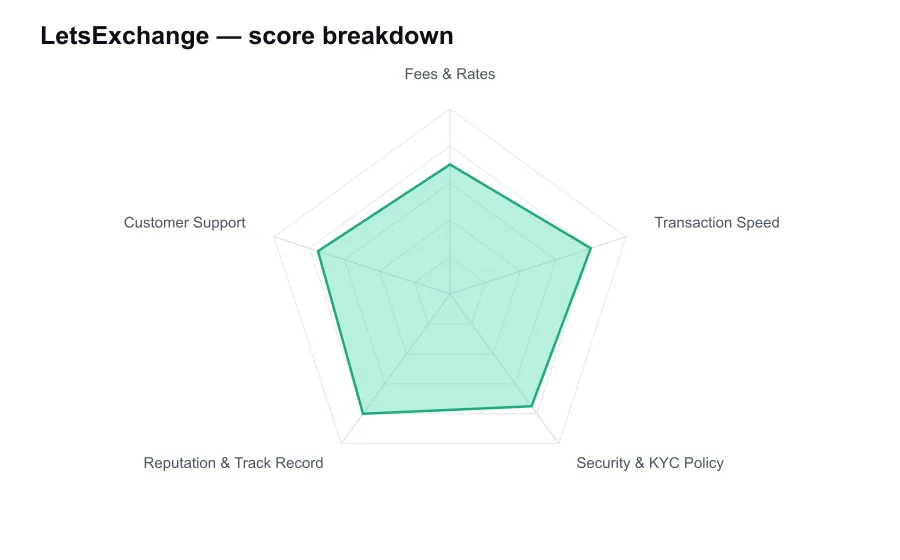
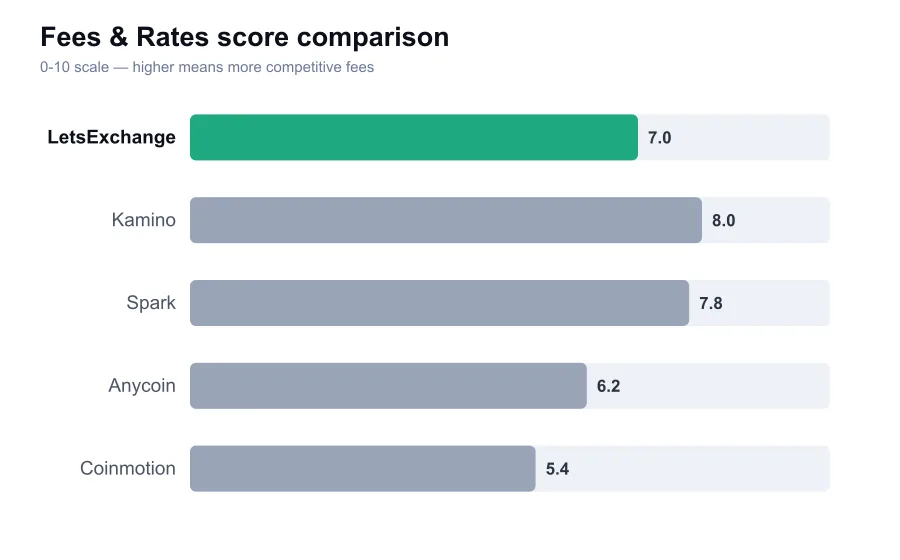
| Fees & Rates | 7.0 | Competitive routing, but the spread varies by route |
| Transaction Speed | 8.0 | Efficient routing and useful order tracking |
| Security & KYC Policy | 7.5 | Non-custodial flow with risk-based verification |
| Reputation & Track Record | 8.0 | Established since 2020 with broad integrations |
| Customer Support | 7.5 | Live chat, email and transaction-level assistance |
In-Depth Review
LetsExchange is an instant crypto exchange and liquidity-routing platform rather than a traditional trading venue. It is designed for users who want to exchange assets directly from one wallet to another without maintaining an account balance on the service. Since launching in 2020, it has become one of the more visible names in the non-custodial swap segment, competing with ChangeNOW, SimpleSwap, StealthEX, Changelly and Godex.
Its proposition is broader than a basic coin converter. LetsExchange supports a large catalogue of cryptocurrencies and tokens, provides fixed and floating exchange modes, and has built an API and widget business for wallets and other crypto products. That infrastructure focus matters. A provider embedded in third-party products has stronger incentives to keep its routing, uptime and support operations functional than a site relying only on occasional direct visitors.
The experience is suitably lean. Select what you are sending, select what you want back, enter the receiving address, and the site presents a quote and deposit address. There is no complex charting package, no margin screen and no custodial account to fund. That is a strength for a user who already knows what they want. It is less suitable for a beginner who needs education, recurring purchases, bank deposits or a proper trading terminal.
LetsExchange does not advertise a single flat fee that applies to every conversion. Instead, the effective cost is built into the quote and varies according to the selected route, liquidity, blockchain fees, and whether the user chooses a fixed or floating rate. The company has publicly described its commission as being included in the displayed rate, with market conditions influencing the final outcome. That is transparent enough only if users compare received amounts, not marketing language.
On popular pairs, LetsExchange is often competitive because it can source liquidity through multiple partners. It will not always win. Direct spot trading on Kraken, Coinbase Advanced, Binance where available, or a decentralized exchange can be cheaper for users willing to handle a more involved process. LetsExchange charges for convenience, routing and a single-screen execution path. For many wallet users, that trade is reasonable. For frequent high-volume traders, it is not.
The fixed-rate tool is one of its better features. A fixed quote can protect the expected payout from a sharp price move while the deposit is travelling through the network. There are limits to that protection, particularly if the user sends too little, too much, or after the deposit window has expired. Read the order terms and send the exact requested amount. Fixed rate does not mean every mistake or delayed deposit is automatically covered.
Speed is generally good for a service in this category. The actual timetable has three parts: confirmation of the incoming transaction, execution through a liquidity provider or route, and confirmation of the outgoing payment. Fast chains and liquid pairs may settle in minutes. Bitcoin and congested networks can take longer before LetsExchange can safely process the deposit. That is blockchain mechanics, not necessarily a service failure.
LetsExchange provides an order-status page and transaction information, which is more useful than vague progress messages. On a normal order, users can follow the deposit and payout rather than simply waiting for an email. The platform also publishes service information around supported assets and exchange flow. I would still avoid making an urgent payment through any instant exchange. If a transfer absolutely must arrive at a particular minute, crypto network confirmations and liquidity maintenance introduce too many variables.
The company presents itself as non-custodial, meaning coins are exchanged rather than held in a permanent customer account. That reduces exposure to the kind of large balance-sheet collapse seen at centralized exchanges, but it does not make the service trustless. During execution, LetsExchange and its partners are involved in the asset flow. Users should verify the destination address themselves and understand that they are relying on the provider's routing and compliance decisions.
Routine account creation is not required for most swaps, and the platform is often described as no-KYC. That phrase needs a footnote. LetsExchange maintains AML and risk-monitoring procedures and can ask for documents or source-of-funds information where a transaction triggers review. Users who believe no-KYC means no questions under any circumstances are misunderstanding how serious instant exchanges operate in 2026.
From a security and policy perspective, LetsExchange is stronger than a lightly documented newcomer because it has public policies, a visible brand history, partner integrations and a support footprint. It is not a licensed bank, a regulated brokerage, or a self-custody protocol. The sensible approach is to keep your own keys, send only what you intend to exchange, and do not use the service as a place to park funds.
Its reputation is solid but not spotless, which is exactly what I expect from a high-volume instant exchange. Public review sites contain many reports of successful swaps, alongside complaints about rate differences, delayed orders and compliance checks. The important question is whether problems are inherent to the model or point to a repeated pattern of bad faith. LetsExchange has enough years in operation and enough partner visibility that I view it as a credible established provider, though not beyond criticism.
Support is available through live chat and email channels, with a help centre that explains common order issues. Responses are usually most effective when the user provides the order ID, transaction hash and screenshots immediately. Support cannot reverse a blockchain payment sent to the wrong address, and it cannot always bypass a liquidity or compliance review. Still, the presence of a recognizable support operation puts LetsExchange ahead of anonymous swap sites that leave users with only a generic form.
LetsExchange is one of the better choices for a user who values breadth of assets, wallet-to-wallet convenience and a fixed-rate option. It is not the cheapest route in every situation, and its no-registration language should not be mistaken for immunity from verification. But it has a more credible operating record than many instant-exchange competitors. For ordinary swaps, it belongs on the shortlist, provided you check the quoted payout before committing.
Pros & Cons
| Pros | Cons |
|---|
Does LetsExchange charge a fixed fee?
There is no universal flat fee for every pair. The platform's effective cost is included in the displayed quote and varies with liquidity, network costs, route and fixed or floating rate selection.
Can LetsExchange ask for KYC?
Yes. Registration is not routinely required, but AML and risk checks may trigger a request for verification or transaction information.
How long does a LetsExchange swap take?
Liquid swaps on fast networks can complete within minutes after confirmation. Bitcoin deposits, congested chains, maintenance and compliance reviews can extend the process.
Is LetsExchange a wallet?
No. It is an exchange service for routing a conversion between wallets. You should control the destination wallet and avoid treating the service as long-term storage.