Editorial independence: our scores and rankings are produced using the fixed criteria above and are not influenced by advertisers. This is an independent ranking site and is not operated by, or affiliated with, any provider we list.
Affiliate disclosure: some links on this page may earn us a commission at no extra cost to you. This does not affect our rankings.
Live market data via CoinGecko, for informational purposes only. Not financial advice.
| Best for | Not for |
|---|---|
| Connected to the established Sky ecosystem | Liquidation risk for borrowers |
Criteria Breakdown
| Criterion | Score | Notes |
|---|---|---|
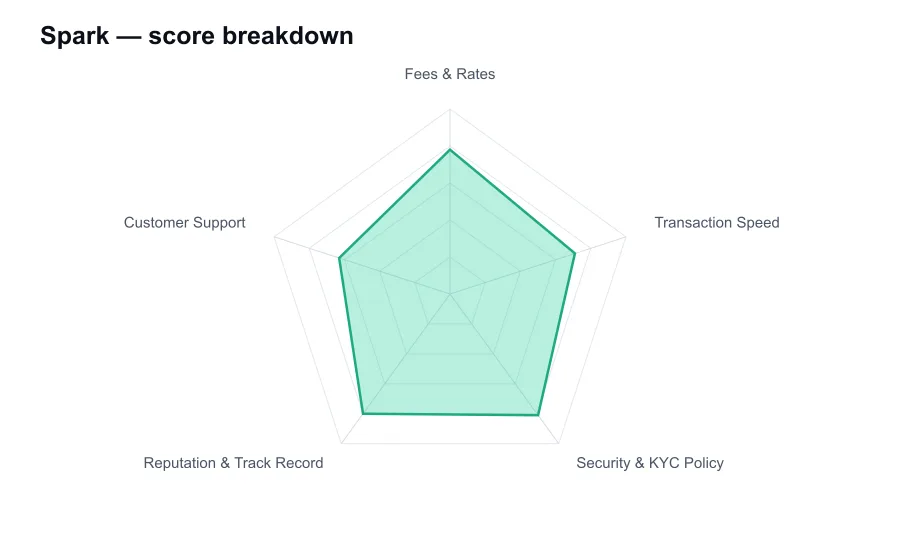
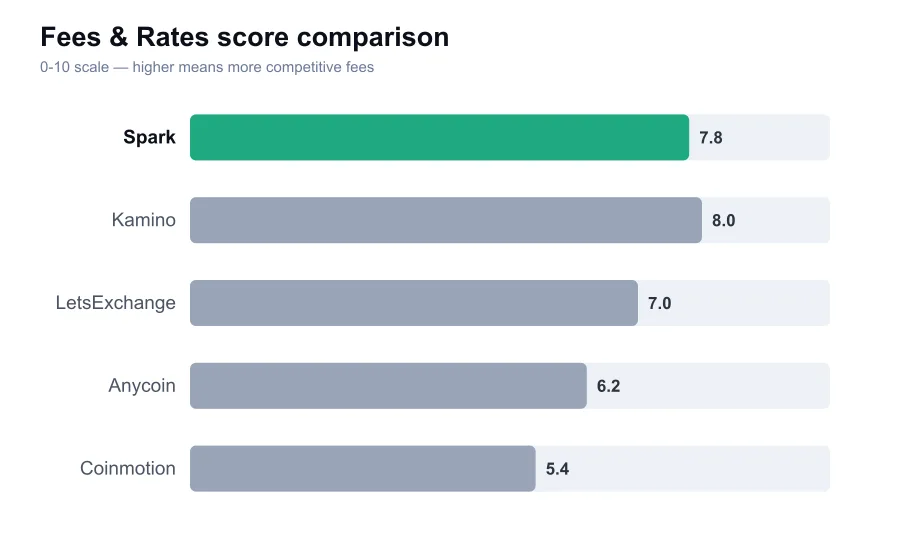
| Fees & Rates | 7.8 | Competitive protocol rates, but Ethereum gas matters |
| Transaction Speed | 7.1 | Transparent on-chain settlement, subject to Ethereum |
| Security & KYC Policy | 8.1 | Established DeFi design with layered protocol risk |
| Reputation & Track Record | 8.0 | Strong Sky ecosystem lineage and public governance |
| Customer Support | 6.3 | Good documentation, but no transaction recovery |
In-Depth Review
Spark is not a conventional crypto exchange, and judging it like one would miss its purpose. It is a DeFi lending and savings ecosystem built around the Sky ecosystem, formerly MakerDAO, with a strong focus on DAI, USDS, ETH, and related on-chain liquidity. The product is designed for people who want to borrow against collateral, earn protocol-defined savings rates, or access efficient stablecoin liquidity. It competes more directly with Aave, Morpho, Maker's legacy interfaces, and certain centralized stablecoin yield products than with spot exchanges.
That positioning gives Spark a clear advantage over vague all-purpose DeFi brands. It has a recognizable protocol lineage, public governance context, and an economic relationship with one of crypto's longest-running collateralized stablecoin systems. SparkLend has used an Aave-style lending market design, while Spark Savings provides access to savings mechanisms connected to Sky's stablecoin architecture. It is a serious protocol, not a generic swap page with little visible infrastructure behind it.
The fee picture is nuanced. Depositors do not face a simple trading commission in the way they would on Coinbase or Kraken. Their return is expressed through a variable lending rate or a savings rate, depending on the product used. Borrowers pay interest, and the relevant cost is the annualized borrowing rate plus any transaction costs needed to open, adjust, or close a position. Rates move with utilization, governance parameters, and market conditions.
Spark's direct protocol economics can be attractive, especially for stablecoin-focused users. The savings side has at times offered rates that are compelling compared with idle stablecoins in a wallet, while lending markets can provide competitive borrowing terms for major assets. But users should not confuse an attractive displayed annual percentage yield with a guaranteed bank deposit rate. Smart contract risk, stablecoin-specific risk, and changing protocol parameters remain part of the deal.
There is no reason to use Spark if you cannot explain how liquidation works. A collateralized loan is not free money. You deposit eligible collateral, borrow against it, and must maintain a safe health factor. If the value of collateral falls or the borrowed asset rises relative to it, liquidation can occur. In volatile conditions, a position that looked conservative on a calm afternoon can become dangerous much faster than a casual user expects.
Spark is usually most sensible for people already comfortable with DAI or USDS and with on-chain borrowing. Someone holding ETH who needs stablecoin liquidity without immediately selling may find the lending model useful. Someone holding stablecoins and seeking a protocol-native savings route may also find it compelling. A person who simply wants to buy Bitcoin with a debit card, trade meme coins, or cash out to a bank should look elsewhere. Spark does not solve those jobs.
Transaction speed is governed by the network used and by the action being performed. A simple deposit or withdrawal can settle as soon as the underlying blockchain confirms it, often within minutes on Ethereum under ordinary conditions. That is slower and more variable than an internal update on a centralized exchange, but it is transparent. You can watch the transaction, inspect the contract interaction, and see whether it completed without relying on a company email.
Ethereum gas fees are the visible friction. During normal periods, opening or adjusting a lending position can be tolerable for a meaningful balance. During network congestion, the same actions become expensive and may be impractical for small users. That makes Spark a poor fit for someone depositing a few hundred dollars and frequently moving funds. Gas can eat an uncomfortable portion of expected yield, especially if the user enters and exits repeatedly.
Security is one of Spark's stronger areas, though strong does not mean risk-free. The protocol benefits from established DeFi engineering patterns, public governance attention, and a design tied into the mature Sky ecosystem. Its contracts and integrations have been subject to security review processes. Even so, composable DeFi has layered risk. A user is exposed not only to Spark's own contracts, but potentially to oracle behavior, governance changes, stablecoin mechanics, and the broader Ethereum environment.
The KYC policy is a major distinction from centralized lending accounts. Standard on-chain interactions do not require users to submit an ID document or create a conventional personal profile. That is useful for self-custody users, but it should not be misread as legal insulation. Wallet activity is public, interfaces may apply geographic restrictions, and regulated ramps into or out of crypto have their own compliance rules.
Spark's reputation is considerably better than that of a new DeFi application because it is connected to a protocol family that has lived through multiple market cycles, stablecoin stress events, and intense public scrutiny. MakerDAO, now Sky, has had governance controversies and risk debates over the years, but that is also evidence of a real, visible system rather than an anonymous product. The protocol has been tested by actual market pressure.
Support follows the DeFi model rather than the brokerage model. Documentation, governance forums, Discord, and community channels can be useful, especially for understanding parameters and troubleshooting interface issues. They will not provide the kind of account-specific intervention a bank customer expects. If you sign the wrong transaction, lose your wallet keys, or allow a liquidation threshold to get too close, support cannot simply undo the result.
For disciplined users, Spark can be a good tool. I like its focus. It does not pretend to be a universal exchange, and its relationship to the Sky ecosystem gives it a more intelligible foundation than many yield products. The trade-off is complexity. You need to monitor collateral, understand the asset you are borrowing, and accept that stablecoin yield is compensation for protocol and market risk rather than a gift.
My final view is positive but selective. Spark is among the more credible DeFi choices for stablecoin savings and collateralized borrowing, particularly for users already operating on Ethereum and familiar with self-custody. It is not beginner finance, and it is not an emergency liquidity solution if gas costs are high or your collateral is close to liquidation. Used conservatively, with a healthy buffer and realistic expectations, it is a strong protocol. Used casually, it can punish the same overconfidence that hurts borrowers everywhere.
Pros & Cons
| Pros | Cons |
|---|
Is Spark a crypto exchange?
Not in the usual spot-trading sense. Spark focuses on DeFi lending, borrowing, stablecoin savings, and liquidity. It is better compared with Aave or Morpho than with Coinbase or Kraken.
Does Spark require KYC?
Normal protocol interactions are performed through a self-custody wallet and do not use a conventional account-opening process. Your wallet activity remains public on-chain and other crypto services may have their own compliance checks.
Can I lose collateral on Spark?
Yes. Borrowed positions can be liquidated if the collateral value falls enough relative to debt. Keep a substantial health buffer and understand the liquidation parameters before borrowing.