Editorial independence: our scores and rankings are produced using the fixed criteria above and are not influenced by advertisers. This is an independent ranking site and is not operated by, or affiliated with, any provider we list.
Affiliate disclosure: some links on this page may earn us a commission at no extra cost to you. This does not affect our rankings.
Live market data via CoinGecko, for informational purposes only. Not financial advice.
| Best for | Not for |
|---|---|
| Finnish provider with a long operating history | Entry-level trading fees are expensive |
Criteria Breakdown
| Criterion | Score | Notes |
|---|---|---|
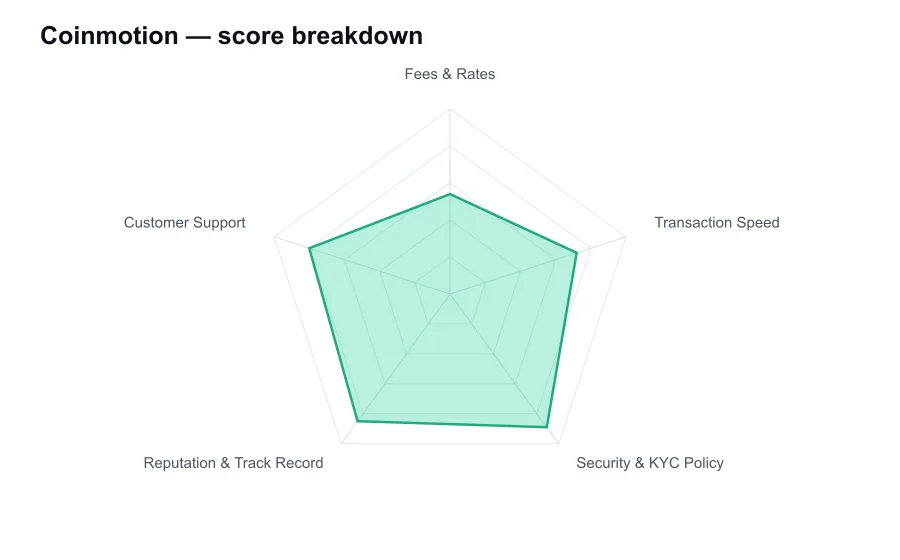
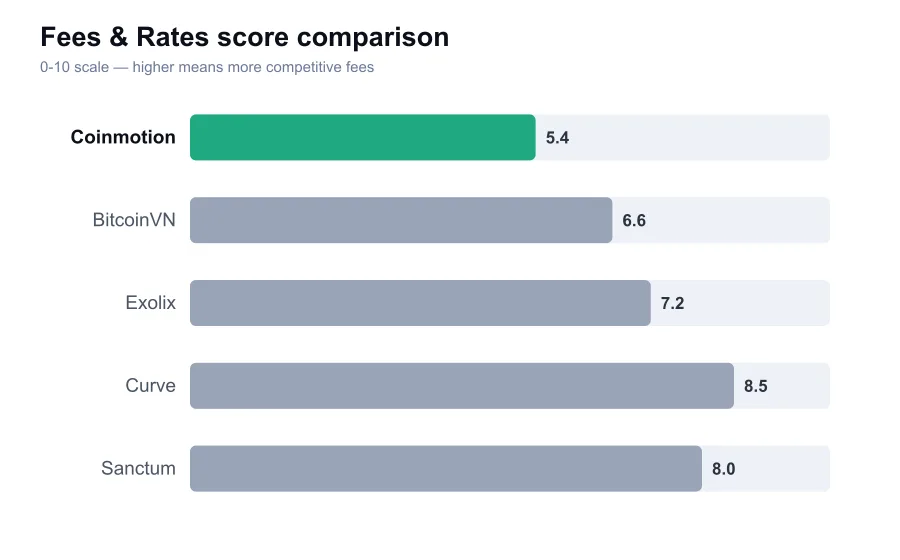
| Fees & Rates | 5.4 | Standard retail fees are high, with better rates at volume |
| Transaction Speed | 7.2 | Routine purchases are smooth, vault withdrawals are intentionally delayed |
| Security & KYC Policy | 8.9 | Strong custody focus, KYC controls and delayed-withdrawal vault |
| Reputation & Track Record | 8.5 | Finnish operator with roots going back to 2012 |
| Customer Support | 8.0 | Local-language support and premium service are real strengths |
In-Depth Review
Coinmotion is a Finland based crypto service that has spent years building a more conventional financial-services identity than the average exchange. It began as Bittiraha in 2012 and later adopted the Coinmotion name, making it one of Europe's longer-running operators. The product is aimed at investors who want to buy, store and use major cryptocurrencies through a regulated European company, with a particular appeal for Finnish users. It is not built for adrenaline-driven day trading, and it is better for that.
The service feels closer to a crypto wealth platform than a global exchange. Customers can buy established assets, make recurring purchases, use a vault-style storage feature, access crypto-backed lending products where available, and in some markets obtain a payment card. Coinmotion also operates a premium service for larger clients. This is a coherent package for someone who wants a managed gateway into crypto, but it is not the place to find every new token or trade perpetual futures at high leverage.
The first issue to understand is price. Coinmotion's standard trading fees have historically been higher than the cheapest order-book exchanges, with published rates commonly starting around 2 percent for lower-volume customers and falling substantially as trading volume rises. The exact pricing and tier thresholds must be checked on the current fee page, because services and regional terms can change. But the broad verdict is stable: Coinmotion is a premium-priced broker style service at the entry level.
That headline number will put off fee-sensitive traders, and frankly it should. A customer making many small trades can give away a significant amount of return through a 2 percent class of fee before market movement even enters the picture. The rate becomes more defensible for someone using the platform's convenience, local support and custody features, or for high-volume clients qualifying for lower tiers. It is not defensible to pretend that a new retail buyer pays the same as a professional using a low-cost exchange.
Deposit, withdrawal and network costs also deserve checking before each transfer. Bank payments may be inexpensive or free depending on method and country, while crypto withdrawals incur blockchain costs and platform policies can vary by asset. The Coinmotion card has its own terms and may involve conversion or usage charges depending on how it is used. This is normal, but the service has enough moving parts that users should not rely on a single advertised trading percentage as their total cost of ownership.
Speed is good for routine purchases once an account is verified and funded. SEPA transfers can be practical for European users, while instant payment availability depends on the customer's bank and the applicable payment method. Crypto transfers then depend on network conditions and internal security processing. Coinmotion's vault feature intentionally adds delay to withdrawals, which is a security benefit but obviously not a speed benefit. Customers should not place coins in a delayed vault if they expect to trade or move them at a moment's notice.
That vault is one of Coinmotion's most distinctive features. It is designed to provide an extra layer of protection for holdings by using time-delayed withdrawal procedures and additional confirmation steps. For long-term investors, this is more valuable than another flashy chart. It creates time to react if an account is compromised. For an active trader, it is inconvenient by design. The feature only works if users understand that protection and instant access are competing goals, not things a platform can maximize simultaneously.
Coinmotion operates in a European regulatory environment and requires customer identification. Expect KYC checks, personal details and potentially further questions for larger or unusual transactions. There is no anonymous mode for customers who want access to banking and card features. That is not a shortcoming unique to Coinmotion, it is the cost of using a service that wants to operate openly with euro payment rails. People who object to KYC should not sign up hoping to find a loophole.
Security is among Coinmotion's strongest selling points. The company has emphasized cold storage, segregated customer holdings and multi-signature security arrangements, while its vault product gives users a practical account-level control. These are meaningful features, not mere branding, because most losses occur when platforms treat hot-wallet convenience as more important than controlled custody. Still, customers should use two-factor authentication, secure their email account and avoid leaving every asset in one place simply because a provider has a good reputation.
The company has also publicized insurance coverage related to stored crypto assets. That can add comfort, but readers should be precise about what insurance means. Coverage terms, limits and exclusions matter, and no policy transforms a custodial account into a risk-free bank deposit. Insurance will not compensate every fraud event or every user error. The right way to view it is as one part of a layered custody approach, alongside cold storage, internal controls, account security and sensible customer behavior.
Coinmotion's longevity gives it a real credibility advantage. Operating since 2012 through several crypto booms and crashes is not a guarantee, but it is a serious data point. Finland has a reputation for robust regulatory expectations, and Coinmotion has pursued a public, compliance-forward profile rather than hiding behind an offshore corporate structure. That makes it attractive to investors who have watched exchange failures and now care more about governance than about the newest token listing.
Its reputation is not flawless, because no company charging premium retail fees escapes criticism. Some customers will find the onboarding process demanding, the asset selection narrow, and transaction costs hard to stomach beside exchanges such as Kraken, Coinbase Advanced or Bitvavo. Those are fair criticisms. Coinmotion's answer is that it offers a more curated, locally accountable service. Whether that is worth the money depends on the user. For a passive investor with a sizable portfolio, it can be. For an active trader, it usually is not.
Customer support is a genuine part of the package. Coinmotion has traditionally emphasized customer service in Finnish and English, and premium customers can receive more personalized help. That has real value when a user is moving a large amount, dealing with estate planning, or trying to understand a vault withdrawal. It does not mean every compliance review will be instant or every support interaction will feel warm. Regulated financial support can be procedural, especially around fraud prevention.
The platform's asset selection is deliberately limited compared with a global exchange. Bitcoin, Ethereum and a set of more established digital assets are the main focus. For many long-term investors, that limitation is healthy. It reduces the chance that a newcomer turns an investment account into a collection of obscure coins bought because they appeared on a trending list. But it also means Coinmotion cannot compete with broad exchanges for discovery, DeFi assets or speculative rotations.
The card and loan-related offerings make Coinmotion more than a simple buy-and-hold broker, but users should approach both carefully. Spending crypto through a card can have tax consequences depending on jurisdiction because a conversion or sale may be triggered. Crypto-backed loans introduce liquidation risk if collateral falls in value. These tools are useful for experienced customers with a clear plan. They are not reasons for a beginner to borrow against volatile assets simply because the application process looks straightforward.
For a Finnish investor or a European customer who wants a long-established, security-conscious provider and is comfortable paying for the experience, Coinmotion makes a credible case. Its vault, custody orientation and local support are more meaningful than a huge coin menu. The central weakness remains cost. A 2 percent class entry fee is a steep starting point in a market where efficient order-book alternatives exist. My view is that Coinmotion is a premium service for patient investors, not a default recommendation for anyone who trades often or measures every basis point.
Pros & Cons
| Pros | Cons |
|---|
What does Coinmotion charge for trading?
Standard customer fees have historically started around 2% and decline at higher trading volumes. Check Coinmotion's current fee schedule for your account and region.
What is Coinmotion Vault?
Vault is a security-oriented storage feature with additional controls and a withdrawal delay. It is designed for long-term protection, not instant trading access.
Does Coinmotion require KYC?
Yes. Coinmotion is a regulated European crypto service and requires customer identification for its services.