Editorial independence: our scores and rankings are produced using the fixed criteria above and are not influenced by advertisers. This is an independent ranking site and is not operated by, or affiliated with, any provider we list.
Affiliate disclosure: some links on this page may earn us a commission at no extra cost to you. This does not affect our rankings.
Live market data via CoinGecko, for informational purposes only. Not financial advice.
| Best for | Not for |
|---|---|
| Fast, low-cost Solana transactions | Multiple layers of LST and smart contract risk |
Criteria Breakdown
| Criterion | Score | Notes |
|---|---|---|
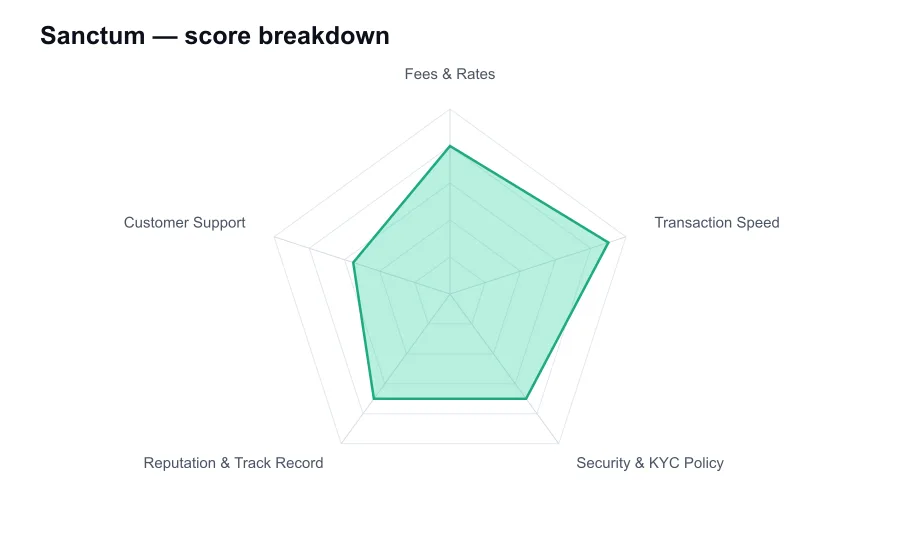
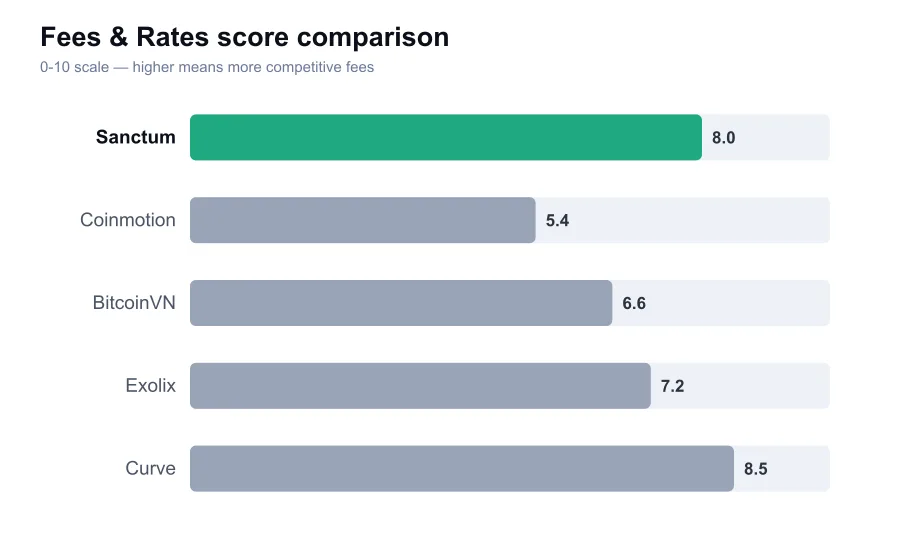
| Fees & Rates | 8.0 | Low Solana costs, though LST issuer economics vary |
| Transaction Speed | 9.0 | Near-instant normal Solana settlement, with congestion caveats |
| Security & KYC Policy | 7.0 | On-chain and LST risks require more than a simple audit check |
| Reputation & Track Record | 7.0 | A credible Solana player, but still relatively young |
| Customer Support | 5.5 | Documentation and community help, not account-level recovery |
In-Depth Review
Sanctum is a Solana-native liquidity and staking protocol built around liquid staking tokens, usually shortened to LSTs. Its purpose is not to be a general crypto exchange in the Coinbase sense. It aims to make SOL staking more liquid and to make the growing collection of Solana validator LSTs easier to trade, use, and move between without being trapped in a single staking product.
That is a meaningful niche. Solana users can stake SOL directly, but unstaking traditionally involves a cooldown period, and a delegated stake account is not especially useful inside DeFi. Liquid staking turns staked SOL into a token that can potentially be traded or used as collateral. Sanctum tries to solve the next problem, which is fragmentation. There are many LSTs, and thin liquidity makes them awkward to exchange at fair prices.
The protocol's Infinity pool is central to that proposition. It provides shared liquidity for supported LSTs and allows users to swap between eligible liquid staking tokens or exchange them for SOL with less friction than hopping through separate pools. That can be valuable for someone who wants exposure to a particular validator set or a specialized LST while retaining a reasonable exit path. It also supports a more diverse staking ecosystem than simply sending every depositor to the largest provider.
Sanctum's Reserve product gives users another route, effectively allowing eligible LSTs to be redeemed for SOL through protocol mechanisms rather than relying solely on a market swap. The exact experience and capacity can vary, and users should check current conditions before acting. Still, the broader point is sound: liquid staking only deserves the word liquid if users have credible ways to leave without taking an ugly discount.
Fees are more nuanced than a simple exchange percentage. The underlying LST has its own staking economics and often an issuer fee that reduces the yield passed to holders. Sanctum may also impose swap or liquidity-related costs depending on the product and route, while Solana transaction fees are normally tiny. A user comparing LSTs should focus on net yield, exchange rate, liquidity depth, and redemption conditions rather than chase the largest displayed APY.
Solana's low transaction costs are one of Sanctum's strongest practical advantages. Swapping or staking through a Solana app generally costs a fraction of an Ethereum mainnet transaction, and confirmations are usually quick. For a user who frequently rebalances SOL exposure, that is liberating. It also means small deposits can be economically rational in a way they often are not in Ethereum liquid-staking systems.
Speed is excellent in normal network conditions. A straightforward transaction can reach confirmation in seconds, and the interface feels much closer to a conventional financial application than an Ethereum mainnet staking flow. Yet Solana has had episodes of congestion, failed transactions, and degraded reliability. A fast chain is not the same as a flawless chain. During high demand, users may need to retry, raise priority fees, or wait for the network to settle down.
Sanctum's real risk profile is broader than a simple swap app's. You are exposed to Solana itself, Sanctum's smart contracts and liquidity design, the individual LST issuer, and potentially the validator or validator group behind that LST. A liquid staking token can also trade below its theoretical value if liquidity dries up or confidence falls. That is not a reason to avoid the category, but it is a reason not to treat an LST as identical to SOL.
The protocol has undergone security reviews and operates in a technically sophisticated Solana ecosystem, but audits are not insurance. Smart contract vulnerabilities, oracle or accounting mistakes, governance changes, and validator-specific trouble can all hurt users. Anyone depositing meaningful SOL should read the current documentation, understand whether they are using Infinity, Reserve, or an individual LST product, and avoid making decisions solely from a social-media yield graphic.
KYC is generally not part of using Sanctum's on-chain products. A compatible Solana wallet is the normal access method, and the protocol does not operate like a regulated fiat gateway. That is good for permissionless access but it also means user protection is limited. Send an asset to the wrong address, sign a malicious transaction, or interact with a fake site, and there is no account manager who can reverse it.
Sanctum has a more credible profile than a fresh yield farm. It emerged as a notable participant in Solana liquid staking, developed recognizable products, and drew significant community attention around its ecosystem incentives and the CLOUD token. Its reputation is still young compared with Lido or Marinade, and token incentive programs can attract mercenary liquidity. I would call it promising and relevant, not yet fully battle-hardened through many years of stress.
The CLOUD token and reward campaigns deserve a sober reading. Points systems and airdrops can create intense demand for deposits, but short-term incentive capital is not the same thing as durable protocol demand. Users should never assume a future distribution will offset staking risk, price movement, or an unfavorable entry. If the product only makes sense because of a rumored reward, the product probably does not make sense.
Support is reasonable for an on-chain project, with documentation and community-led channels, but it is not bank-grade support. Solana communities are particularly full of impersonators offering help in direct messages. Legitimate support will not request a seed phrase or ask you to import a wallet into a new website. This is basic advice, yet it remains the most relevant security warning for many DeFi users.
Sanctum is compelling for people who already hold SOL and want liquid staking flexibility, particularly those interested in diverse validator exposure. It is less compelling for a newcomer who merely wants passive crypto yield and has not learned wallet security. Marinade, Jito, and direct SOL staking are all valid comparisons, and the best choice depends on whether you value validator choice, MEV-related economics, liquidity, or simplicity.
My take is positive but selective. Sanctum addresses a genuine Solana liquidity problem and benefits from the chain's fast, cheap transaction environment. Its complexity is also real, and LST diversification can conceal layers of risk rather than remove them. Use it as a deliberate staking tool, not as a yield lottery ticket. A cautious SOL holder can find real utility here, but should keep enough plain SOL for fees and maintain a clear view of every protocol layer involved.
Pros & Cons
| Pros | Cons |
|---|
What does Sanctum do?
Sanctum is a Solana protocol focused on liquid staking token liquidity. It helps users access, swap, and manage supported SOL LSTs through products such as Infinity and Reserve.
Does Sanctum require KYC?
Its on-chain products generally use a Solana wallet and do not require ordinary account KYC. Users remain responsible for wallet security and for complying with applicable laws.
Is a Sanctum LST the same as SOL?
No. An LST represents staked SOL exposure but can have issuer fees, liquidity conditions, smart contract risk, and a market price that differs from its underlying redemption value.