Editorial independence: our scores and rankings are produced using the fixed criteria above and are not influenced by advertisers. This is an independent ranking site and is not operated by, or affiliated with, any provider we list.
Affiliate disclosure: some links on this page may earn us a commission at no extra cost to you. This does not affect our rankings.
Live market data via CoinGecko, for informational purposes only. Not financial advice.
| Best for | Not for |
|---|---|
| Excellent stablecoin and correlated-asset execution | Smart contract and depeg risks are real |
Criteria Breakdown
| Criterion | Score | Notes |
|---|---|---|
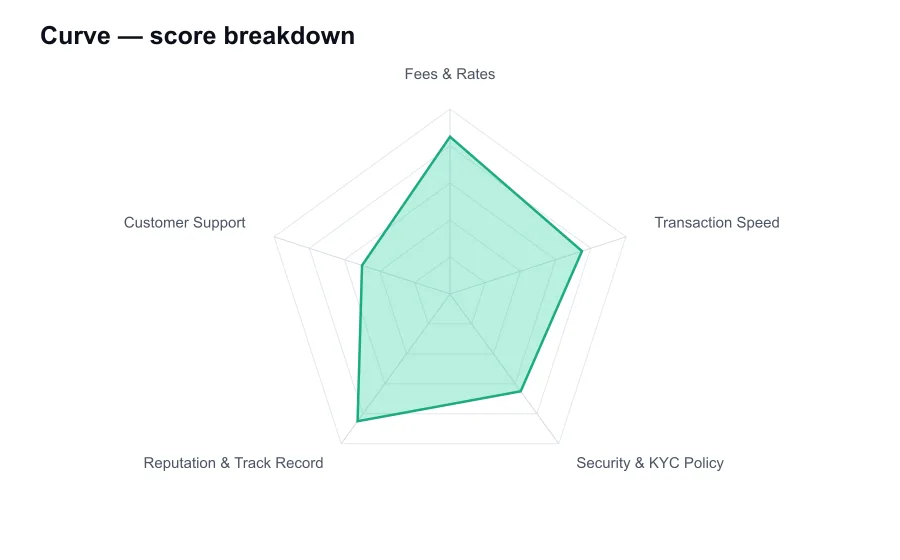
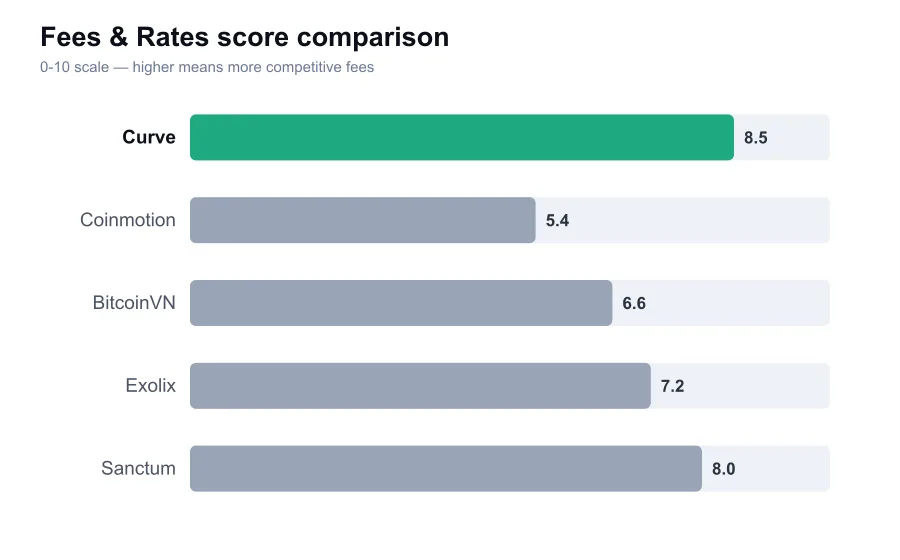
| Fees & Rates | 8.5 | Low pool fees, though network gas can dominate small swaps |
| Transaction Speed | 7.5 | Fast on L2s, dependent on the underlying chain |
| Security & KYC Policy | 6.5 | Extensively tested, but the 2023 Vyper exploit matters |
| Reputation & Track Record | 8.5 | A major DeFi liquidity venue since 2020 |
| Customer Support | 5.0 | Documentation and community channels, not account support |
In-Depth Review
Curve Finance is one of DeFi's foundational trading venues, built mainly for swaps between assets that should trade close to the same price. Think USDC to USDT, ETH to stETH, or one wrapped bitcoin to another. It is not trying to be a general-purpose exchange in the Uniswap sense. Curve's specialty is efficient stablecoin and correlated-asset liquidity, and it has remained relevant because that niche is still huge.
The core attraction is price execution. Curve's automated market maker uses a bonding curve designed to keep slippage low when assets are near parity. For a modest stablecoin swap, it can be dramatically cheaper than routing through a conventional constant-product pool. That matters to treasuries, market makers, arbitrageurs, and anybody moving six figures rather than buying a few tokens for fun.
Fees are usually low by DeFi standards, but users should understand what they are paying. Standard Curve pool swap fees have commonly been around 0.04 percent, though individual pools can use different parameters. Part of the fee goes to liquidity providers, and a portion can be directed to veCRV holders. The apparent bargain can disappear if Ethereum gas is expensive, especially for smaller trades.
Curve is far more attractive on lower-cost networks. Deployments and integrations across networks such as Arbitrum, Optimism, Base, Polygon, and others make small trades more reasonable than they are on Ethereum mainnet. Still, the user experience is fragmented. You need to know which chain your funds are on, have native gas tokens available, and be careful not to confuse versions of bridged assets.
Transaction speed is really chain speed. Curve does not custody assets or operate an internal matching engine that can instantly settle a trade. A swap is settled once the network confirms it. On Ethereum that can mean seconds to several minutes depending on congestion and the confirmation standard you use. On an L2, the interaction usually feels close to immediate, although bridge withdrawals can take longer.
The protocol's routing can be excellent, but the interface is not always the simplest place to discover the best route. Curve has a well-earned reputation among sophisticated users, yet its menus, pool designs, gauges, and incentive layers can look intimidating. A newcomer who just wants to exchange tokens may find a wallet aggregator or a polished frontend such as 1inch easier to navigate.
Security is both Curve's biggest strength and its biggest source of historical concern. The protocol has been extensively audited and battle-tested through immense trading volume, but DeFi security is not a permanent badge. In July 2023, several Curve pools using vulnerable Vyper compiler versions were exploited, with losses estimated at roughly $60 million before recovery efforts reduced the eventual damage. That event was a reminder that audited smart contracts can still fail through tooling dependencies.
Curve's response after the exploit was unusually active. The team, white hats, liquidity providers, and broader DeFi ecosystem coordinated recoveries and remediation. That did not erase losses or eliminate risk, but it showed why Curve remains a serious protocol rather than a neglected codebase. The incident also pushed users to pay closer attention to exactly which pool they are entering rather than treating the Curve brand as a blanket guarantee.
There is no standard platform KYC for normal onchain use. You connect a self-custody wallet and sign transactions. That is appealing for users who value privacy and permissionless access, but it moves responsibility onto the user. Curve will not reverse a mistaken transfer, recover a compromised wallet, or protect you from approving a malicious token allowance.
The CRV governance model is famous, sometimes to a fault. Locking CRV for veCRV can boost liquidity incentives and gives holders voting power. The resulting market for vote incentives, often called the Curve Wars, became one of DeFi's more fascinating and complicated governance systems. It is clever capital allocation machinery, but it is not a feature most ordinary swappers need to understand.
Liquidity quality differs sharply from pool to pool. Deep pools involving major stablecoins, liquid staking tokens, and established wrappers can offer superb execution. Smaller pools may have thin liquidity, volatile incentive emissions, or exposure to a weak underlying asset. Curve's interface shows useful pool data, but users should still inspect the assets, TVL, pool composition, and historical volatility before depositing.
The depeg risk deserves more attention than the headline fee. A stablecoin pool can produce low-slippage trades precisely while a token is losing its peg, because the pool composition shifts as traders dump the weak asset. Curve is a venue, not an assurance that USDT, crvUSD, FRAX, or any other asset will hold its intended value. Liquidity providers are especially exposed to ending up concentrated in the asset the market no longer wants.
Support is modest and community-led. Curve offers documentation, governance forums, Discord channels, and social channels, but it does not operate like a regulated exchange with a staffed account desk for every retail complaint. Scam support accounts are common across crypto, so users should use only links published through official Curve channels. If you need a human to rescue a transaction, Curve is the wrong product category.
Curve's reputation is complicated but strong. It has been central to stablecoin liquidity since 2020, survived multiple market cycles, and influenced how a large part of DeFi thinks about liquidity incentives. At the same time, its governance politics, exploit history, and technical complexity mean it should not be presented as a risk-free stablecoin savings tool. It is infrastructure, and infrastructure can be powerful without being forgiving.
For active stablecoin traders and DeFi-native users, Curve remains one of the best places to check before executing a sizeable correlated-asset swap. Its fee model and deep liquidity can beat simpler venues by a meaningful margin. For casual users, the savings may not justify the learning curve, gas management, and contract risk. My view is blunt: Curve is excellent at its narrow job, but only users who understand that job should make it their default exchange.
Pros & Cons
| Pros | Cons |
|---|
Does Curve require KYC?
Normal Curve swaps through a self-custody wallet do not require routine platform KYC. Your wallet provider, fiat on-ramp, or local law may impose separate requirements.
What fees does Curve charge?
Many Curve pools have historically used swap fees around 0.04 percent, but fees vary by pool. You also pay the gas fee charged by the network.
Is Curve safe after the 2023 exploit?
Curve remains widely used, but no DeFi protocol is risk-free. The 2023 Vyper-related exploit shows why users should assess pool and smart contract risk before depositing.