Editorial independence: our scores and rankings are produced using the fixed criteria above and are not influenced by advertisers. This is an independent ranking site and is not operated by, or affiliated with, any provider we list.
Affiliate disclosure: some links on this page may earn us a commission at no extra cost to you. This does not affect our rankings.
Live market data via CoinGecko, for informational purposes only. Not financial advice.
| Best for | Not for |
|---|---|
| Established instant-exchange brand | Fees are built into quotes rather than itemized |
Criteria Breakdown
| Criterion | Score | Notes |
|---|---|---|
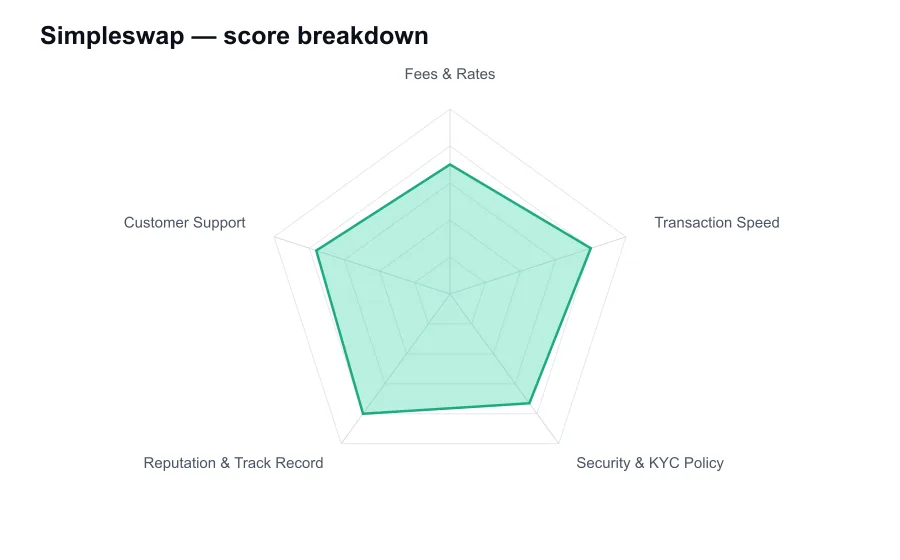
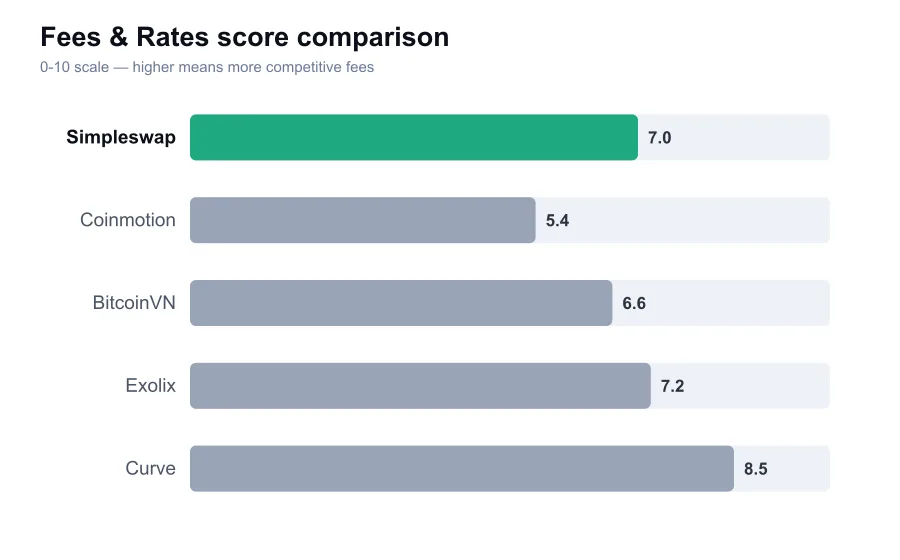
| Fees & Rates | 7.0 | Often fair on liquid pairs, but all-in spreads require comparison. |
| Transaction Speed | 8.0 | Reliable tracking and quick routine execution after confirmations. |
| Security & KYC Policy | 7.3 | Noncustodial-style swaps, with conditional KYC for flagged orders. |
| Reputation & Track Record | 8.0 | A long-running, widely recognized name in instant exchanges. |
| Customer Support | 7.6 | 24/7 channels and useful order tracking, complex cases vary. |
In-Depth Review
SimpleSwap is one of the more recognizable instant exchange brands, a middle ground between a full centralized exchange and a do-it-yourself decentralized swap. It lets users convert one cryptocurrency into another without keeping a trading balance on the platform. The service has been around long enough to be familiar to many wallet users, and it has expanded beyond a bare swap form with an API, referral tools, a loyalty-style token and occasional fiat purchase options.
Its core product remains uncomplicated. Select the asset you are sending, choose the asset you want, enter a receiving address and send the deposit. SimpleSwap then routes the trade through its own liquidity arrangements and pays out to your wallet. For someone who wants to turn BTC into ETH, SOL into USDT or a supported altcoin into another asset without navigating a spot exchange, that is a legitimate convenience.
The service supports a large number of coins and tokens, though users should separate listed availability from meaningful liquidity. Major networks and mainstream stablecoins are the safest territory. Exotic tokens, low-volume pairs and newly issued assets can be more fragile, with wider quotes, changing limits or temporary route failures. The presence of a token symbol is not a promise that it can be exchanged cheaply or quickly at every hour.
SimpleSwap offers both floating and fixed-rate exchanges. Floating rate means your payout is calculated from the market rate available during processing. It usually produces a better initial quote but exposes the user to price movement while deposits confirm and the service executes the route. Fixed rate locks a quoted amount for a stated payment window, subject to the deposit arriving correctly and on time. That option is valuable, particularly in volatile BTC and ETH markets.
Fee disclosure is where SimpleSwap is competent but not exemplary. The platform does not generally present a universal flat service fee because its pricing changes by pair, network cost and liquidity source. Instead, its margin is built into the quote. The company says it does not add hidden fees, but that wording is less useful than a transparent breakdown would be. A customer should focus on the receive amount, then compare it against at least two alternatives.
On major pairs, SimpleSwap can be reasonably priced, especially if its routing happens to find a good market. It can also be noticeably less attractive than an exchange order book, a decentralized exchange or another aggregator. This is not unique to SimpleSwap, but it is central to whether the product makes sense. You are paying for convenience, no order management and access to routes you may not have yourself. That premium should be measured, not assumed.
The minimum exchange amount can surprise beginners. Networks with high transaction costs require a larger deposit to make a swap economical, and sending below the stated minimum can create a support problem rather than a neat refund. Read the minimum carefully before paying. Also account for the fee charged by your sending wallet. The amount that arrives at SimpleSwap must meet the required threshold, not merely the amount you typed into the first field.
Transaction speed is usually respectable for liquid routes. Once a deposit receives the needed confirmations, SimpleSwap can often complete an ordinary trade within 10 to 30 minutes. Bitcoin can take longer, particularly during fee pressure. Ethereum-based transfers may be slowed by gas conditions. The service cannot control every delay because the actual process can include your sending chain, a liquidity partner's execution and the payout chain.
SimpleSwap's tracking page is one of its practical strengths. Customers can follow an order using its ID and see whether the deposit has arrived, the exchange is underway or the payout has been sent. That transparency does not cure a delay, but it reduces the panic caused by a blank screen. For any swap, save the order ID and both transaction hashes. Those details make support much more effective if something stalls.
The company operates a noncustodial-style instant exchange rather than a custodial trading account. It does not ask users to leave coins sitting in a SimpleSwap balance. That is a real security benefit compared with keeping funds indefinitely at an exchange. Yet the service necessarily receives the deposit during the swap, so users are trusting SimpleSwap and its liquidity partners for that period. It is safer than permanent custody, not the same thing as a trustless protocol.
SimpleSwap is generally usable without mandatory registration and has long marketed a no-KYC experience for normal exchanges. The fine print matters. It can request verification if an order is flagged by risk controls or a compliance partner. This is an industry-wide issue, but it remains one of the sharpest risks for privacy-minded customers because the request can arise after the deposit is already locked into the process.
Users with funds that may attract blockchain-monitoring scrutiny should not assume a no-registration screen guarantees an anonymous transaction. Large transactions, unusual patterns and coins with a problematic history can receive attention. If producing documents is impossible or unacceptable, an instant exchange may be a poor fit. SimpleSwap's policy is more realistic than pretending compliance does not exist, but the customer still bears the inconvenience of a post-deposit review.
SimpleSwap has a stronger public reputation than smaller swap websites because it has operated for years and has a large volume of visible feedback. That does not mean every review should be taken at face value, particularly on platforms where incentives and disputes can affect ratings. Still, longevity and a sizable user footprint count for something. It is a known name in the instant exchange sector, even if it is not in the same institutional trust class as a major regulated exchange.
The negative feedback is also predictable and useful. Customers complain about floating payouts that differ from the opening estimate, delays on particular coins, address or memo mistakes and KYC reviews. Some complaints reflect misunderstandings of how floating-rate exchanges work. Others are reminders that customer service quality becomes critical only after a transaction goes wrong. A positive review for a five-minute swap is nice. A documented resolution of a hard case is more meaningful.
Support is available around the clock through live chat and email channels, and SimpleSwap has enough scale that it generally provides better documentation than tiny competitors. Response quality can vary. Routine status questions are usually handled quickly, while a compliance hold or partner problem can require back-and-forth and patience. The service would benefit from more detailed public escalation standards, but its support operation is not an afterthought.
The platform also offers an API and business integrations, which is relevant for wallets, merchants and apps that want instant conversion without building liquidity connections from scratch. That is a legitimate strength, though end users should remember that an embedded SimpleSwap widget is still an instant-exchange route with the same quote, confirmation and compliance risks. Convenience at the application layer does not change the underlying economics.
SimpleSwap is a practical choice for ordinary self-custody users who want broad coin coverage, recognizable branding and a choice between fixed and floating execution. It is not the cheapest venue by default, and it is not ideal for people who demand zero chance of identity checks. I trust it more than a lightly documented newcomer, but I still compare rates every time. That is the right habit with any aggregator, including this one.
Pros & Cons
| Pros | Cons |
|---|
Does SimpleSwap charge a fixed fee?
There is no universal public flat fee for every route. Network costs, liquidity pricing and SimpleSwap's margin are reflected in the rate, so compare the final receive amount before sending.
Can I use SimpleSwap without KYC?
Most standard exchanges can be initiated without account registration or routine KYC. SimpleSwap may request verification for orders flagged by compliance or risk-monitoring systems.
What is the difference between fixed and floating rate on SimpleSwap?
A floating payout follows the market during processing. A fixed-rate order aims to lock the stated payout for a limited deposit window, usually with a slightly less favorable initial quote.