Editorial independence: our scores and rankings are produced using the fixed criteria above and are not influenced by advertisers. This is an independent ranking site and is not operated by, or affiliated with, any provider we list.
Affiliate disclosure: some links on this page may earn us a commission at no extra cost to you. This does not affect our rankings.
Live market data via CoinGecko, for informational purposes only. Not financial advice.
| Best for | Not for |
|---|---|
| Large asset and network selection | Fees are embedded in variable quotes |
Criteria Breakdown
| Criterion | Score | Notes |
|---|---|---|
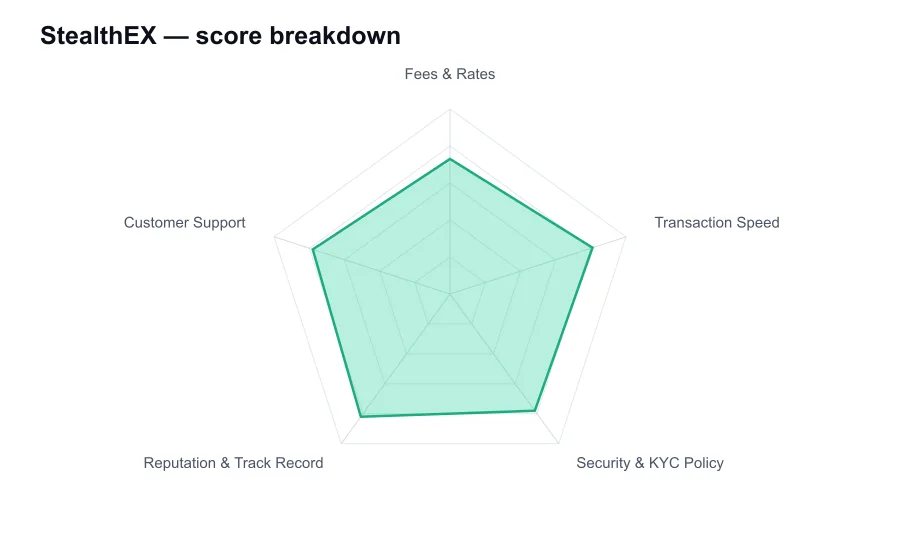
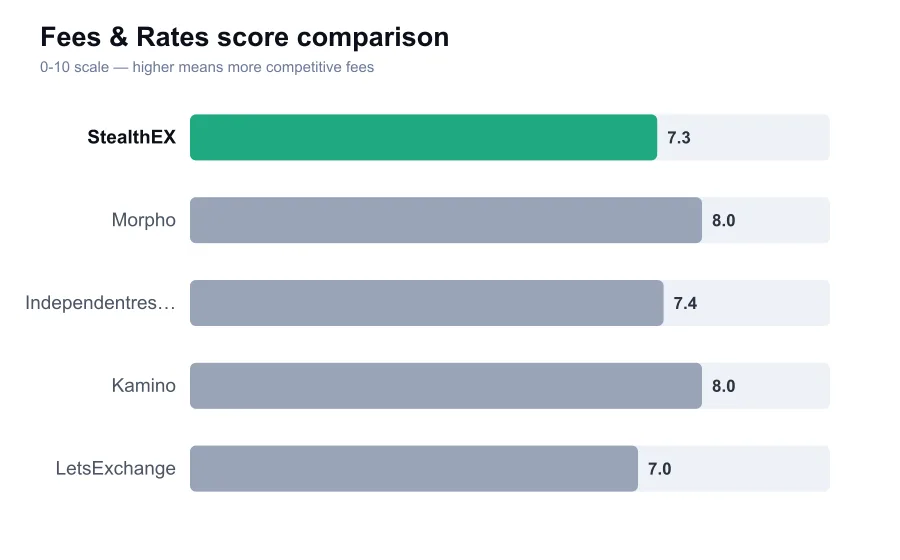
| Fees & Rates | 7.3 | Competitive aggregator quotes, though spreads vary by route. |
| Transaction Speed | 8.1 | Strong processing speed after normal blockchain confirmations. |
| Security & KYC Policy | 7.8 | Noncustodial design with transaction monitoring and possible reviews. |
| Reputation & Track Record | 8.2 | Well-known multi-cycle brand in the instant-swap market. |
| Customer Support | 7.8 | 24-hour online support and a more mature support presence. |
In-Depth Review
StealthEX is a noncustodial crypto exchange aggregator that has become one of the more recognizable names in the instant-swap business. Its pitch is simple: exchange hundreds of digital assets directly from one wallet to another without creating a conventional trading account. The service is not an exchange in the Binance or Coinbase sense. It does not offer a deep public order book or invite customers to keep a portfolio on the platform. It is a routing and execution layer.
That distinction explains both its strengths and its weaknesses. StealthEX is convenient for a person who holds coins in a hardware wallet, software wallet, or decentralized application and wants to move from one asset to another quickly. It is not designed for day traders seeking limit orders or institutions needing an auditable execution desk. The product is built around a single task, and it handles that task more professionally than most small instant exchangers.
The supported asset list is extensive, covering major chains, stablecoins, popular tokens, and a large number of less familiar assets. That breadth is a genuine advantage. It is also a potential trap for inexperienced users. A token name can exist on multiple networks, and selecting USDT on Tron instead of USDT on Ethereum is not a cosmetic choice. StealthEX displays network options, but the user remains responsible for matching the receiving wallet and the selected chain.
Pricing is quote-based. StealthEX aggregates liquidity and presents an expected output amount, with its service cost and network-related execution costs reflected in that quote. It does not give the simplicity of a fixed posted 0.25 percent fee schedule because the actual cost changes by asset, route, and market conditions. That is normal for an aggregator. The right test is to compare the amount received against ChangeNOW, Quickex, Changee, and a centralized exchange after withdrawal costs.
On common routes, StealthEX can be quite competitive. Its large asset coverage and relationships with liquidity sources give it a better chance than a tiny service of finding a workable route. Yet it is not reliably the cheapest provider. A quote can include a noticeable spread, particularly for low-liquidity tokens, cross-chain stablecoin moves, or trades during market stress. I like the service for convenience, but I would never accept a large quote without checking at least one alternative.
One of StealthEX's better features is its fixed-rate option for eligible pairs. The fixed quote gives users more certainty about the final amount and is especially valuable for volatile assets. It is not magic. The deposit must reach the service correctly and within the stated time window, and network fees still affect what a sender pays to initiate the transaction. But fixed execution removes a major source of anxiety that comes with floating-rate swaps during a fast market move.
Speed is strong on liquid routes. Once an incoming transaction reaches the necessary confirmations, StealthEX can often complete the payout within minutes, especially on fast networks. The company cannot make Bitcoin blocks appear faster or cure Ethereum congestion, and users should be skeptical of anyone who implies otherwise. A practical estimate has to include the time to send, confirm, process, and receive the payout, not merely the time between internal processing steps.
StealthEX has one practical advantage over lesser-known swap sites: its transaction tracking and interface are relatively polished. The order page gives a user something concrete to reference if an exchange is pending. This matters because blockchain transfers are final and support agents need exact details to investigate a case. Keep the exchange ID and transaction hash. If a transaction enters an unusual state, those details are far more useful than a general message saying that funds have not arrived.
The platform is commonly described as no-KYC because users can initiate routine exchanges without opening an account or supplying identity documents. That description is useful but incomplete. StealthEX operates anti-money-laundering controls and may stop an exchange for a compliance review if a transaction triggers those systems. This is not unique to StealthEX, it is industry reality. Anyone who needs guaranteed permissionless execution should understand that a third-party swap service cannot offer that guarantee.
From a security perspective, the wallet-to-wallet structure is a serious benefit. Users are not asked to leave a standing balance exposed to exchange insolvency or account takeover. Once the swap finishes, funds should be back under the user's own key control. Still, the service receives the deposit in the middle of the process, so it has temporary control and therefore temporary counterparty risk. The safest practice is to verify the official domain, use a hardware wallet where possible, and test new routes with a small amount.
StealthEX has a substantially stronger public profile than many instant-exchange competitors. It has been visible through multiple market cycles, has maintained a consistent brand, and is integrated or mentioned in parts of the wider crypto ecosystem. That does not make it risk-free, and user reviews inevitably include complaints about delays or verification requests. It does make the service easier to assess than a recently launched anonymous exchanger with no history beyond a handful of promotional reviews.
Support is available around the clock through online channels, including live chat and email-style ticket contact. The company has a reputation for being more reachable than many small aggregators, which is important. I would still avoid assuming that support can instantly reverse an on-chain error or bypass a compliance procedure. Good support can trace a valid order and communicate clearly. It cannot recover a deposit sent on the wrong network or promise a payout before required checks are completed.
StealthEX also offers business-facing capabilities and API-style integration options, which is a sign of a more developed operation than a consumer-only swap page. That will matter to wallet developers, affiliate operators, and services wanting exchange functionality without building their own liquidity stack. It matters less to an individual user, but it supports the view that StealthEX is established infrastructure rather than a temporary retail site.
For individual users, the central question is not whether StealthEX is flawless. No instant exchanger is. The question is whether its ease, range, and established operational footprint justify the quote it offers. In many cases, the answer is yes. It is particularly useful for moving between assets that a single centralized exchange may not list together. It is less compelling for a huge BTC or ETH conversion where an order book and controlled execution can save significant money.
My judgment is that StealthEX belongs near the top tier of noncustodial swap aggregators, though not above scrutiny. It scores well on asset breadth, fixed-rate availability, speed, and public track record. The price of that convenience is opaque route-based pricing and the residual risk of a compliance hold while funds are in transit. For normal self-custody swaps, it is a service I would seriously consider after comparing the live payout. For life-changing sums, use deeper liquidity, split the transaction, and do not mistake a simple interface for zero risk.
Pros & Cons
| Pros | Cons |
|---|
Does StealthEX require identity verification?
Most ordinary swaps can start without registration or routine KYC. Transactions that trigger risk controls may be paused for a compliance review.
Are StealthEX rates fixed?
It offers fixed-rate exchanges for eligible pairs and floating-rate exchanges for others. Check the selected rate type before sending funds.
How long does a StealthEX swap take?
Many liquid swaps complete within minutes after deposit confirmations. Timing depends heavily on the source chain, congestion, and any review.
Is StealthEX custodial?
It does not provide a standing user balance for storage, but it temporarily receives the deposit while processing a swap.