Editorial independence: our scores and rankings are produced using the fixed criteria above and are not influenced by advertisers. This is an independent ranking site and is not operated by, or affiliated with, any provider we list.
Affiliate disclosure: some links on this page may earn us a commission at no extra cost to you. This does not affect our rankings.
Live market data via CoinGecko, for informational purposes only. Not financial advice.
| Best for | Not for |
|---|---|
| Long Australian operating history since 2013 | Entry-level trading fee is not the market's lowest |
Criteria Breakdown
| Criterion | Score | Notes |
|---|---|---|
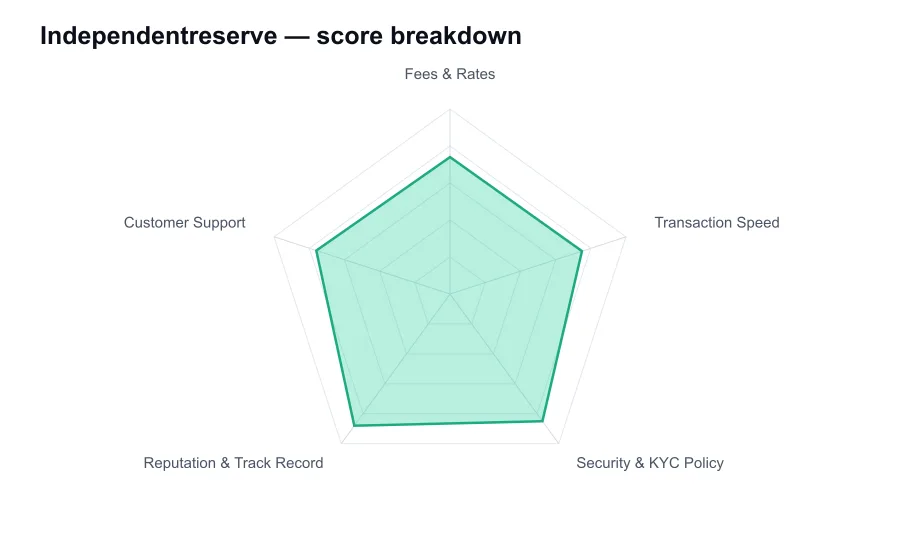
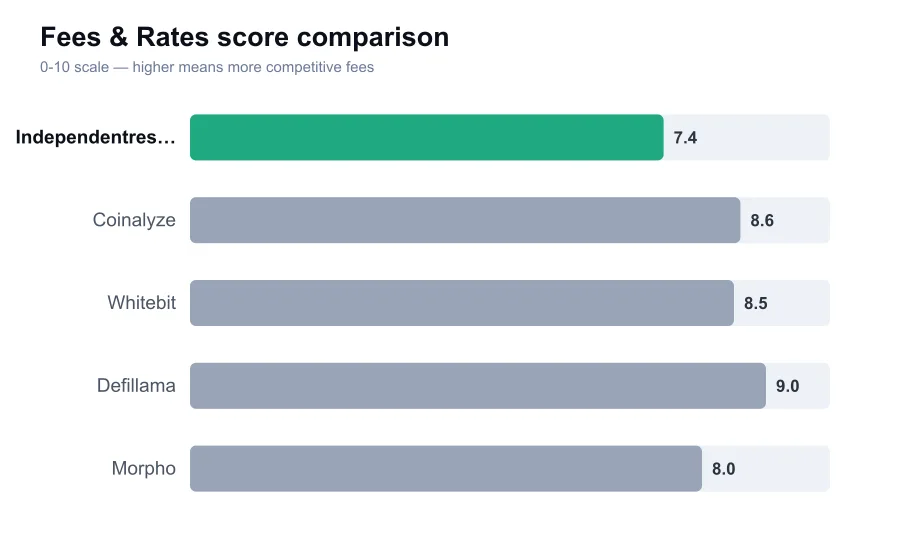
| Fees & Rates | 7.4 | Published volume tiers, starting around 0.5% for standard trading |
| Transaction Speed | 7.5 | Prompt exchange execution, local banking speed varies |
| Security & KYC Policy | 8.5 | KYC-led platform with cold-storage focused custody controls |
| Reputation & Track Record | 8.8 | Australian exchange operating since 2013 |
| Customer Support | 7.6 | More accountable local support than many offshore venues |
In-Depth Review
Independent Reserve is one of the oldest surviving Australian crypto exchanges, founded in 2013 and built around a fairly conservative idea of what a digital-asset platform should be. It is not trying to win customers with casino-style token listings or aggressive leverage promotions. Instead, it targets Australian and Singaporean users who want an established exchange, local-currency access and a more compliance-minded environment. That makes it less exciting than some global rivals, but often more suitable for people dealing with meaningful sums.
The exchange has long positioned itself closer to financial infrastructure than crypto entertainment. Australian dollar and Singapore dollar markets, verified accounts, tax-oriented reporting and an OTC desk are all part of that picture. The design is functional rather than glamorous. Beginners can buy and sell through a standard interface, while serious users have access to order-book trading and an API. It is a better fit for deliberate investors than for traders chasing every new narrative token.
Fees are one of Independent Reserve's better attributes, especially for users who actually trade through the order book. Its published trading fee schedule has historically started around 0.5 percent and falls with 30-day trading volume, reaching materially lower levels for high-volume customers. The exact tiers and applicable rates should be checked before trading, but the principle is straightforward: regular traders are not trapped in a flat retail spread. This is better than a simple broker model where the true cost is harder to see.
A 0.5 percent entry-level fee is not industry-leading by global pro-exchange standards. Kraken Pro, Binance and some Australian competitors can be cheaper for active trading, depending on pair and tier. But Independent Reserve's pricing is reasonable for a domestically focused, regulated platform, particularly when compared with instant-buy services that hide a wide spread behind a friendly interface. Customers should use the order book rather than a convenience purchase function whenever they want the clearest execution and fee control.
Deposits and withdrawals need separate attention. Australian bank transfers through local rails are generally practical, but payment timing depends on the sending bank and anti-fraud controls. Crypto withdrawals carry network fees, and those fees can rise sharply on congested networks such as Bitcoin or Ethereum. This is not an Independent Reserve invention. Still, users should look at the withdrawal screen before moving a small balance, because fixed blockchain fees can make frequent withdrawals poor value.
Execution quality is respectable on major pairs, but liquidity is not infinite. Bitcoin and Ethereum against AUD are the natural strengths. Less common assets and pairs can have thinner books, which means a market order can produce more slippage than a casual user expects. That is not a reason to avoid the exchange, it is a reason to use limit orders. A customer moving a large position should consider the OTC desk rather than sweeping an order book and complaining afterward about the price.
The OTC service is one of the features that helps Independent Reserve stand apart from a bare-bones retail app. It is intended for larger transactions and can provide an execution path better suited to substantial orders. The precise minimums and availability can change, so it is not something every customer can assume they qualify for. But the presence of an established OTC offering signals that the business serves more than first-time buyers putting a small amount into Bitcoin.
Transaction speed is solid for normal exchange activity. Crypto trades execute as soon as matching liquidity is available, while fiat deposit and withdrawal times depend on banking rails. Most frustration in this area comes from people treating a bank transfer, identity review and blockchain confirmation as one instant process. They are not. A verified user funding an account with a supported local method will usually have a much smoother experience than a new customer attempting a large first deposit at an inconvenient time.
The exchange requires KYC. This is not optional for users wanting fiat access, and it should not surprise anyone choosing an Australian financial service provider. Identity checks, proof of address and possible source-of-funds requests are part of the service. Some crypto users resent this, but the alternative is usually an offshore venue with weaker accountability and a higher chance of banking disruption. Independent Reserve is choosing regulatory durability over anonymity.
Its security posture is one of the main reasons to consider it. The company has emphasized cold storage, multi-layered security controls and operational procedures designed to limit online exposure. It also offers account protections such as two-factor authentication and security features users should enable immediately. No centralized exchange can remove custody risk completely. The sensible approach is to keep trading balances on the platform and move long-term holdings to a wallet where you control the keys.
Independent Reserve has also maintained an insurance arrangement relating to certain crypto assets held in custody, a point that deserves careful interpretation. Insurance can be useful, but customers should read the policy scope, exclusions and coverage limits rather than assume it protects every kind of loss. It will not rescue a user who gives away credentials, sends crypto to a scammer, or loses money through poor trading. Marketing phrases about insurance are never a substitute for understanding custody risk.
The track record is strong by crypto standards. Surviving since 2013 without the type of major public collapse associated with several international exchanges is meaningful. It has operated through the 2017 mania, the 2022 failures and repeated shifts in compliance expectations. That history does not make it invulnerable, but it is stronger evidence than a newly launched exchange promising extraordinary yields. The company also has a recognizable position in Australia's regulated crypto landscape.
Support is usually regarded as more accountable than what users get from huge offshore exchanges. Local business hours, documentation, ticket handling and an identifiable operating company are all advantages when something goes wrong. Yet support quality is not magical. Verification delays, banking compliance questions and blockchain withdrawal errors can still be frustrating. Customers should keep records, use the official support route and avoid relying on direct messages from supposed staff, which are a common scam vector.
The asset selection is conservative. For many readers, that is a feature. Independent Reserve lists established cryptocurrencies and does not make a business of racing to list every short-lived token. It is therefore unsuitable for someone whose strategy revolves around early access to low-cap coins, DeFi experiments or high-leverage perpetuals. It is much more convincing as a place to trade major assets in AUD with a degree of institutional sobriety.
Its account tools also deserve mention. Features such as recurring purchases, price alerts, tax-related reporting support and APIs can make routine investing easier. They are not revolutionary, but they are useful. An investor buying Bitcoin and Ethereum over years benefits more from reliable record keeping and dependable local withdrawals than from a flashy homepage. Independent Reserve understands that audience better than many platforms that constantly redesign themselves around the latest token trend.
Independent Reserve is not the lowest-fee exchange, the broadest exchange or the fastest-moving exchange. It is a mature regional platform with sensible controls, respectable fee transparency and a reputation earned through survival rather than noise. Australians and Singaporeans who want a compliant venue for major assets should put it on a shortlist. Traders needing global liquidity, very low fees, hundreds of altcoins or derivatives should look elsewhere. My take is that its deliberate pace is a strength, provided you accept that conservative does not mean cheap or anonymous.
Pros & Cons
| Pros | Cons |
|---|
What are Independent Reserve trading fees?
Published order-book fees have historically started around 0.5% and reduce as 30-day trading volume rises. Check the current schedule before trading.
Does Independent Reserve require identity verification?
Yes. KYC is required for the regulated fiat and crypto exchange service, and additional compliance questions may apply to some transactions.
Is Independent Reserve good for large crypto purchases?
It can be. The exchange offers an OTC service for qualifying larger transactions, while limit orders are preferable to market orders on thinner books.