Editorial independence: our scores and rankings are produced using the fixed criteria above and are not influenced by advertisers. This is an independent ranking site and is not operated by, or affiliated with, any provider we list.
Affiliate disclosure: some links on this page may earn us a commission at no extra cost to you. This does not affect our rankings.
Live market data via CoinGecko, for informational purposes only. Not financial advice.
| Best for | Not for |
|---|---|
| Competitive multi-DEX routing | Ethereum gas can make small swaps uneconomic |
Criteria Breakdown
| Criterion | Score | Notes |
|---|---|---|
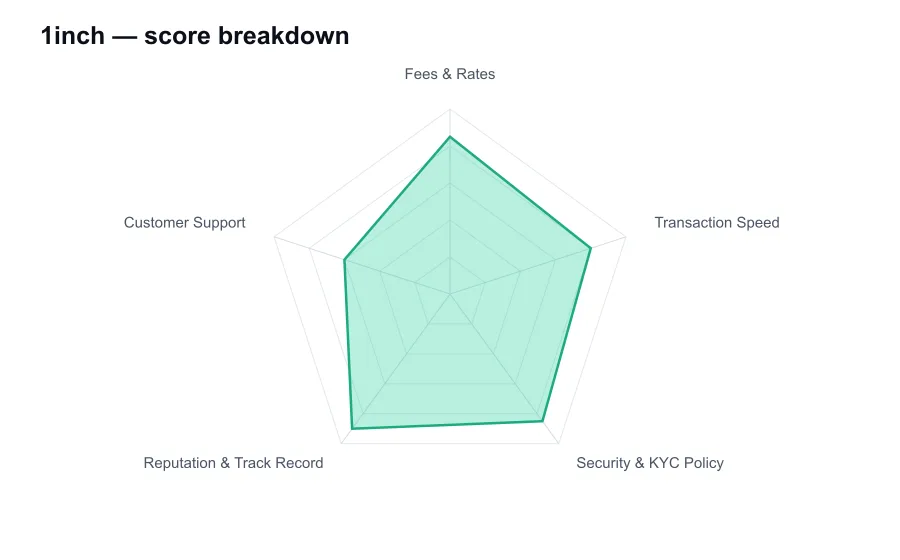
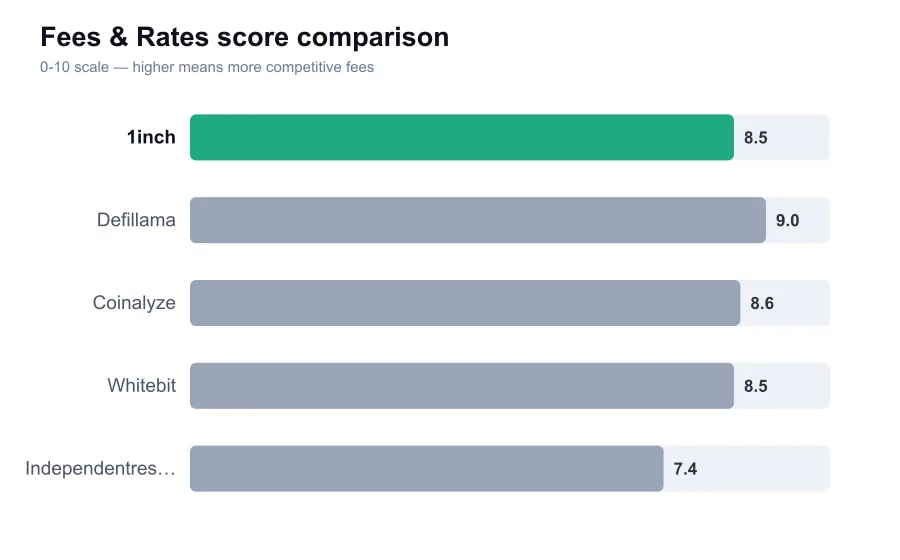
| Fees & Rates | 8.5 | No standard swap fee, but gas and route costs still matter |
| Transaction Speed | 8.0 | Fast on L2s, with settlement determined by each chain |
| Security & KYC Policy | 8.5 | Self-custody architecture, audits, and mature protocol tooling |
| Reputation & Track Record | 9.0 | A major DeFi brand operating since 2019 |
| Customer Support | 6.0 | Strong documentation, but no recovery service for user errors |
In-Depth Review
1inch is one of the best known decentralized exchange aggregators in crypto, built for users who want to trade from their own wallet rather than deposit assets into a centralized platform. It searches liquidity across decentralized exchanges and routes a swap through one or more venues in pursuit of a better result. In a market crowded with swap buttons, 1inch remains a serious piece of DeFi infrastructure, not just a retail interface.
That distinction matters. 1inch does not function like Coinbase or Kraken, where an operator keeps an internal balance and matches trades on its own books. You connect a wallet such as MetaMask, Rabby, or a hardware-wallet-backed browser wallet, approve a token, and sign blockchain transactions. The assets remain under your control until the smart contract executes the trade. That removes a major custody risk, but it also makes the user responsible for every signature.
Its strongest feature is aggregation. A direct swap on Uniswap may be perfectly fine for a liquid ETH and USDC trade, but it is not always the best route. 1inch can evaluate pools and market makers across supported networks, split an order among sources, and use routing logic to reduce price impact. For larger on-chain swaps, that can produce a noticeably better final result than choosing a single DEX by habit.
Fees need a careful explanation because users often misunderstand them. 1inch has generally not charged a standard interface trading fee for ordinary swaps. The major costs are the liquidity-provider fee embedded in each pool, price impact, any spread in the route, and blockchain gas. A route with no visible 1inch fee can still be expensive on Ethereum mainnet if gas is high or if the token is thinly traded.
The practical question is not whether the app claims zero fees. It is whether the quoted output beats another route after gas. 1inch is often excellent at this, especially where its routing can find fragmented liquidity. Yet there are cases where a simple direct transaction on Uniswap, Curve, or a network-native DEX is cheaper because it uses fewer calls and less gas. Sophisticated users should inspect the route rather than worship the aggregator.
1inch shines more on lower-cost networks. On Arbitrum, Optimism, Base, Polygon, BNB Chain, Avalanche, and similar ecosystems, a user can explore routes without Ethereum's punitive gas bill distorting every choice. On mainnet, approving a new token and executing a multi-hop route can cost enough to make a small trade irrational. The protocol is powerful, but it cannot repeal the economics of blockspace.
The Fusion mode has been one of 1inch's more interesting developments. Instead of forcing a user to pay gas directly for a typical swap, the user signs an intent that resolvers compete to fill. This can offer gasless execution for the user and protection against certain forms of maximal extractable value, commonly called MEV. It is genuinely useful, though users should remember that an intent-based system introduces different execution and timing dynamics from a plain pool swap.
Speed is tied to the network selected and the route taken. A transaction on a fast chain can be visible almost immediately and settle within seconds or minutes. Ethereum mainnet is slower and can become expensive during demand spikes. Fusion orders may wait for a resolver fill rather than land as a standard public transaction. That is often a good trade, but someone trying to hit a rapidly moving market may prefer a conventional swap with an explicit gas setting.
Security is one of 1inch's better areas, though it deserves neither blind praise nor casual use. The protocol has long been a major DeFi target and has undergone multiple audits and bug-bounty activity. It has also built a reputation around limit-order and aggregation infrastructure rather than a fly-by-night token launch. Still, smart contract risk remains real, token approvals can be dangerous, and a malicious website impersonating 1inch can empty a careless wallet.
KYC is not required to connect a self-custody wallet and use the core decentralized swapping experience. That privacy is a major advantage for many users. It does not exempt someone from local tax law, sanctions rules, or the compliance requirements of an eventual centralized off-ramp. Users should also understand that public-blockchain activity is traceable even if the application does not ask for a passport.
The 1INCH token has had the usual governance-token volatility, and the project has made controversial decisions around interface access and regional restrictions over the years. That is not unusual for a protocol operating under a changing legal environment, but it does undercut the simplistic idea that DeFi front ends are permanently permissionless. The contracts may be accessible, while a particular hosted interface can still impose restrictions or block addresses.
Reputation is strong by DeFi standards. 1inch launched in 2019, survived several market cycles, attracted significant funding and integration activity, and remains recognized by developers and active on-chain traders. It has a much deeper record than most swap aggregators. It is not immune to the risks of protocol upgrades, governance decisions, or third-party wallet failures, but it has earned its place in the first tier of established DeFi brands.
Support is not like calling a bank. There is no magic recovery desk for a transaction you approved to the wrong address. 1inch offers documentation, help materials, and community channels, but users must be alert to scammers posing as support staff. No legitimate helper needs your seed phrase, private key, or a signature that transfers every token from your wallet. The self-custody model is empowering right up to the moment a user makes an irreversible mistake.
I rate 1inch highly for users who understand those responsibilities. It delivers real value through routing, broad network support, and a mature product surface. It is not the best first crypto experience for someone who cannot distinguish an approval from a swap, and it is not automatically the lowest-cost path for tiny trades. For serious on-chain trading, however, it is one of the first tools I would check.
My final view is that 1inch has earned trust as infrastructure, not as a shortcut around careful trading. Its fee model is usually favorable, its security posture is comparatively mature, and its reputation is far stronger than most DeFi interfaces. Gas costs, bad token approvals, and volatile routing conditions remain the user's problem. Bring a hardware wallet, verify every contract interaction, and 1inch can be one of the most effective ways to trade on-chain.
Pros & Cons
| Pros | Cons |
|---|
Does 1inch charge a trading fee?
1inch generally does not add a standard protocol fee to ordinary swaps. You still pay liquidity-provider fees, price impact, and network gas, all of which are reflected in the final trade economics.
Is 1inch KYC-free?
Connecting a self-custody wallet to the core protocol does not normally require KYC. Hosted interfaces can apply regional restrictions, and blockchain transactions remain publicly traceable.
What is 1inch Fusion?
Fusion lets users sign a swap intent that resolvers fill, often without the user directly paying gas. It can improve MEV protection, but fill timing differs from a conventional on-chain swap.