Editorial independence: our scores and rankings are produced using the fixed criteria above and are not influenced by advertisers. This is an independent ranking site and is not operated by, or affiliated with, any provider we list.
Affiliate disclosure: some links on this page may earn us a commission at no extra cost to you. This does not affect our rankings.
Live market data via CoinGecko, for informational purposes only. Not financial advice.
| Best for | Not for |
|---|---|
| Free access to unusually broad DeFi market data | Not a conventional exchange or fiat on-ramp |
Criteria Breakdown
| Criterion | Score | Notes |
|---|---|---|
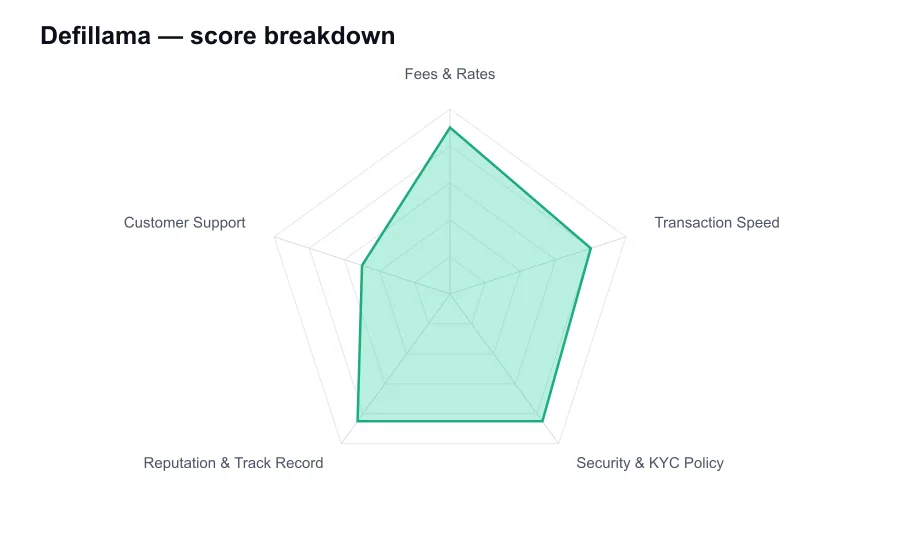
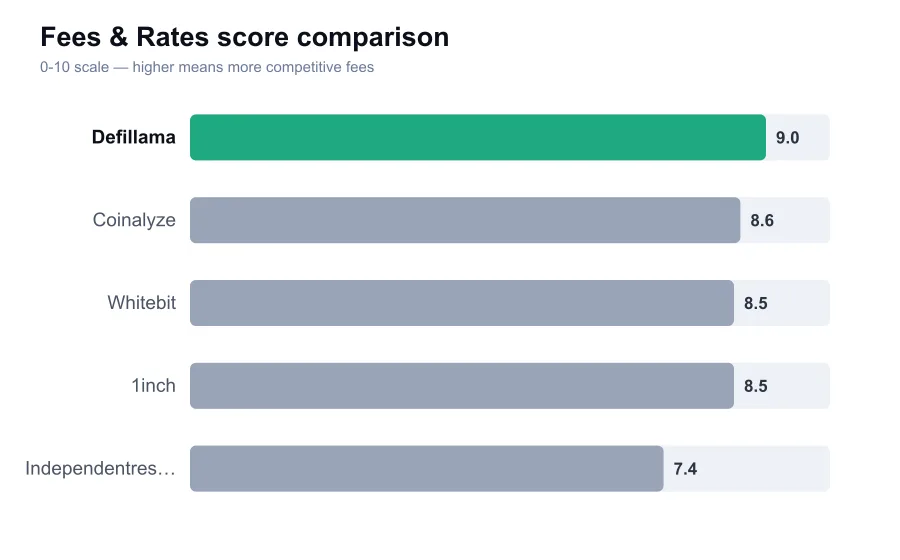
| Fees & Rates | 9.0 | Core analytics are free, swap costs come from routes and networks |
| Transaction Speed | 8.0 | Fast dashboard, settlement depends on the selected blockchain |
| Security & KYC Policy | 8.5 | No routine custody or KYC, but wallet signing remains user risk |
| Reputation & Track Record | 8.5 | Widely used independent DeFi data source |
| Customer Support | 5.0 | Community-led help, not retail account support |
In-Depth Review
DefiLlama occupies an unusual place in crypto. It is not a conventional exchange, broker, or custodian. It is primarily a DeFi data platform, best known for tracking total value locked across chains, protocols, bridges, yields, stablecoins, unlocks, and decentralized exchange volumes. For researchers, onchain traders, and people trying to see past marketing claims, it has become one of the most useful public dashboards in the industry. Its strength is that it helps users compare the market before they put money anywhere.
That distinction matters because DefiLlama does not generally take custody of customer assets. There is no standard account balance, no fiat deposit rail, and no central order book where it controls execution. A visitor can browse most of the site without creating an account or completing identity checks. In an era where many crypto services collect personal documents before showing a chart, DefiLlama's privacy-friendly approach feels refreshing.
The site is especially strong at making fragmented DeFi information legible. A user can compare Ethereum, Solana, Arbitrum, Base, Tron, BNB Chain, and dozens of smaller networks without opening a stack of protocol-specific dashboards. The TVL pages, chain rankings, stablecoin data, protocol revenue figures, and historical charts are often the first place serious users look when assessing whether a protocol has real traction or just a loud social media presence.
Its data coverage is broad, but broad coverage is not the same thing as perfect coverage. DefiLlama relies on public blockchain data, protocol integrations, and methodology decisions that can be challenged at the margins. TVL is also an imperfect metric. A protocol can show a large figure because of incentives, looping strategies, or volatile collateral, while having little organic usage. DefiLlama presents the numbers well, but it cannot stop readers from mistaking a headline metric for a complete investment case.
Fees are one of the platform's clearest advantages. Browsing its analytics products is free, and most users can access an enormous amount of data without paying a subscription. That puts it in sharp contrast with institutional terminals and many premium research services. There is no standard platform fee for looking at chain data, yield tables, unlock schedules, or protocol dashboards. For an independent analyst, that is a genuinely valuable public good.
DefiLlama's swap interface is a different product and should not be confused with its research tools. The interface routes trades through decentralized liquidity sources. The costs a trader sees are usually network gas, liquidity provider fees, slippage, and any charges imposed by the underlying route. A low displayed fee does not guarantee a cheap trade. On Ethereum during busy periods, gas can dominate the cost of a smaller swap, while thin liquidity can produce worse execution than a centralized exchange.
The swap tool is convenient for users who want a simple route finder without surrendering custody, but it is not a replacement for checking execution carefully. Compare the expected output, price impact, and route before signing. On liquid assets, the results can be competitive with other aggregators. On obscure tokens, crosschain trades, or volatile conditions, a route that looks acceptable before wallet confirmation can become expensive quickly. DefiLlama provides useful plumbing, not a promise of best execution in every market.
Speed depends less on DefiLlama itself than on the blockchain and protocol being used. The analytics site is generally fast and lightweight, especially compared with bloated trading platforms that load endless promotional widgets. Data updates can be frequent, but onchain values are never truly static. A large movement in TVL or volume may take time to be reflected if an integration changes, a chain has indexing issues, or a protocol's contracts are upgraded.
For swaps, settlement is governed by the selected network. A transaction on Solana, Base, Arbitrum, or another fast chain can confirm quickly, often within seconds or a few minutes. Ethereum mainnet can be slower and much more expensive during congestion. Crosschain activity requires more patience because bridges, relayers, and destination-chain confirmations add moving parts. Anyone promising instant crosschain settlement is overselling the reality of blockchain infrastructure.
The security case for DefiLlama is strong in one important sense. It does not ask users to hand over coins or routinely provide identity documents. That sharply reduces the risk associated with a centralized exchange collapse, frozen withdrawal queue, or database leak involving KYC files. Still, the moment a user connects a wallet or signs a swap, the security burden shifts back to the user. A noncustodial interface cannot reverse an approved malicious transaction.
Users should be particularly careful with links, token contracts, and cloned websites. DefiLlama's reputation makes it a tempting target for phishing campaigns. Bookmark the official domain, verify the wallet prompt, and treat unsolicited airdrop claims as hostile by default. The platform can help users discover protocols, but discovery is not due diligence. A protocol listed in a dashboard is not being endorsed as safe, solvent, or well managed.
DefiLlama has earned a strong reputation among DeFi-native users because it has repeatedly challenged inflated metrics and resisted the polished but shallow presentation common in crypto marketing. Its team has also shown a willingness to explain methodology publicly. That independence has real value. The limitation is that its brand is stronger with experienced onchain participants than with beginners, who may find the volume of information intimidating and the distinctions between metrics unclear.
Customer support is the weak point, though that is partly a consequence of the product's open and free nature. DefiLlama is not built like a retail exchange with a staffed account desk, phone line, and recovery process. Documentation, social channels, GitHub activity, and community discussion are more useful than expecting personal help with a wallet mistake. If you need someone to reverse a transfer or investigate a trading dispute, this is the wrong kind of service.
My view is simple. DefiLlama is one of the best free tools in crypto, but it should be treated as a research layer rather than a place to park funds. It is excellent for comparing DeFi ecosystems, identifying market trends, tracking protocol fundamentals, and finding routes to investigate further. Beginners can use it, but they should start with the basic chain and protocol pages rather than diving straight into yields and bridges. For users who want a regulated custodian, fiat support, or human account assistance, DefiLlama is not a substitute for an exchange.
Pros & Cons
| Pros | Cons |
|---|
Does DefiLlama charge a fee to use its data dashboards?
Most core analytics pages are free to access. If you use a swap feature, your costs come primarily from blockchain gas, liquidity provider fees, slippage, and the underlying transaction route.
Does DefiLlama require KYC?
Browsing DefiLlama's public data does not normally require KYC or a user account. Connecting a wallet for an onchain action is different and may expose you to the rules of the selected protocol or network.
Is DefiLlama an exchange?
Not in the traditional sense. It is mainly a DeFi analytics platform. Its swap tools can help route onchain trades, but it does not operate like a custodial exchange holding customer balances.