Editorial independence: our scores and rankings are produced using the fixed criteria above and are not influenced by advertisers. This is an independent ranking site and is not operated by, or affiliated with, any provider we list.
Affiliate disclosure: some links on this page may earn us a commission at no extra cost to you. This does not affect our rankings.
Live market data via CoinGecko, for informational purposes only. Not financial advice.
| Best for | Not for |
|---|---|
| Useful open interest, funding and liquidation visualizations | It is not an exchange and cannot execute trades |
Criteria Breakdown
| Criterion | Score | Notes |
|---|---|---|
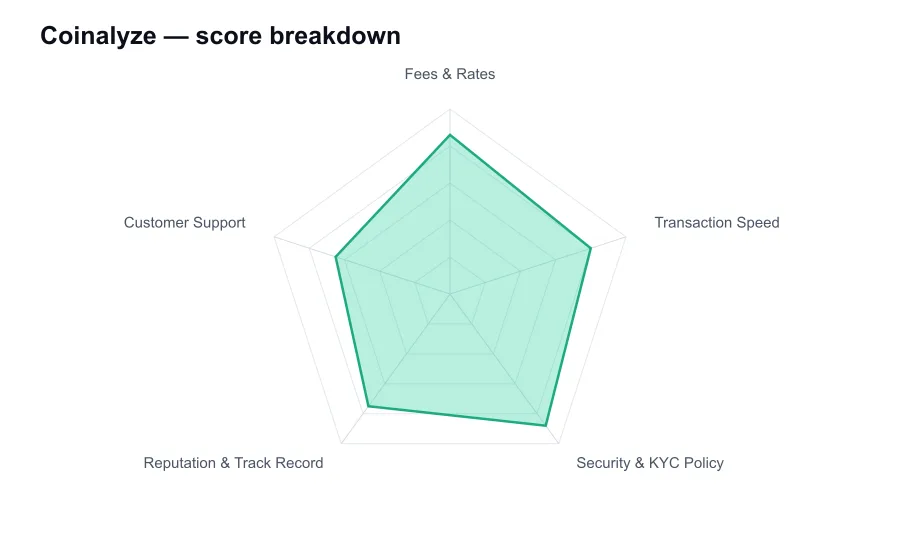
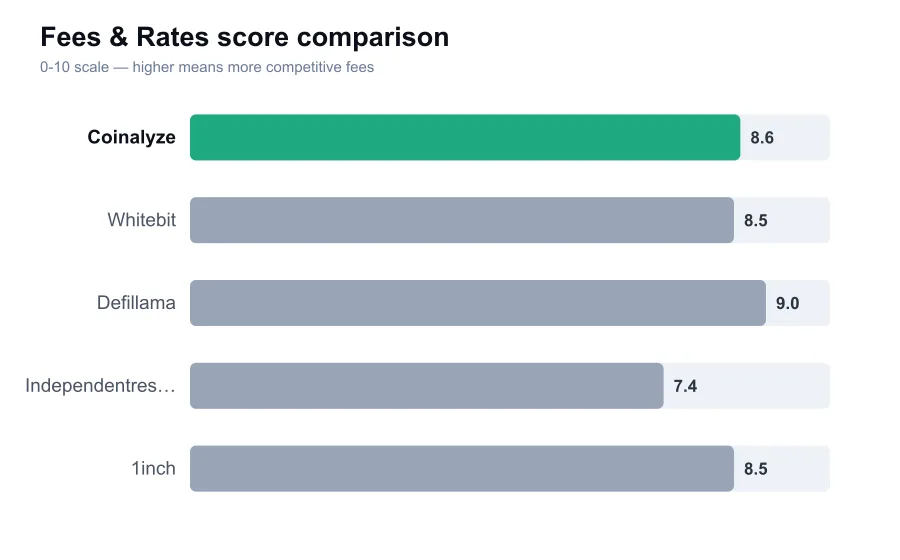
| Fees & Rates | 8.6 | Free core analytics, paid tiers for deeper tools and API access |
| Transaction Speed | 8.0 | Responsive market monitoring, but dependent on source exchange feeds |
| Security & KYC Policy | 8.8 | No customer trading balances or crypto custody |
| Reputation & Track Record | 7.5 | Well regarded specialist in crypto derivatives analytics |
| Customer Support | 6.5 | Practical product support, not a live trading desk |
In-Depth Review
Coinalyze is not a conventional crypto exchange, and treating it like one would give readers the wrong impression from the start. It is a market-data and charting platform focused heavily on derivatives analytics, including open interest, funding rates, liquidations and exchange-specific futures data. Traders use it to study what is happening across venues, then place trades elsewhere. That distinction drives almost every part of this review, because traditional exchange scores for deposits, withdrawals and execution do not fully apply.
The platform occupies a useful niche between a basic price chart and an expensive institutional data terminal. A spot investor can open a chart almost anywhere. A derivatives trader trying to understand whether open interest is expanding, whether funding is overheated, or whether a move is being driven by liquidations needs more context. Coinalyze puts much of that information in one interface. For active perpetual futures traders, that can be genuinely valuable rather than merely decorative.
Its strongest tools are the derivatives overlays and historical datasets. Users can inspect open interest, funding, liquidations, long versus short ratios where available, volume, basis-related information and exchange markets. The ability to view these beside price helps a trader form a hypothesis about leverage in the market. A sharp rally with rising open interest can tell a very different story from one fueled by liquidated shorts. Of course, it is still evidence, not a trading signal handed down from a mountain.
The charts are flexible enough for serious retail analysis. Timeframes, technical indicators, drawing tools and comparisons across listed markets are familiar territory for anyone who has used charting software. Coinalyze also covers data from major derivatives exchanges and offers API access on paid tiers. It is not trying to replace every specialist analytics product, but it gives traders a workable view of data that many exchange interfaces bury or display poorly.
Fees are unusual here because Coinalyze does not charge trading commissions, spreads or withdrawal fees. It does not hold customer fiat or execute a market order. Its basic data access is available without the cost structure attached to an exchange, while subscriptions unlock greater history, more alerts, more indicators, API access and other advanced functions. That can make the entry point very attractive for a trader who wants to test whether derivatives data actually improves their decisions.
The free plan should not be mistaken for unlimited institutional-grade access. Restrictions on data history, alerts, indicators or API capabilities are precisely what push heavy users toward paid plans. Subscription pricing and plan entitlements can change, so a prospective subscriber should check the current plan page before committing. My practical view is that the value depends on discipline. If you use open interest and funding daily, a paid charting tool can earn its keep. If you glance at liquidations once a month, it is unnecessary.
Speed is strong in the only sense that matters for this product: chart response and data availability are generally designed for active monitoring rather than end-of-day research. The platform aggregates feeds from external exchanges, so it cannot be faster than the source venue and should not be treated as a perfect tick-for-tick execution reference. A trader placing a very short-term scalp should always confirm the live order book and mark price at the exchange where they intend to trade.
That caveat matters more than many users realize. Data services can have feed interruptions, symbol mapping differences, calculation methodology changes or small delays during extreme volatility. In quiet conditions, those details barely matter. During a violent Bitcoin move, they can matter a lot. Coinalyze is excellent for situational awareness, but it should sit beside an exchange terminal, not replace it. Anyone making decisions on seconds should have a backup source for critical market information.
Security is comparatively simple because Coinalyze is not a custodian. It does not ask users to deposit coins, does not store a trading balance, and does not operate a fiat payment account in the way a centralized exchange does. That substantially reduces the classic exchange risk of losing assets in a platform breach or insolvency. It also means the service cannot directly protect a trader from losses caused by a bad trade made on Binance, Bybit, OKX or another connected venue.
Account security still matters. A paid analytics account may include saved layouts, alerts and billing details, so users should use a unique password and two-factor authentication if it is offered on their account. More importantly, be wary of fake Coinalyze links and social-media accounts promising signals. Analytics brands attract copycats because traders are eager for an edge. Coinalyze provides data, not guaranteed outcomes, and any person selling certainty around liquidation charts is selling something more dangerous than a subscription.
KYC is not central to the standard data-viewing experience in the way it is at a fiat crypto broker. This is a real advantage for users who simply want research tools without opening another financial account. Billing for a premium subscription may naturally require payment information, but that is different from submitting identity documents for a trading account. The absence of KYC should never be confused with anonymity across the wider trading process, since the exchange where orders are placed may require full verification.
Coinalyze has developed a credible reputation among derivatives-focused crypto traders, particularly those who want accessible open interest and liquidation data. It is a specialist brand, not a household name among casual coin buyers, and that is fine. Its audience is narrower. The important reputation test is whether the tool is used as one input among several, rather than treated as a magic dashboard that predicts the next candle. Sensible traders tend to get more from it than signal-chasers do.
Compared with TradingView, Coinalyze is less universal but more directly oriented toward crypto derivatives metrics. Compared with high-end platforms such as Glassnode, CryptoQuant or institutional terminals, it can be more immediately chart-focused and less broad in on-chain or macro research. There is room for all of them. Coinalyze is most persuasive for a trader who wants futures positioning data integrated into the same working screen as price action, without paying for an enterprise research stack.
Support is adequate for a software platform but not a concierge service. Documentation, contact options and issue reporting matter more here than live chat because the common problems involve subscriptions, chart settings, data questions or API usage. A trader who needs someone to explain risk management at 2 a.m. will be disappointed, and rightly so. The service is a tool for people prepared to interpret markets themselves.
There is a temptation to overfit every wiggle in funding or open interest. Coinalyze can make that temptation worse because a dense dashboard feels authoritative. A good user will start with a basic question, such as whether leverage is building into a breakout, and then check price structure, volume, news and the actual exchange market. A bad user will find one metric that confirms an existing bias. The product cannot solve that behavioral problem.
The platform is therefore best judged as a very capable research layer, not as a place to buy crypto. Its fees are attractive because basic access costs little or nothing, its security exposure is low because it is non-custodial, and its speed is good for monitoring data. Its limitations are equally clear: it cannot offer trade execution, it cannot guarantee perfect real-time feeds, and it will not make an inexperienced trader profitable. Used properly, it is more useful than many flashy signal products. Used carelessly, it is just another screen full of reasons to overtrade.
Pros & Cons
| Pros | Cons |
|---|
Can I buy Bitcoin or trade futures on Coinalyze?
No. Coinalyze is an analytics and charting platform. It provides market data, while trades must be placed through a separate exchange.
Does Coinalyze require KYC?
Standard use is not structured like opening a regulated trading account. Premium billing may require payment details, while your trading exchange may require full KYC.
Is Coinalyze data suitable for scalping?
It is useful for market context, but traders should verify prices and order-book conditions at their execution venue because external data feeds can differ or lag.