Editorial independence: our scores and rankings are produced using the fixed criteria above and are not influenced by advertisers. This is an independent ranking site and is not operated by, or affiliated with, any provider we list.
Affiliate disclosure: some links on this page may earn us a commission at no extra cost to you. This does not affect our rankings.
Live market data via CoinGecko, for informational purposes only. Not financial advice.
| Best for | Not for |
|---|---|
| Practical coverage for local payment routes | Spread-based pricing needs careful comparison |
Criteria Breakdown
| Criterion | Score | Notes |
|---|---|---|
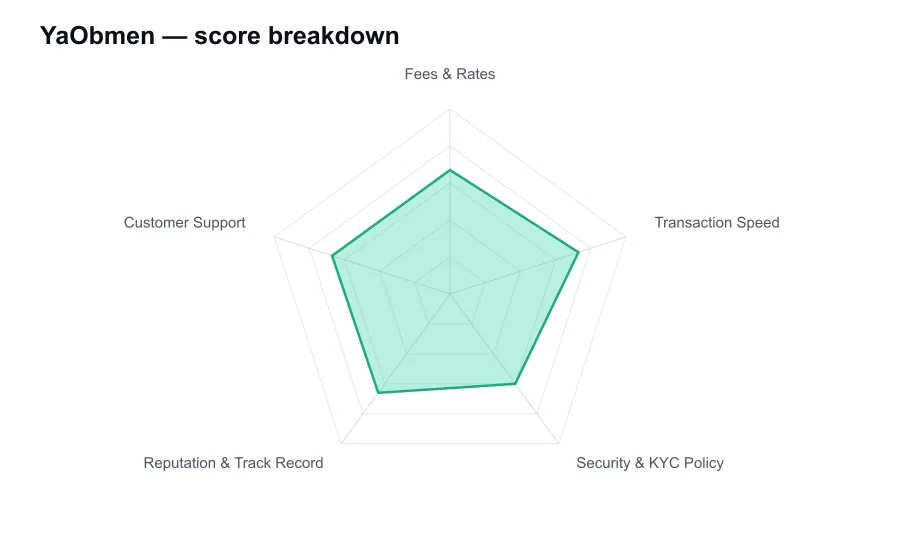
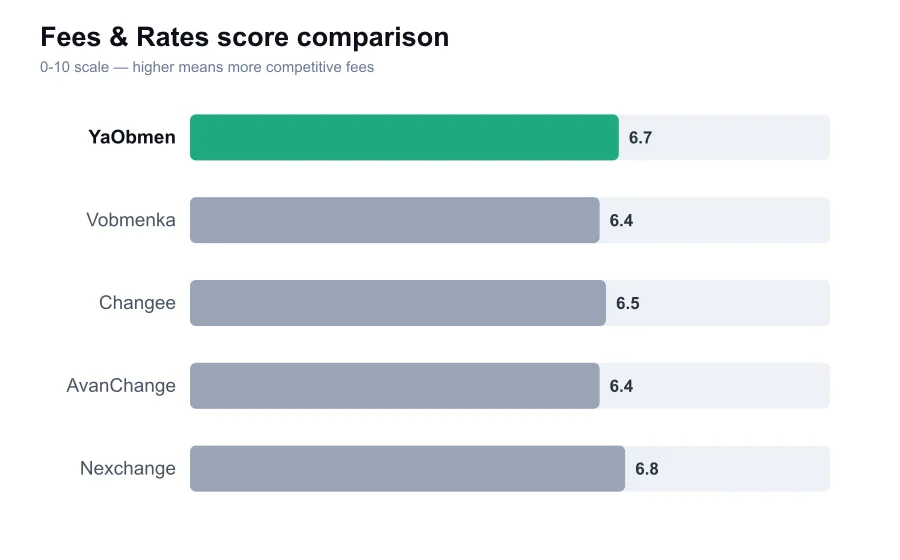
| Fees & Rates | 6.7 | Competitive on selected routes, quote comparison is essential. |
| Transaction Speed | 7.3 | Clean orders can settle promptly after confirmations. |
| Security & KYC Policy | 6.0 | Risk-based verification can affect an otherwise simple order. |
| Reputation & Track Record | 6.6 | A niche service without major-exchange disclosure depth. |
| Customer Support | 6.7 | Useful for exceptions, but not a large support operation. |
In-Depth Review
YaObmen is the kind of independent exchange service that competes on route coverage and familiar local payment options rather than brand glamour. Its natural audience is not a derivatives trader. It is the person who needs to exchange cryptocurrency into a card, electronic payment system, or another supported currency without learning a full exchange terminal. That can be genuinely useful, especially in markets where banking access and crypto access do not line up neatly. It also puts the service in a category where execution quality is more important than marketing language.
The site format will feel familiar to users of exchanger monitoring platforms. You choose what you are sending and what you want to receive, review a quoted amount, enter details, and fund the order. This is simpler than placing a market order, but it has a cost. YaObmen is taking payment, liquidity, volatility, and operational risk into account, so its pricing is typically expressed through the rate rather than a transparent maker-taker schedule. Comparing only a headline figure is a mistake.
For fees, YaObmen is best judged transaction by transaction. There is no reason to assume it is always cheap or always expensive. Some routes are competitive because the service has a good payment partner or sufficient reserve. Others can carry a noticeable spread, particularly when fiat cards, less liquid currencies, or urgent payouts are involved. Check the received amount against at least two alternatives. For crypto-to-crypto conversions, larger exchanges and established swap providers often have the advantage. For a difficult local payout, YaObmen may justify a higher effective fee.
The unpleasant surprises in this market usually come from network and payment details rather than the advertised rate. USDT is not one asset operationally if one order uses TRC20 and another uses ERC20. Sending through the wrong network, omitting a tag, or paying after an order has expired can create a recovery request. YaObmen's instructions should be read literally. A customer should also verify whether the amount shown includes the receiving bank's possible charges, because an exchanger cannot always control what a bank or card processor deducts later.
Speed looks respectable for clean, standard orders, which is what YaObmen should be judged on. Once crypto arrives with the required confirmations, a straightforward payout can be handled quickly if reserves are available. Fast stablecoin networks are naturally better suited to this than Bitcoin during a congested period. I would not describe any card-oriented exchange route as instant in the strict sense, though. Banking systems, fraud filters, and manual confirmation requests can all slow the last mile.
That distinction matters for buyers who are trying to use a service as an emergency cash-out tool. If you need funds at an exact hour, do not build your plan around an independent exchanger's best-case timing. Place a small order on a non-urgent day and learn how long your bank and chosen network actually take. YaObmen may perform well in normal conditions, but an operator cannot force a card processor to release a payment or reverse a compliance hold immediately.
The service's KYC policy needs to be understood as risk-based rather than as a blanket promise of privacy. Many independent exchangers market a low-friction process, and YaObmen can be convenient for a standard order. Yet suspicious activity controls, source-of-funds questions, disputed card information, and sanctions screening can still lead to document requests. That is not unusual. The problem is that users sometimes confuse a quick signup-free order page with a guarantee that no verification can ever happen.
If privacy is important, ask a specific question before payment. State the asset, network, amount range, destination type, and whether your payment method is in your own name. Keep the answer. A serious support team should at least explain whether the direction is likely to be reviewed, although no legitimate provider can promise that every future transaction will bypass compliance. Anyone unwilling to provide documents under any circumstances should use a service whose policy is explicitly designed for that model, while accepting the legal and market risks that come with it.
From a security perspective, YaObmen carries the ordinary strengths and weaknesses of a non-custodial order flow. You do not need to leave a balance sitting in a trading account, which reduces one category of exposure. On the other hand, you are sending funds to an operator and relying on them to settle the other side. There is no equivalent of a regulated broker's investor-protection story here. The practical safeguards are careful address checking, a secure device, an authentic website, screenshots of the order, and a test transaction.
Its public reputation is likely to matter more than its corporate presentation. A small exchanger can develop a solid following through consistent processing and responsive issue handling, but public feedback should be read critically. Look at whether reports are recent and whether the same complaints recur: frozen orders, changing rates, unavailable reserves, or unexplained payout delays. One angry review proves little. A pattern does. I would put more weight on detailed reports that identify a direction and timeframe than on generic praise.
YaObmen does not have the scale or external visibility of a household-name exchange. That is a meaningful limitation, not a reason to dismiss it outright. It simply changes how a prudent customer should use it. I would not send an amount that would materially hurt me if resolution took days, and I would never treat it as long-term storage. A reputable small service earns trust gradually, through transactions, not through a logo or an optimistic monitor ranking.
Support is where YaObmen can either retain customers or lose them. In this category, users do not need elaborate educational content. They need a real answer when an order has a missing confirmation, a payment-provider issue, or a receiving detail that must be corrected before payout. The available contact channels are useful, but response quality matters more than the number of icons on a website. Include an order number and transaction hash from the first message. It reduces back-and-forth and makes it easier to assess whether the team is engaged.
I like YaObmen more as a targeted payment tool than as a universal crypto venue. It has a sensible role for someone who has already compared rates and knows the mechanics of the network they are using. The service is less persuasive for a novice who wants certainty, a highly liquid trader, or a customer transferring a sum large enough to require robust compliance support. Those people are better served by a major platform, even if the route takes an extra step.
My view is that YaObmen deserves consideration, but not blind loyalty. Its strongest argument is flexibility around exchange directions that big platforms may ignore. Its weakest point is the same one that affects most small exchangers: users must accept quote-based pricing and a lower level of public transparency. Use it for a defined job, test it first, and move on after settlement rather than allowing a balance to linger. That is the disciplined way to get its convenience without pretending the risk profile is the same as a large regulated exchange.
Pros & Cons
| Pros | Cons |
|---|
How does YaObmen make money on an exchange?
The effective fee is generally incorporated into the exchange rate, alongside blockchain and payment-route costs. Compare the final receive amount, not just the displayed rate.
Is YaObmen suitable for holding crypto?
No. It is better treated as a transaction service. Send the required amount for the order and keep long-term crypto in a wallet you control.
Why might a YaObmen order take longer than expected?
Blockchain confirmations, incorrect payment details, reserve issues, bank processing, and compliance checks can all extend an order beyond its normal estimate.