Editorial independence: our scores and rankings are produced using the fixed criteria above and are not influenced by advertisers. This is an independent ranking site and is not operated by, or affiliated with, any provider we list.
Affiliate disclosure: some links on this page may earn us a commission at no extra cost to you. This does not affect our rankings.
Live market data via CoinGecko, for informational purposes only. Not financial advice.
| Best for | Not for |
|---|---|
| Useful API and integration focus | Less friendly for first-time retail users |
Criteria Breakdown
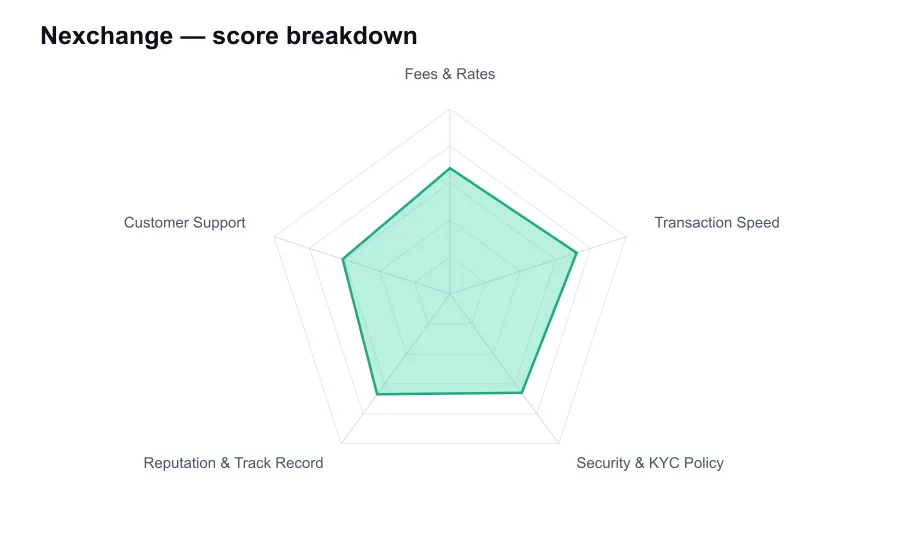
| Criterion | Score | Notes |
|---|---|---|
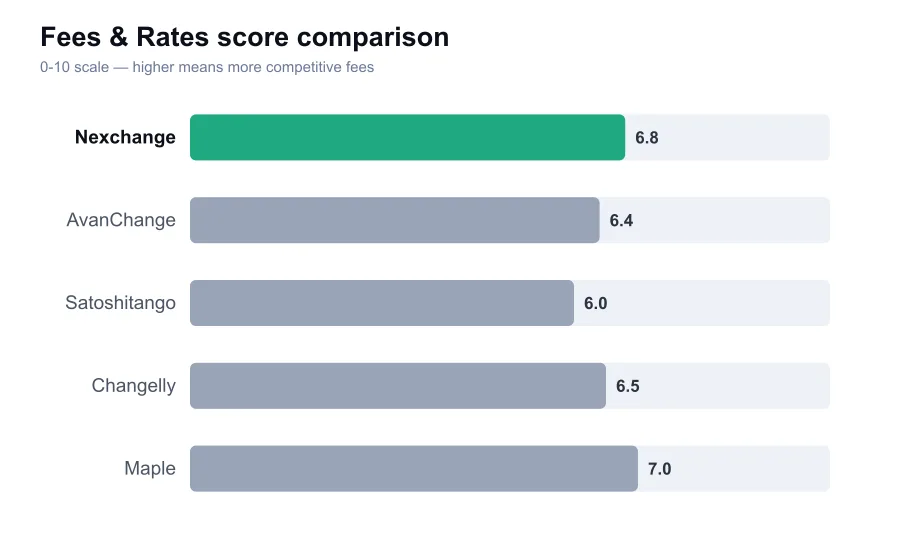
| Fees & Rates | 6.8 | Competitive quote routing, but effective spreads vary by pair. |
| Transaction Speed | 7.2 | Efficient for liquid routes after required confirmations. |
| Security & KYC Policy | 6.6 | Noncustodial-style order flow with compliance controls. |
| Reputation & Track Record | 6.7 | Established API-focused presence, smaller retail profile. |
| Customer Support | 6.1 | Best suited to users who can provide technical order details. |
In-Depth Review
Nexchange has historically occupied a more technical niche than the typical consumer-facing instant exchange. It is known for providing cryptocurrency exchange infrastructure and an API that other businesses can integrate, alongside a direct conversion interface for users. That positioning matters because the service is less about flashy retail trading and more about routing conversions behind the scenes. For developers and payment businesses, that can be useful. For a casual buyer, it can feel comparatively bare-bones.
The product is not a conventional custodial exchange in the Binance or Coinbase sense. You do not deposit money into an account, place limit orders, and watch an order book. Instead, an exchange order is created for a specified amount and pair, then funds are sent to the provided address. Nexchange and its liquidity sources execute the conversion and send the output to the recipient wallet. It is a practical model, but it has the same irreversible-send risk common to all instant exchangers.
Pricing is generally quote-driven. Nexchange exposes rate information through its interface and API, but the amount a customer receives is affected by market conditions, network charges, liquidity, and the route selected for the order. That is better than pretending every pair has a single static percentage fee. It is still less transparent than trading on a visible order book where the maker fee, taker fee, and market depth are all plainly available.
For mainstream assets, Nexchange can be competitively priced because routing and liquidity aggregation can reduce the need for a huge retail markup. The result is not guaranteed. A service that uses external liquidity is only as sharp as the liquidity available at that moment. Stablecoin conversions and heavily traded coins are where I would expect the most sensible quotes. Exotic assets, low-liquidity chains, and small transaction sizes can produce a notably worse effective rate.
The API orientation is one of Nexchange's genuine strengths. A business that needs programmatic quotation, order creation, status checks, and withdrawal handling may find it more useful than a consumer-only swap widget. Documentation and predictable order-state reporting matter a great deal in that setting. The trade-off is that an API does not erase operational risk. If your product sends customer funds into an exchange route, you need careful error handling, reconciliation, and a human escalation process.
Speed is usually reasonable on routes with healthy liquidity, though the word instant should never be read literally. The service has to see the incoming transaction, obtain the required confirmations, execute or route the trade, and broadcast the payout. For a fast network and a liquid pair, that can happen in a relatively short window. Bitcoin deposits, Ethereum congestion, destination-tag issues, or provider-side checks can stretch the timeline significantly.
Nexchange is stronger than some small competitors in its emphasis on transaction status and integration logic. That makes it easier to understand where an order is in the process, at least for users and developers who are comfortable reading status information. Still, a status page cannot solve the anxiety of a delayed conversion. A customer watching a large transfer remain pending wants a concrete explanation, not merely a technical label.
On security, the noncustodial transaction model limits the risk of holding a long-term balance on the platform. There is no reason to leave coins sitting there after a conversion because the service is meant to pay out to a wallet you control. That is a positive. Yet the platform temporarily handles the transaction flow, and users remain exposed to the company's wallet security, operational discipline, liquidity partners, and compliance decision-making during each order.
KYC is another area where marketing shorthand can mislead. Nexchange has served a business-oriented market and has compliance obligations. An ordinary crypto-to-crypto order may proceed without a lengthy onboarding process, but this should not be interpreted as a permanent no-KYC guarantee. Suspicious activity screening, sanctioned-address checks, unusual order patterns, and partner requirements can all result in requests for information. Anyone who cannot accept that possibility should use self-custodial decentralized trading where appropriate.
Its reputation is respectable within the narrower exchange-API and instant-conversion space, although it has never had the consumer recognition of the market's biggest names. The company has been discussed more often by developers and service operators than by mainstream retail traders. That is not a flaw by itself. It does mean public review volume is thinner and less useful as a guide to how Nexchange handles a rare but painful retail dispute.
I view Nexchange as more established than a newly launched anonymous swap site, but less battle-tested in public view than a major regulated exchange. The distinction is important. A mature API, technical documentation, and a long-running web presence are positive signals. They do not provide the same reassurance as audited financial reporting, broad licensing disclosures, or a vast record of independently documented customer outcomes. The service deserves measured confidence, not automatic trust.
Support is likely to feel strongest for businesses that understand the API and can provide transaction identifiers, webhook logs, and exact order details. That is the audience the platform seems built to serve. A retail user who simply says their swap has not arrived may find the process more opaque. Prompt, clear support matters most after a blockchain mistake, and no instant exchange can easily reverse a wrongly sent transaction or recover an unsupported asset.
Before using Nexchange, check the minimum and maximum limits for the exact pair, the payout network, and whether the quoted amount is fixed or floating. Test the recipient address with a modest order if the chain is unfamiliar. Businesses should also model failed deposits, partial payments, network reorgs, and compliance holds rather than treating the API as a magical conversion button. The technical side is good enough to reward careful use, but careless integration can create expensive support problems.
Nexchange is a credible choice for developers, merchants, and technically confident users who value programmatic exchange access more than a polished retail experience. It is not my first recommendation for someone making their first crypto purchase or moving a large personal holding under time pressure. Its infrastructure focus is a real advantage, and its quote model can be competitive. The weak point is the same one that shadows much of this sector, limited consumer-grade transparency compared with the major regulated venues.
Pros & Cons
| Pros | Cons |
|---|
Is Nexchange a normal trading exchange?
No. It is primarily an instant conversion and exchange-infrastructure service. Users create an order and send funds for conversion rather than trading on a public order book.
Does Nexchange offer an API?
Yes. Nexchange is known for exchange APIs and integration tools that can provide rates, create orders, and track transaction status programmatically.
Can an Nexchange order require verification?
Yes. A crypto-to-crypto order may be simple, but compliance screening or a liquidity partner can request information in higher-risk situations.