Editorial independence: our scores and rankings are produced using the fixed criteria above and are not influenced by advertisers. This is an independent ranking site and is not operated by, or affiliated with, any provider we list.
Affiliate disclosure: some links on this page may earn us a commission at no extra cost to you. This does not affect our rankings.
Live market data via CoinGecko, for informational purposes only. Not financial advice.
| Best for | Not for |
|---|---|
| Established on-chain credit protocol | Credit defaults remain a real risk |
Criteria Breakdown
| Criterion | Score | Notes |
|---|---|---|
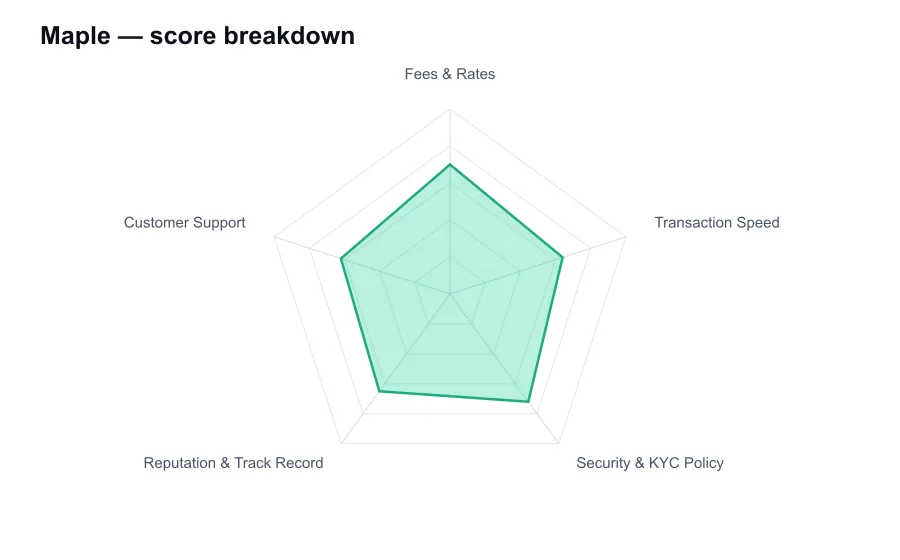
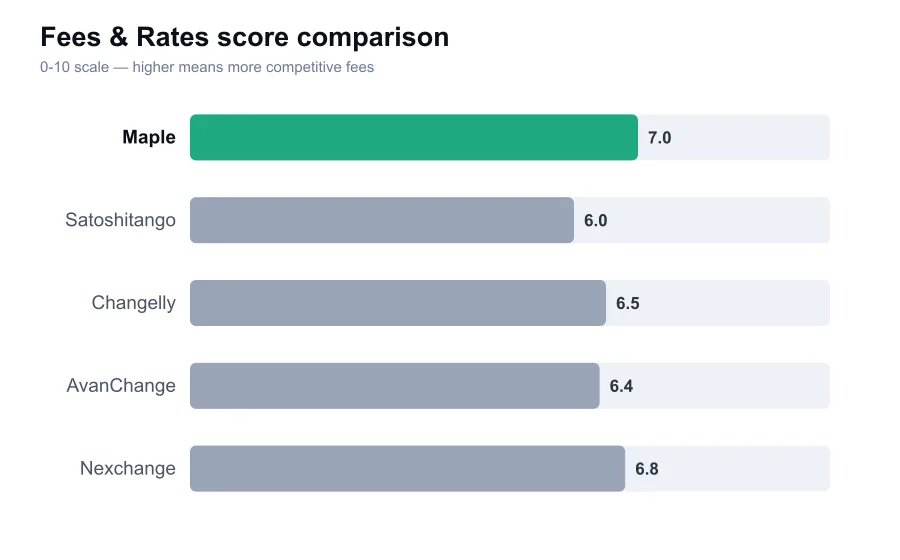
| Fees & Rates | 7.0 | Net yield depends on pool-specific fees and terms |
| Transaction Speed | 6.4 | On-chain settlement, but credit liquidity can be limited |
| Security & KYC Policy | 7.2 | Technical controls cannot remove borrower default risk |
| Reputation & Track Record | 6.5 | Established protocol with a serious default history |
| Customer Support | 6.2 | Built for sophisticated users, not retail hand-holding |
In-Depth Review
Maple is a credit protocol, not a retail exchange in the ordinary sense. It was built to bring parts of institutional lending on-chain, allowing capital providers to supply assets to lending pools while vetted borrowers access credit under defined terms. That puts it in a very different category from Binance, Uniswap, or a simple instant-swap service. Maple is closer to private credit, only with blockchain settlement, transparent pool data, and smart contracts in the middle.
The distinction matters because Maple's rewards and risks are not the familiar risks of holding a spot coin. A lender is not simply earning yield from automated market making. They are taking credit exposure, either directly or through a pool structure. The advertised yield is compensation for that risk. Anybody looking at an attractive USDC return without asking who borrows the money, what collateral exists, and what happens in a default is missing the entire point of the product.
Maple has changed materially since its early growth phase. The 2022 credit failures and defaults were painful, public reminders that institutional branding does not eliminate counterparty risk. Maple's history includes losses tied to borrowers such as Orthogonal Trading and others during the broader market contagion. That chapter should not be ignored. It is the most important evidence available about how the system behaves when credit assumptions fail.
To Maple's credit, the protocol did not simply disappear after that period. Its later direction has emphasized more conservative lending structures, greater use of secured lending, clearer pool mandates, and products aimed at qualified or institutional participants. The platform's evolution is meaningful. But a rebuilt risk framework is not a clean slate. The older failures should make every lender read the current pool documentation with more skepticism, not less.
Fees are less straightforward than a trading commission. Lenders need to distinguish gross borrower interest from net yield after management fees, delegate fees, protocol fees, reserve allocations, and any other pool-specific deductions. The displayed annual percentage yield can be useful, but it should be read alongside the pool terms and historical performance. A higher yield may indicate a shorter duration, a different borrower profile, lower liquidity, or materially more credit risk.
That means Maple can look expensive or inexpensive depending on what you compare it with. Against a no-risk ideal, every fee and every credit exposure looks unattractive. Against private credit funds and institutional lending desks, on-chain transparency and programmatic settlement can be compelling. The fair question is whether the net yield adequately compensates you for borrower and liquidity risk. For retail users, that answer is rarely obvious enough to justify chasing the highest number.
Transaction speed is one of Maple's cleaner qualities. Deposits, withdrawals, and pool interactions settle through the blockchain, generally on Ethereum-compatible infrastructure, so users can observe their transactions rather than waiting for a back-office ledger update. Yet quick transaction confirmation should not be confused with quick liquidity. Credit pools may have withdrawal windows, loan durations, utilization constraints, or redemption queues. Your transaction may settle promptly while your capital remains economically committed.
This is a crucial point for anyone accustomed to exchange balances. A USDC lending position on Maple is not the same as cash in a wallet. If capital is deployed into loans, immediate exit may not be available on the terms you want. Pool-specific rules matter. Before depositing, read the withdrawal mechanics, expected notice period, pool utilization, loan maturity profile, and whether there is a secondary path to liquidity. Do not discover those details after needing the money.
Security has two layers at Maple. The smart contract layer includes the usual risks of exploits, upgrade controls, oracle or accounting bugs, and interface compromise. Maple has had professional security work and has operated publicly through difficult market conditions, which counts for something. The more distinctive layer is credit risk. Smart contracts can execute perfectly while a borrower still fails to repay. Technical security does not solve a bad underwriting decision.
KYC access depends on the product and jurisdiction. Some Maple offerings are designed for accredited, professional, or institutional participants and may require whitelisting or verification. Other protocol interactions may be more open at the wallet level. Do not assume that DeFi branding means every pool is available without checks. This is a credit market with real regulatory and eligibility considerations, not an anonymous token swap page.
Maple's reputation is mixed, and that is the honest answer. It has a far more substantial and recognizable record than a newly launched DeFi yield app. It has founders, public materials, a history of actual loan activity, and a visible response to a major market crisis. But its track record also includes real defaults. A reviewer who gives it a pristine reputation score would be ignoring the central risk event that shaped its development.
Support is reasonable for a protocol serving sophisticated users, with documentation, community channels, and institutional contact paths. Still, it is not consumer banking support. If a lender misunderstands a pool's liquidity terms or takes a loss from a borrower default, there is no support ticket that turns the position into a guaranteed deposit. The documentation is part of the product, and users need to treat it that way.
Maple is best for informed capital allocators who understand fixed income, credit underwriting, and liquidity risk, or for institutions that can perform their own diligence. It can also be useful for crypto-native treasuries seeking on-chain credit exposure with more structure than anonymous yield farming. It is not appropriate for someone whose main goal is simple passive income, instant withdrawals, or protection of principal. Those users are likely to interpret the yield as safer than it is.
My judgment is that Maple is serious, useful, and still inherently risky. The protocol deserves credit for surviving a brutal test and adapting, but survival should not be mistaken for a guarantee. It is one of the more credible names in on-chain credit precisely because there is enough history to inspect, including the ugly parts. For the right lender, that transparency is valuable. For the average retail user, the old rule remains the right one: do not lend money into a credit structure you cannot independently evaluate.
Pros & Cons
| Pros | Cons |
|---|
Is Maple a crypto exchange?
No. Maple is primarily an on-chain credit and lending protocol. Lenders provide capital to pools and borrowers access credit under pool-specific terms, rather than trading tokens on an order book.
Can I withdraw from Maple whenever I want?
Not necessarily. Withdrawal timing depends on the pool's terms, utilization, loan duration, and redemption rules. Confirm the current liquidity and withdrawal mechanics before supplying funds.
Has Maple experienced defaults?
Yes. Maple was affected by notable borrower defaults during the 2022 crypto credit crisis. Its later product design has emphasized more conservative and secured structures, but credit risk remains.
Does Maple require KYC?
Requirements depend on the specific product, pool, and jurisdiction. Certain institutional or permissioned offerings require verification or whitelisting, so users should check eligibility before planning a deposit.