Editorial independence: our scores and rankings are produced using the fixed criteria above and are not influenced by advertisers. This is an independent ranking site and is not operated by, or affiliated with, any provider we list.
Affiliate disclosure: some links on this page may earn us a commission at no extra cost to you. This does not affect our rankings.
Live market data via CoinGecko, for informational purposes only. Not financial advice.
| Best for | Not for |
|---|---|
| Cross chain swaps from a self custodial wallet | Bridge and smart contract risk remains significant |
Criteria Breakdown
| Criterion | Score | Notes |
|---|---|---|
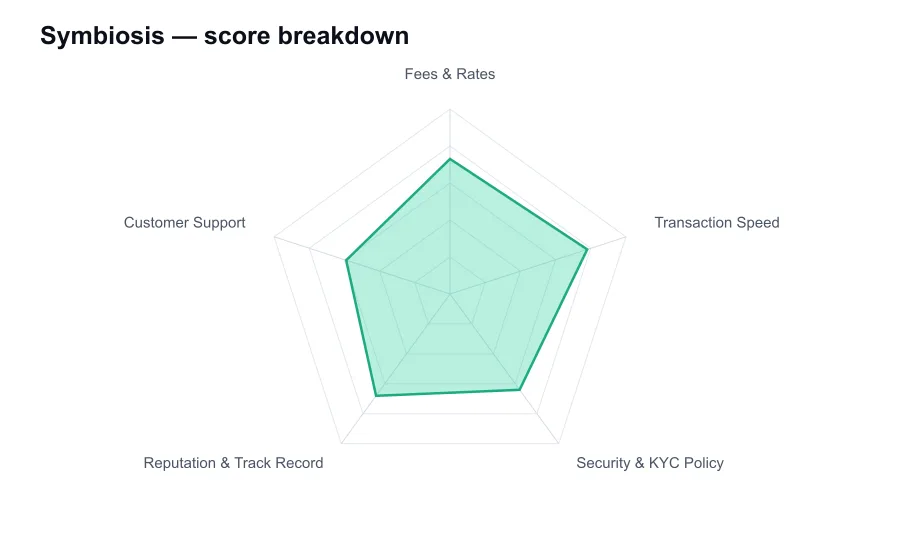
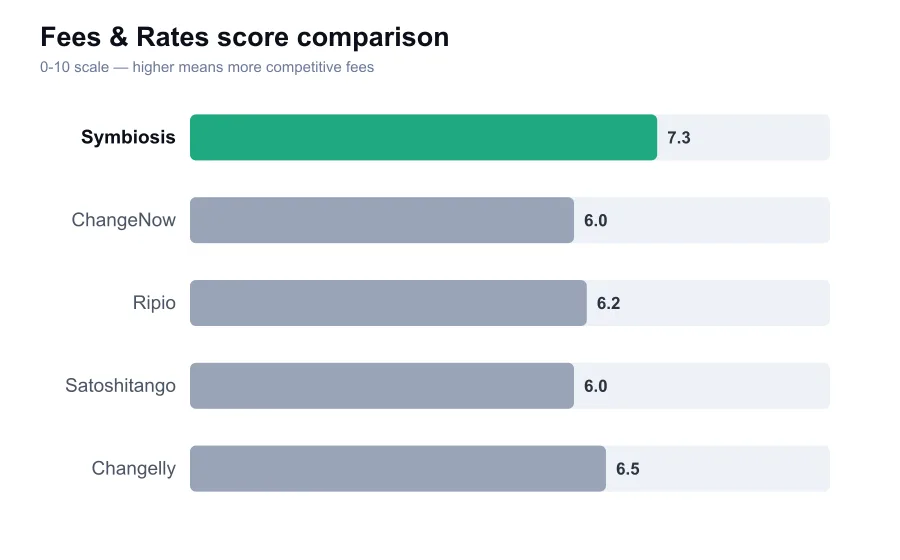
| Fees & Rates | 7.3 | Competitive stablecoin routes, but gas and price impact can dominate |
| Transaction Speed | 7.8 | Often minutes across supported chains, with bridge delays still possible |
| Security & KYC Policy | 6.4 | Self custody and audits help, but cross chain smart contract risk is material |
| Reputation & Track Record | 6.8 | Recognized multichain protocol, operating in a historically risky sector |
| Customer Support | 5.9 | Community help exists, but blockchain transfers cannot be reversed |
In-Depth Review
Symbiosis is not an exchange in the normal centralized sense, and it is not simply another bridge either. It is a cross chain liquidity protocol designed to let users swap assets between different blockchain ecosystems through a single interface. The appeal is obvious to anyone who has tried to move a stablecoin from Ethereum to BNB Chain, Arbitrum, Polygon, or another network and discovered that a bridge, a separate swap, gas on both ends, and several browser tabs were required.
The protocol tries to compress that messy sequence into one transaction path. A user connects a self custodial wallet, chooses a source chain and asset, selects a destination chain and asset, approves the transaction, then receives the output on the destination network. In the best case, it feels much closer to a cross chain exchange than manually bridging and trading. That is a real usability improvement, particularly for stablecoin users moving between supported networks.
The product is fundamentally different from Trocador or ChangeHero. There is no email account, no central deposit address assigned to a user, and no support agent holding a traditional exchange ledger. Smart contracts, liquidity pools, relayers, and cross chain infrastructure do the work. That lowers dependence on a custodian, but it replaces familiar company risk with technical risk. A clean interface cannot make bridges inherently simple or risk free.
Fees are difficult to summarize with one neat percentage because a Symbiosis transaction can include several components. There may be a protocol fee, liquidity provider fee, price impact, source chain gas, destination chain execution costs, and a small amount reserved for cross chain gas. The app shows the expected output before confirmation, which is the number users should focus on. A quoted route that looks cheap can still be expensive if the source chain is Ethereum and gas is elevated.
For stablecoin routes between low fee networks, Symbiosis can be very competitively priced. Avoiding a separate bridge and decentralized exchange transaction may save both time and gas. On the other hand, it is not always the cheapest path for larger trades. A deep native bridge paired with a major DEX can produce a better result, especially where liquidity is thin or the protocol's route has visible price impact. Sophisticated users should compare the exact output, not just assume aggregation equals best execution.
Speed is one of Symbiosis's attractions. Many supported cross chain swaps complete in a few minutes, and transactions between lower fee networks can feel surprisingly quick. But settlement is not instant in the way a centralized order book is instant. The source transaction must confirm, relayer and bridge processes must complete, and the destination transaction must be executed. During chain congestion or a relayer issue, a route can take far longer than its estimate.
The source and destination network selection is where users make the most expensive mistakes. USDC on Ethereum is not automatically interchangeable with USDC on Arbitrum, Polygon, or BNB Chain, even if the ticker looks identical. Symbiosis helps by presenting supported routes, but the user must still connect the correct wallet network and understand what asset is arriving. Sending funds to an exchange that does not support that specific chain remains a classic way to lose time or trigger recovery fees.
No conventional KYC is required because Symbiosis is a permissionless DeFi protocol accessed through a wallet. That is a meaningful difference from WhiteBIT and from many instant exchangers that reserve the right to demand documents. It should not be treated as a promise of invisibility. Public blockchains remain public, wallet activity is traceable, and front ends, RPC providers, and jurisdictional restrictions can influence access. Self custody is not the same as secrecy.
Security rests heavily on smart contract design, bridge architecture, operational key management, and audit quality. This is the hard part of reviewing any cross chain protocol. Bridges have historically been among the most heavily exploited sectors in DeFi because they connect separate trust domains and often secure large liquidity pools. Symbiosis has undergone audits and has operated through multiple market cycles, which is better than launching without scrutiny. Audits reduce risk, but they do not insure users against an undiscovered vulnerability.
The protocol's liquidity and route availability also deserve closer attention than marketing pages usually receive. A cross chain swap can only be as good as the liquidity available along its path. Major stablecoin routes are generally the sensible use case. Exotic token combinations, very large sizes, and newly added networks are more likely to face poor quotes, price impact, disabled routes, or delays. The interface may make every route look equally simple, but the underlying market absolutely is not.
Symbiosis has earned a recognizable place in multichain DeFi, though its reputation is narrower than that of Uniswap, Across, Stargate, or established layer specific bridges. It has built a functioning product rather than merely issuing a token and promising interoperability. Still, the protocol operates in a sector where reputation can change overnight after a smart contract incident. That is why I would judge it by disciplined usage and transparent risk assumptions, not by community enthusiasm alone.
Support is naturally weaker than a centralized exchange's support model. Documentation, community channels, transaction explorers, and Discord or Telegram style assistance can be useful for understanding a stuck route. But there is no bank style service desk capable of reversing an approved blockchain transaction. If a wallet is connected to a malicious site, a token approval is abused, or funds are sent to the wrong chain, the protocol cannot simply undo the mistake.
The user experience is generally good for DeFi, but it presumes basic wallet competence. Users need native gas tokens on the source network, should keep a little gas on the destination network, and must understand token approvals. Infinite approvals should be avoided where a wallet offers a custom amount option. Hardware wallet users may find the transaction sequence slower, but that extra friction is usually healthy on a cross chain transaction.
There is also a difference between bridge completion and a good financial result. Symbiosis can successfully deliver the requested asset while the user still loses more to slippage and gas than expected. This is particularly easy to miss during volatile markets. Review the minimum received figure, compare it with a reference price, and do not approve a large transfer after glancing only at the token quantity. DeFi interfaces often make complex economics look deceptively routine.
Symbiosis is a capable cross chain tool for users who already understand self custody and need efficient movement between supported chains. Its lack of routine KYC, composable design, and convenient stablecoin routing are legitimate strengths. I would use it for measured transfers and modest DeFi positioning, not for blindly moving a treasury or rescuing funds under time pressure. The protocol can simplify multichain DeFi, but it cannot remove the bridge risk that defines the category.
Pros & Cons
| Pros | Cons |
|---|
Does Symbiosis require KYC?
Symbiosis is accessed with a self custodial wallet and does not use conventional account verification for protocol swaps. Blockchain activity remains publicly traceable.
How long does a Symbiosis cross chain swap take?
Many routes finish in a few minutes, but timing depends on source confirmations, destination execution, relayer activity, and congestion on both networks.
Why do I need gas tokens after bridging?
Receiving an asset on a destination chain does not always provide the native token needed for later transactions. Keep some ETH, MATIC, BNB, or the relevant gas token available.
Can Symbiosis reverse a mistaken transaction?
No. Confirmed blockchain transactions are generally irreversible. Check the source chain, destination chain, token, wallet address, and minimum received amount before approving.