Editorial independence: our scores and rankings are produced using the fixed criteria above and are not influenced by advertisers. This is an independent ranking site and is not operated by, or affiliated with, any provider we list.
Affiliate disclosure: some links on this page may earn us a commission at no extra cost to you. This does not affect our rankings.
Live market data via CoinGecko, for informational purposes only. Not financial advice.
| Best for | Not for |
|---|---|
| Established Latin American crypto brand | Effective spreads are not always transparent |
Criteria Breakdown
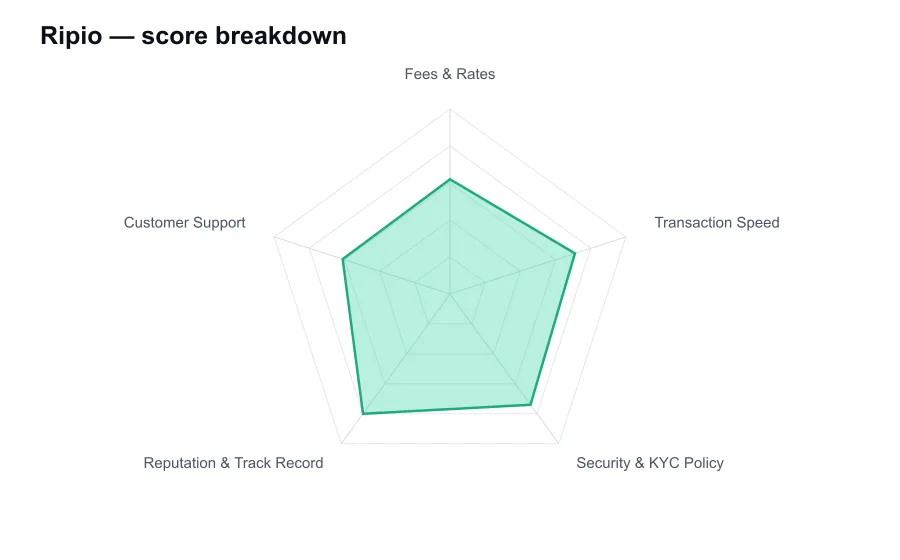
| Criterion | Score | Notes |
|---|---|---|
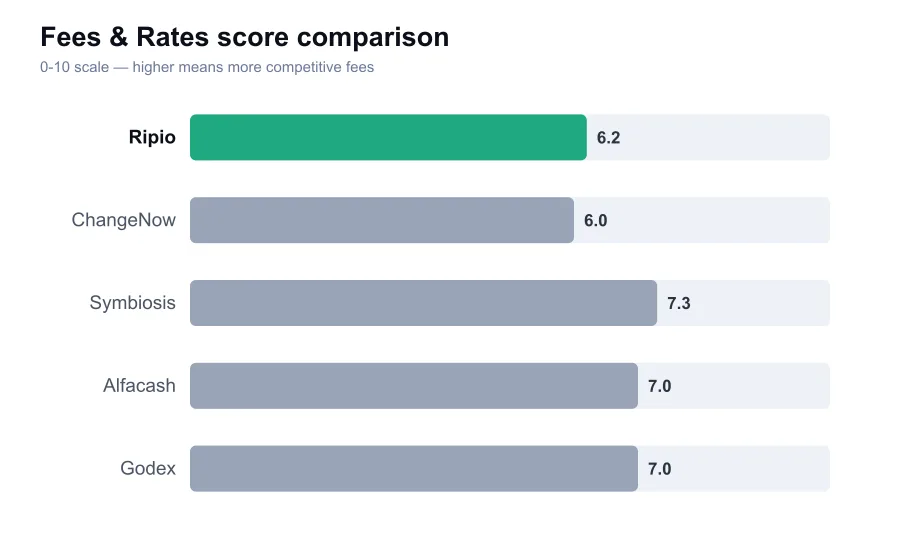
| Fees & Rates | 6.2 | Convenient local access, but quoted spreads can be costly. |
| Transaction Speed | 7.1 | Fast internal activity, fiat timing varies by country. |
| Security & KYC Policy | 7.4 | Established regulated operator with mandatory identity checks. |
| Reputation & Track Record | 8.0 | Operating in Latin America since 2013. |
| Customer Support | 6.1 | Regional language coverage, mixed reports on complex cases. |
In-Depth Review
Ripio is one of the better known Latin American crypto companies, particularly in Argentina, Brazil, Uruguay and Colombia. It began as BitPagos in 2013 and built its name by making Bitcoin accessible to people dealing with volatile local currencies and limited banking options. Today it operates more like a regional crypto platform than a bare-bones exchange, with buying, selling, custody, wallet functions and, in some markets, payment products.
That background matters. Ripio isn't trying to beat Binance at every trading feature, nor is it a privacy-first instant swap service. Its practical appeal is convenience for users who want local fiat rails, a familiar mobile app and an established Spanish and Portuguese speaking brand. For a first crypto purchase in Argentina or Brazil, that can be far more useful than a globally famous exchange that treats local banking as an afterthought.
The trading experience is deliberately simple. New users can deposit local currency, choose an asset and place a purchase without learning order-book mechanics. Bitcoin, Ether, stablecoins and a changing list of major altcoins are the main focus. Serious active traders may find the product restrained, but the app's straightforward design is one reason Ripio has lasted while many regional crypto startups disappeared.
Fees need closer inspection than Ripio's marketing sometimes encourages. The platform commonly presents a quoted buy or sell price rather than a clean, exchange-style maker and taker schedule. That means the effective cost can be spread into the rate you receive. The final quote is what matters, not the headline claim that an operation is simple or low cost. Compare Ripio's price with Mercado Bitcoin, Bitso, Lemon Cash or a major global exchange before confirming.
For small recurring buys, the difference may be acceptable. A few percentage points hidden in a spread is less painful than wrestling with an international wire transfer or an unsupported payment method. On a large stablecoin conversion, though, the pricing can become expensive quickly. Ripio is a convenience platform, not a venue I would choose to execute a large trade without checking several competing quotes first.
Deposit and withdrawal costs also depend heavily on the country and method. Local bank transfers are usually the sensible route where supported, while card purchases can cost more and may face issuer restrictions. Blockchain withdrawals deserve the same care. Network fees fluctuate, and withdrawing small balances on a costly chain can make an otherwise reasonable purchase look poor value. Ripio gives users more local access than many competitors, but local access doesn't automatically equal the best rate.
Speed is generally good for internal conversions and card or wallet purchases once an account is active. Crypto transfers between Ripio accounts are effectively immediate, while blockchain withdrawals naturally depend on the selected network and its congestion. Fiat settlement is less predictable because banks, local payment systems and compliance checks still control part of the process. A transfer made during a business day may move quickly, but users shouldn't assume every cash-out will be instant.
The company has a meaningful security advantage over anonymous swap sites: it has operated publicly for years, maintains regulated operations in several jurisdictions and requires identity verification for normal account use. KYC is not optional for the mainstream Ripio experience. Expect personal details, identity documents and, in higher-risk cases, questions about source of funds. That will frustrate privacy-focused buyers, but it is consistent with a fiat-facing platform that wants durable banking relationships.
Ripio says it uses security controls such as account protections and custody measures, but customers should still use unique passwords, two-factor authentication where offered and withdrawal whitelisting if available. No exchange account should be treated as a long-term vault. The firm has survived multiple crypto cycles, which is reassuring, yet its users remain exposed to the usual custodial risks: account compromise, service interruptions and the possibility that withdrawal rules tighten during periods of market stress.
Its reputation is stronger in Latin America than it is in the global crypto conversation. Ripio has raised institutional funding, expanded across the region and partnered with recognizable businesses, including efforts connected to the sports and payments world. Longevity counts for a great deal here. A company founded in 2013 has had to manage bear markets, changing regulation and local currency crises that would have overwhelmed a less disciplined operation.
Still, a long track record is not a blank cheque. App-store reviews and social media complaints regularly mention verification delays, transfer holds and support responses that feel slow when money is involved. Those complaints are common across regulated exchanges, but Ripio's strength in onboarding beginners makes slow problem resolution especially frustrating. Someone buying their first Bitcoin rarely distinguishes between a blockchain confirmation delay and a platform issue.
Support is available through in-app and online channels, with Spanish and Portuguese language coverage being a genuine regional advantage. Documentation answers basic questions reasonably well. The hard test is account recovery, a failed deposit or a compliance review. In those cases, response quality appears uneven. I would not fund an urgent purchase or time-sensitive payment through Ripio unless I had already tested the account and withdrawal route with a small amount.
Ripio's best use case is ordinary regional crypto access, not aggressive trading. It offers a route from local currency into digital assets that many Latin American users can understand and use without importing a foreign platform's complexity. The trade-off is that you pay for that comfort through less transparent execution pricing and a full KYC relationship.
My take is that Ripio deserves more respect than flashy newer apps because it has operated through genuinely difficult regional conditions. It is a sensible starting point for a user who values local payment support and a recognizable company. It is not the cheapest place to trade, and support can feel bureaucratic precisely when speed matters most. Use it for accessible on-ramps, compare every large quote, and move long-term holdings to self-custody rather than treating the app as your permanent wallet.
Pros & Cons
| Pros | Cons |
|---|
Does Ripio require identity verification?
Yes. Ripio is a fiat-facing, regulated platform and normal account use requires KYC. The exact document and verification requirements can vary by country and transaction level.
Are Ripio's fees visible before I buy?
The purchase quote is shown before confirmation, but the effective cost may be included in the quoted exchange rate rather than listed as a separate trading fee. Compare the final amount received.
Is Ripio safe for long-term crypto storage?
Ripio is an established custodial platform, but no exchange wallet is ideal for large long-term holdings. For meaningful balances, a self-custody wallet is the safer long-term arrangement.